.svg)

.JPG)
The Nigerian designer talks building a fashion brand from personal need, the real cost of independent production, and a five-piece collection that puts Black women at the centre of the conversation.
Ogechi Edith Osi started St. Nuella because she couldn’t find clothes that fit. Specifically: trousers, jeans, jorts, and maxi dresses that worked for taller women without sacrificing style for length. It’s a problem that sounds small until you’re the one standing in a fitting room watching hemlines hit three inches above your ankle. That frustration became a brand.
“Fashion was honestly a hobby at the beginning,” Osi says. “I was making outfits for myself, not necessarily with the intention of turning it into a business. But whenever I wore pieces I made, people noticed. They complimented them, asked questions, and connected with the designs.”
Before the brand existed as a label, Osi was already doing the work. Friends came to her before weddings, birthdays, and special occasions for styling advice. She sketched constantly, drawing from films, magazines, events, anything that caught her eye, and found that the process of turning an idea into a garment, from sketch to pattern to final fit, was the thing she kept coming back to. “That was the moment it became clear that this was not simply a passion project, but a path I was meant to pursue with intention,” she says.
The original vision for St. Nuella was direct: create pieces that make women feel seen, confident, comfortable, and beautiful. Inclusive by design, especially for women who are overlooked in fit conversations. Every piece should carry elegance and timelessness. “At its core, St. Nuella was created to offer more than clothing,” Osi says. “It was created to give women presence.”
The Cost of Making Things Properly
There’s a conversation that keeps coming up around independent Nigerian fashion brands, and Osi addresses it directly: the assumption that because production happens locally, the final product should be cheap.
“The reality is much more complex,” she says. “A lot of the materials and tools needed for good production are imported, so costs are affected by sourcing, shipping, and exchange rates. Then there’s inconsistent power supply, alternative power solutions, machinery maintenance, these are real costs, even though they’re not always visible to the customer.”
She’s also candid about the human side of production: finding and keeping experienced tailors, investing in staff development, managing turnover. All of it feeds into the final price of a garment. “When customers see the final price of a locally made piece, especially from a luxury brand, it can sometimes feel expensive compared to foreign ready-to-wear,” Osi says. “But local brands are often producing in smaller quantities, with more attention to detail, better finishing, and in some cases bespoke options. That’s very different from mass-produced clothing.”
It’s the kind of transparency that more emerging designers could benefit from offering. The gap between what customers see in a price tag and what goes into producing a single garment in Lagos is wider than most people assume.
Growing Without Losing the Plot
For a brand St. Nuella’s size, scaling isn’t just about volume. Osi describes it as becoming more structured: improving operations, strengthening production capacity, maintaining quality as demand increases. The excitement of early momentum is real, but she’s clear-eyed about what comes after.
“In practical terms, scaling looks like increasing repeat customers, growing our retail and bespoke client base, and expanding into product areas where we know there is still a gap,” she says. “Especially for women who are often underserved in fit. That includes trousers, jackets, coats, pieces where fit and proportion matter a lot, particularly for taller women.”
The market approach is both-and, not either-or. A strong local base for trust and identity, but international growth is already happening, St. Nuella has returning customers in both Nigeria and the UK. “Over the next few years, the vision is to deepen our presence locally while expanding globally through digital platforms, community, and consistent brand storytelling,” Osi says. “We are especially interested in broader growth across Europe and the Americas, as global audiences continue to show more appreciation for Nigerian fashion.”
This is the part of the story that often gets missed when people talk about Nigerian fashion. Everyone sees the finished product. Nobody talks about the systems you have to build just to get there.
Valora: Five Dresses, Five Arguments
Which brings us to the work. Valora, from the Latin valere, meaning strength, worth, courage, is a five-piece womenswear collection released February 24, 2026. It’s Osi’s most complete statement yet on what St. Nuella is and who it’s for.
“When I was developing the collection, I was thinking a lot about how clothing should make a woman feel, not just how it should look,” she says. “I wanted each piece to feel refined and feminine, but also intentional. The kind of pieces that make you feel confident the moment you put them on.”
The collection moves through five dresses in crimson, royal blue, purple, gold, and emerald green. All bold, all saturated, and, on the lookbook evidence, all extraordinary on dark skin. Every colour pops against melanin in a way that reads as deliberate rather than coincidental. When asked whether designing the palette around melanin-rich tones was a conscious starting point, Osi’s answer is nuanced. “The colour story was very intentional,” she says. “We chose tones that felt rich, elevated, and expressive. But we did not build the collection with only one skin tone in mind. At St. Nuella, versatility and inclusivity are very important. We design with a broader view, across different skin tones, body shapes, and sizes.”
Fair enough. But the lookbook speaks for itself. These colours were made for this skin.
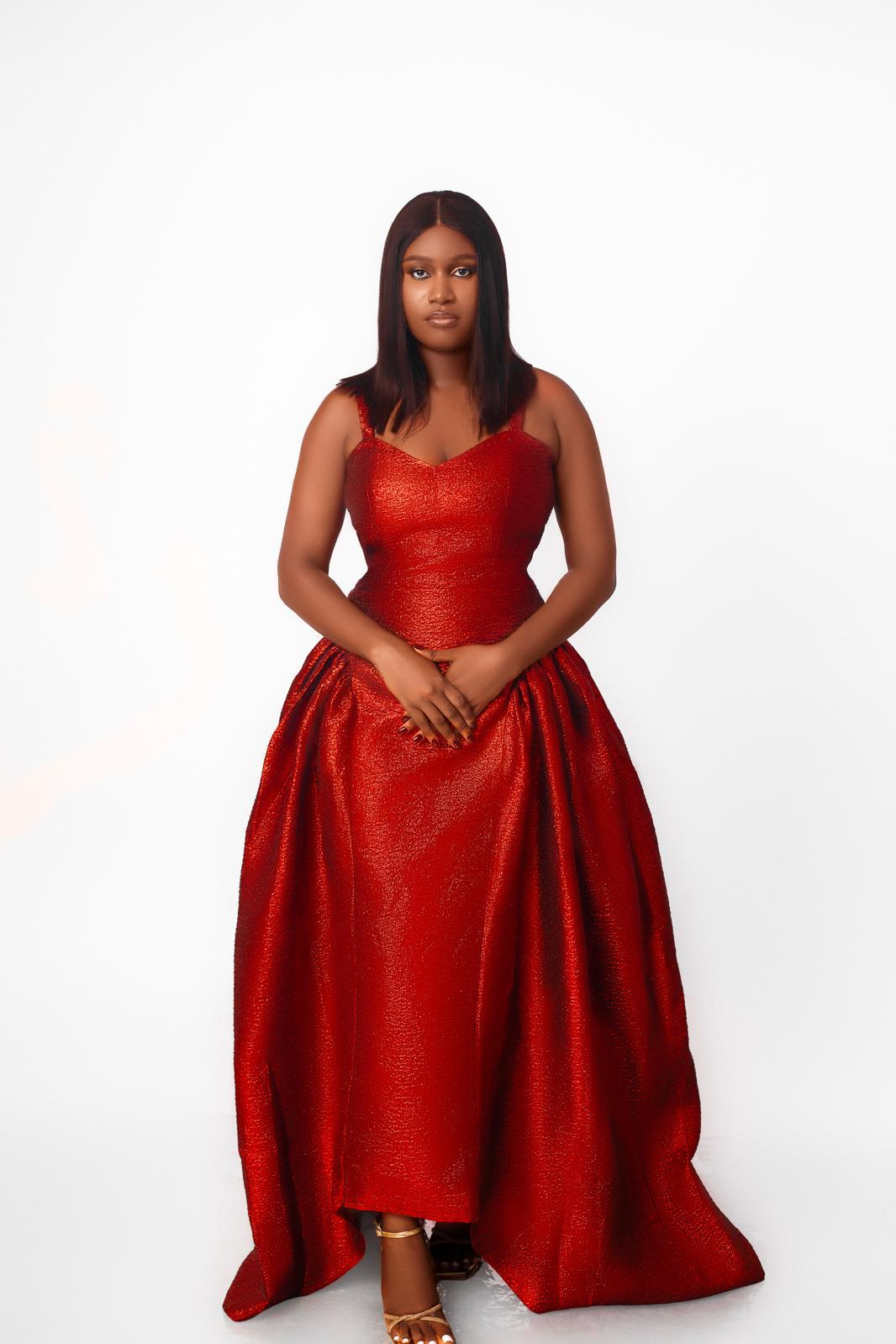
The crimson gown is the collection’s most traditional piece and its biggest statement. Floor length, shimmering textured fabric, ruched bodice with a sweetheart neckline and spaghetti straps so thin they nearly disappear. The skirt is full, pooling at the floor with the kind of volume that commands a room. This is a dinner gown. The kind of dress that starts conversations you don’t even have to join.
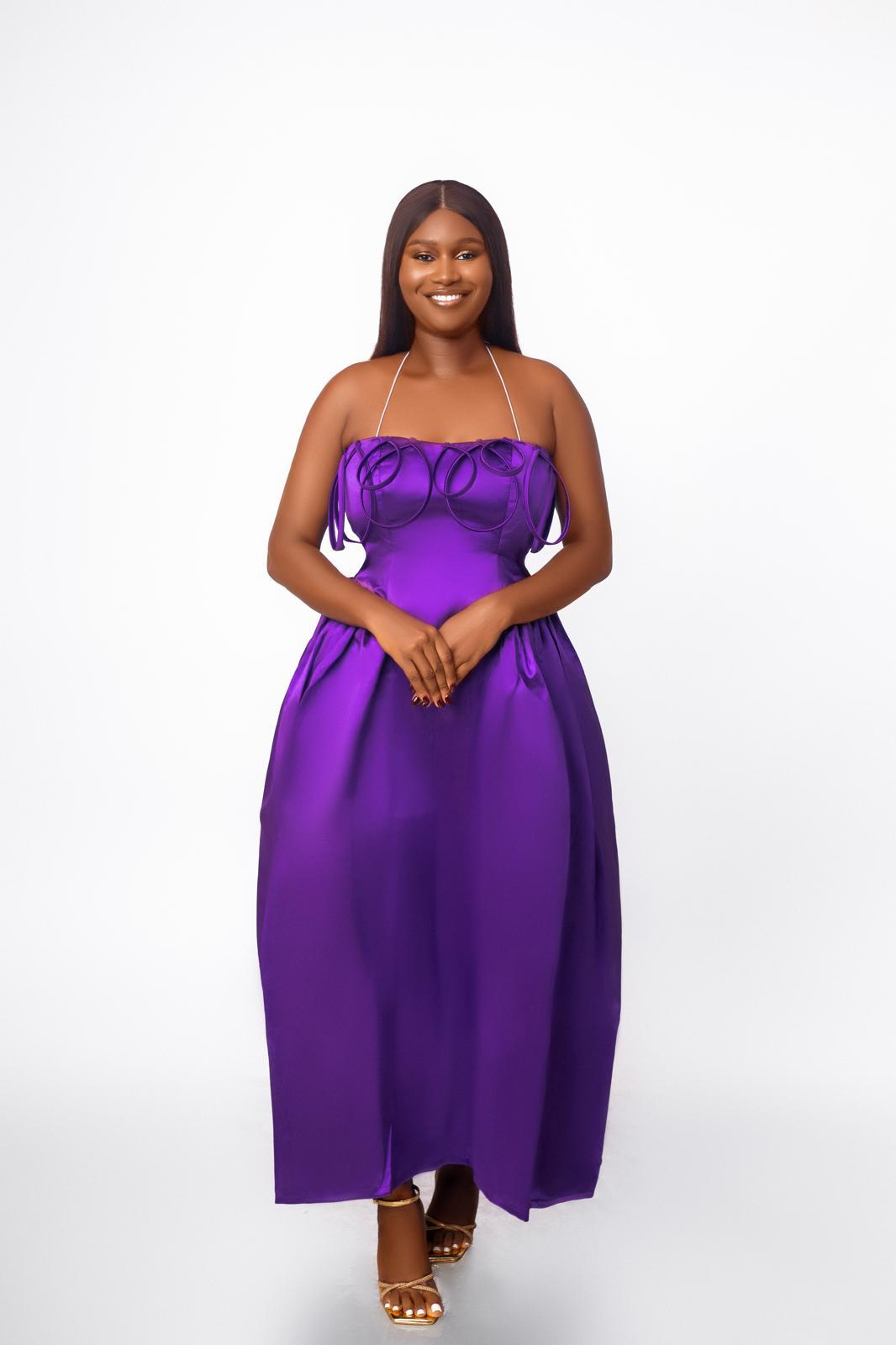
The purple satin piece has my favourite design detail in the collection: three dimensional sculptural loops across the bustline, hoops of fabric that curve and fold in a way that’s both unexpected and genuinely beautiful. Inspired by a trendy detail that makes you look twice and then a third time trying to figure out how it’s constructed. Below the bust, the dress gathers into a flowing skirt with thin halter straps. Those loops are the mark of a designer thinking with her hands.
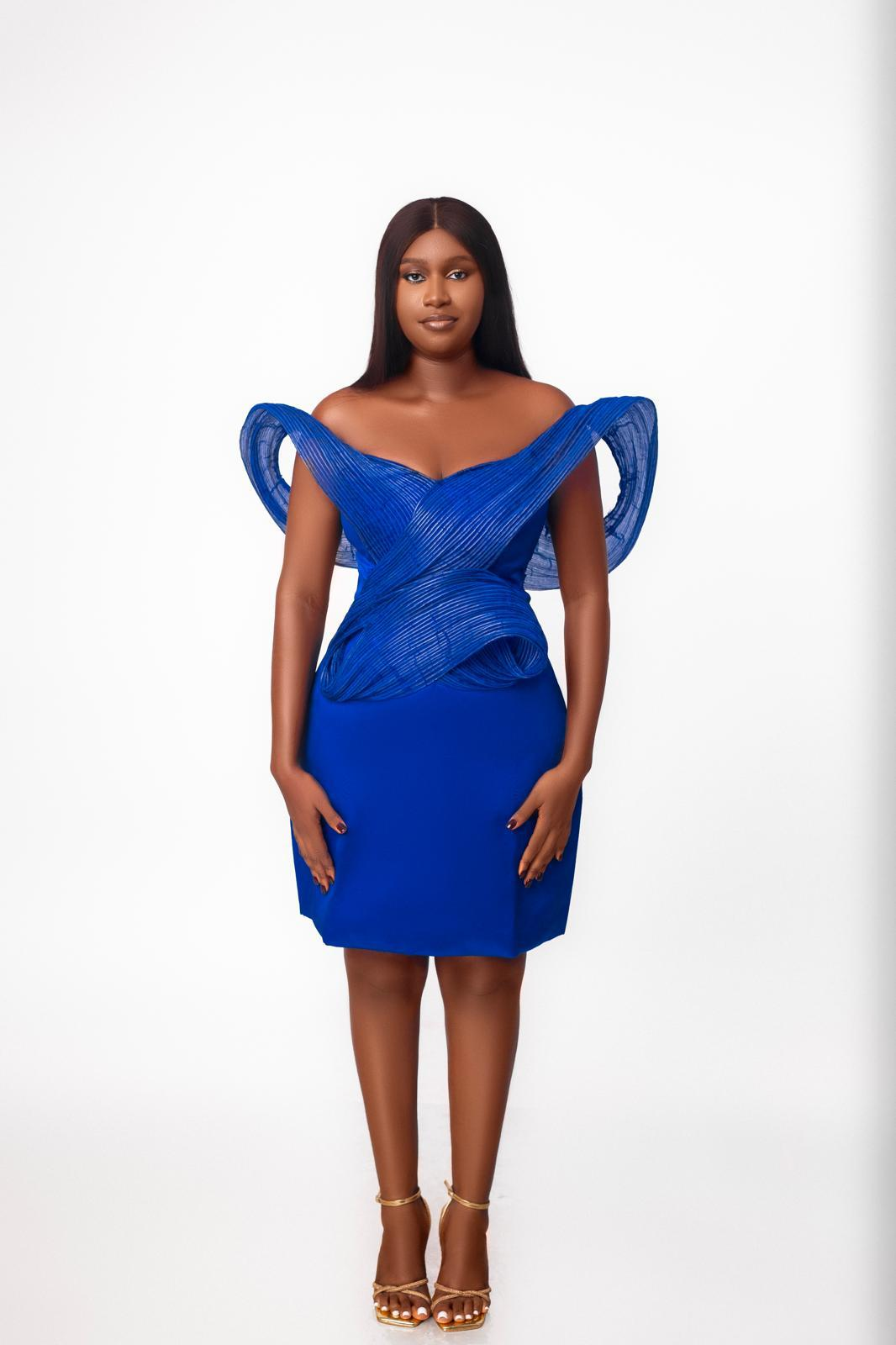
The royal blue cocktail dress, which Osi calls Ugonma, is the piece she’s most proud of, and the most technically ambitious in the collection. Off-shoulder with sculptural pleated sleeves that fan outward like wings. The pleating is tight and precise: fine ridges wrapping across the bodice in an X-pattern before opening into dramatic shapes at the shoulders. Osi worked with a specific type of boning to achieve the structure, and getting the sleeves to the exact form she envisioned took multiple attempts. “The most challenging part was developing the sleeve construction,” she says. “It required a lot of patience, precision, and attention to detail to get it right.”
The body of the dress is clean and fitted, wisely letting the sleeves carry the entire visual weight. This is the piece you’d photograph from five different angles and get five different pictures.
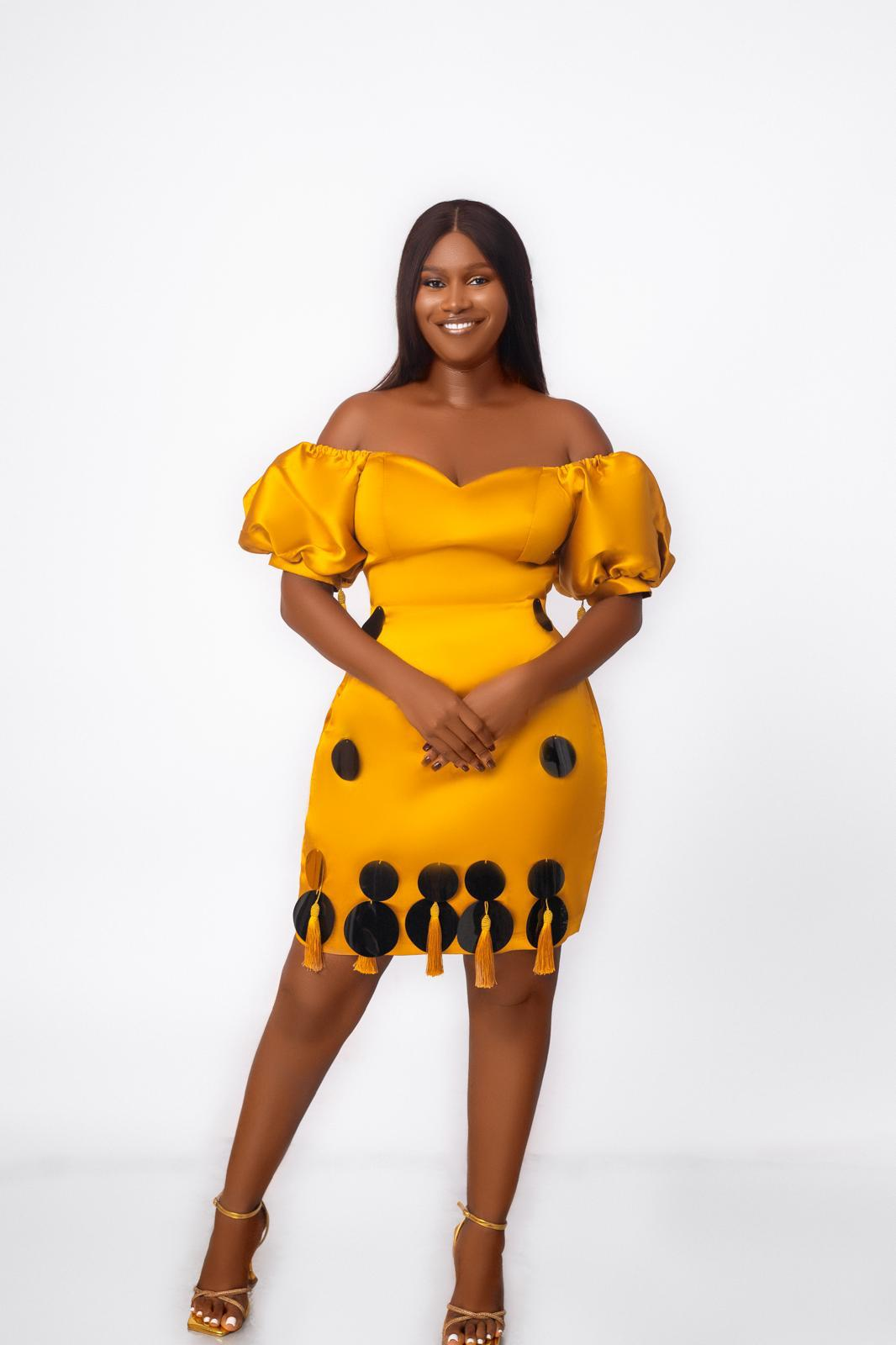
The gold dress shifts register. Off-shoulder with soft balloon puff sleeves, a sweetheart neckline, and a bodycon fit through the hip. The talking point is the hemline: black circular disc appliqués with gold tassels hanging from them, creating movement and a graphic black-on-gold contrast. This is the most event ready piece in the collection, the one that photographs well in dim light.
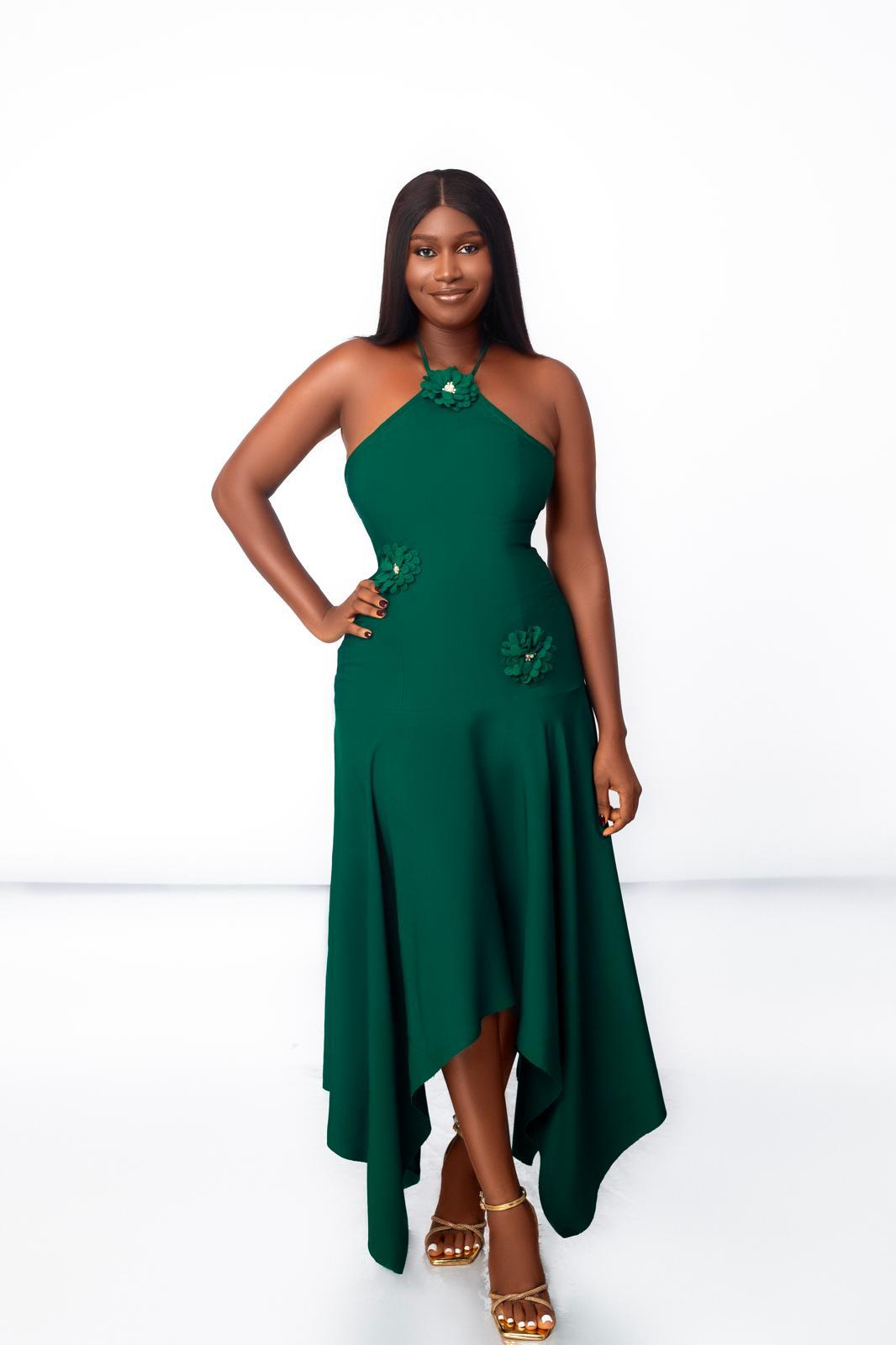
And the emerald dress. Halter-neck, backless, with three fabric floral appliqués, one at the neckline, two at the waist. Of the five pieces, this one breathes the most. It looks like the kind of dress that catches the air when you turn quickly, and the open back adds a quiet confidence that the other pieces express differently. Osi placed three flowers and stopped. That restraint is what makes them work.
Ask Osi who the St. Nuella woman is and she doesn’t hesitate. “She’s confident, self aware, and true to herself. She’s not trying to become someone else through fashion. She uses fashion as an extension of who she already is.” What she describes is a woman who dresses with intention rather than trend: “There is a quiet certainty about her, and you feel it before she speaks. Whether she chooses to be bold or subtle in a particular moment, it is always on her own terms.” That tracks across all five Valora pieces. None of them shout. All of them hold the room.
Osi’s next move is into elevated office wear and structured wardrobe staples. Coats, suits, tailored blazers, trousers, officewear gowns. The direction is clean tailoring with St. Nuella’s signature emphasis on femininity and fit.
“Think of a perfectly tailored women’s suit, a well-cut blazer and trousers, strong lines, refined construction, and a beautiful fit,” she says. “We want to give our woman more options for how she shows up, especially in work and professional spaces, without losing the elegance and presence that define St. Nuella.”
For a brand that started because its founder couldn’t find trousers that fit, that’s a full circle moment. It’s also the smartest possible next step, office wear is where consistent fit and quality matter most, and it’s a space where smaller brands with a clear identity can punch well above their weight.
The conversation around Nigerian fashion has rightly celebrated the brands that opened the doors, the ones with the stockists, the fashion week slots, the international press. They built visibility and credibility for an entire industry, and that work matters. But behind every wave of recognition, there are brands you haven't heard of yet doing the same work at a different scale: getting the fit right, solving the production problems, building customer trust one garment at a time.
St. Nuella is one of those brands. Valora, which released February 24, is the clearest signal yet that Ogechi Edith Osi knows exactly what she’s building and exactly who she’s building it for. Five dresses. Five colours. All of them making a case that you don’t need a hundred pieces to prove you belong in the conversation. You just need the right five.



.png)

