The Director in the Pew: Bianca Censori's 'Father' Is Architecture in Motion.

Authored by

For three years, the world has mostly looked at Bianca Censori’s outfits, her silence, and her proximity to one of the most discussed men alive. The photographs have been plentiful. The bylines have been scarce. So when the music video for Ye and Travis Scott's “Father” , the lead single off Ye's twelfth studio album ,”Bully” dropped on March 28th alongside the album, and the director credit read Bianca Censori, it was worth stopping to look more carefully. Not at her, but at what she created.

The video is a single continuous shot with no cuts, edits, or concessions to the conventions of the music video format. It’s set in a church rendered in muted earth tones and architectural in its design. Ye sits in the pews throughout, largely still, his thousand-mile stare aimed at something the camera never quite reveals. Around him, the scene populates with figures that feel simultaneously symbolic and completely unexplained. “You find” a Michael Jackson lookalike sitting quietly in the last row, unbothered; a knight in full plate armour arriving on horseback down the aisle; police officers arresting a nun mid-slumber; a pageant queen carried ceremonially toward the altar; a magician whose card tricks ignite into real flames. A UFO lands. Nobody particularly reacts. Travis Scott arrives for his verse and appears to be marrying two women at once. At one point, Ye and Scott pull down their masks to reveal alien faces beneath - celebrity and extraterrestrial already interchangeable, already the same thing. 
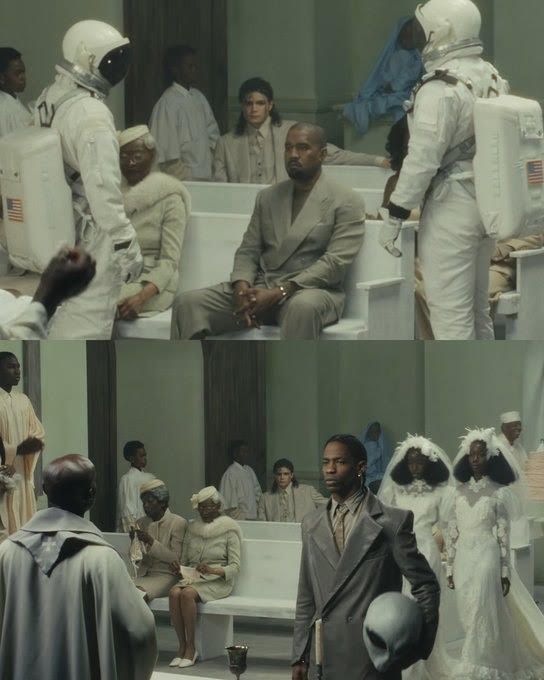
Credit: Hypebeast

The film presents a church not as a real place, but as a surreal dreamlike environment, where time feels slowed, spatial logic is distorted, and reality becomes fantasy. Censori said, describing the single-shot decision "constructing a logic that could only exist within a dream, where unrelated characters, worlds and temporalities collide within one continuous space."

The word “architecturally” is the key to reading the video correctly. Censori holds a Bachelor's and Master's degree in architecture from the University of Melbourne and has served as Head of Architecture at Yeezy since 2020. As a student, she described architecture saying "the grandest artistic gesture that we can place onto the earth." The “Father” video is not a departure from that training. It is a direct application of it. The church is not dressed as a location  it is designed as a spatial argument. The simultaneous action in different areas of the frame, the deliberate use of depth and peripheral activity, the refusal to cut and therefore the refusal to direct the viewer's attention are architectural decisions focused onhow space produces meaning. The Hollywood Reporter compared the video's cinematography to Jacques Tati and its weight to Andrei Tarkovsky, two filmmakers whose works are fundamentally about what happens in the frame when you refuse to simplify it. 

The symbolism is dense and deliberately unresolved. The church is a site of collective belief and institutional power. The knight and the police are two versions of the same enforcement structure separated by centuries. The Michael Jackson lookalike as a figure of celebrity mythology - adored, consumed, isolated. Ye and Scott are men who wear their fame like a costume over something else entirely. What Censori is doing is not illustrating the song. She is building a parallel text - one that sits alongside Ye's music without being subordinate to it. The video could exist without the track. That is not a criticism. That is the point.

Which brings the second question that formal analysis alone cannot answer. Bianca Censori has spent most of her public life being looked at rather than listened to. She appeared on the cover of ‘Vultures 1’. She walked red carpets. She wore things that generated headlines. She was, in the language of the industry, a muse. In the December 2025 South Korea art show, she staged women in bondage presented as human furniture, and the line between her own artistic vision and Ye's aesthetic territory was contested and unclear. The 'Father' video is the first time she has signed her name as the sole author. "Directing is not a departure for me," she told Architectural Digest. "I'm still shaping space, bodies and emotion, it's just articulated through film." 

The question of independence, whether Censori is truly working from her own vision or extending Ye's, is one that the video itself raises and declines to answer. The church, the religious iconography, the masked figures, the performance art sensibility - these are all firmly within the aesthetic world Ye has occupied for years. Whether that represents collaboration or influence or something more complicated is not resolvable from the video alone. What is resolvable is the craft. The blocking is confident. The single-shot discipline holds. The spatial logic, distorted as she intends it to be, is coherent on its own terms.

For a directorial debut, 'Father' is not a tentative first step. It is an argument about space, about ritual, about the fog between reality and fantasy made with the precision of someone who has been thinking in built environments for a decade. Whether the next video is as good, and whether it arrives with her name more firmly in focus than his, is the more interesting question now.

IG: @ffeistyhuman
The Director in the Pew: Bianca Censori's 'Father' Is Architecture in Motion.

Authored by
This is some text inside of a div block.

For three years, the world has mostly looked at Bianca Censori’s outfits, her silence, and her proximity to one of the most discussed men alive. The photographs have been plentiful. The bylines have been scarce. So when the music video for Ye and Travis Scott's “Father” , the lead single off Ye's twelfth studio album ,”Bully” dropped on March 28th alongside the album, and the director credit read Bianca Censori, it was worth stopping to look more carefully. Not at her, but at what she created.

The video is a single continuous shot with no cuts, edits, or concessions to the conventions of the music video format. It’s set in a church rendered in muted earth tones and architectural in its design. Ye sits in the pews throughout, largely still, his thousand-mile stare aimed at something the camera never quite reveals. Around him, the scene populates with figures that feel simultaneously symbolic and completely unexplained. “You find” a Michael Jackson lookalike sitting quietly in the last row, unbothered; a knight in full plate armour arriving on horseback down the aisle; police officers arresting a nun mid-slumber; a pageant queen carried ceremonially toward the altar; a magician whose card tricks ignite into real flames. A UFO lands. Nobody particularly reacts. Travis Scott arrives for his verse and appears to be marrying two women at once. At one point, Ye and Scott pull down their masks to reveal alien faces beneath - celebrity and extraterrestrial already interchangeable, already the same thing. 

Credit: Hypebeast

The film presents a church not as a real place, but as a surreal dreamlike environment, where time feels slowed, spatial logic is distorted, and reality becomes fantasy. Censori said, describing the single-shot decision "constructing a logic that could only exist within a dream, where unrelated characters, worlds and temporalities collide within one continuous space."

The word “architecturally” is the key to reading the video correctly. Censori holds a Bachelor's and Master's degree in architecture from the University of Melbourne and has served as Head of Architecture at Yeezy since 2020. As a student, she described architecture saying "the grandest artistic gesture that we can place onto the earth." The “Father” video is not a departure from that training. It is a direct application of it. The church is not dressed as a location  it is designed as a spatial argument. The simultaneous action in different areas of the frame, the deliberate use of depth and peripheral activity, the refusal to cut and therefore the refusal to direct the viewer's attention are architectural decisions focused onhow space produces meaning. The Hollywood Reporter compared the video's cinematography to Jacques Tati and its weight to Andrei Tarkovsky, two filmmakers whose works are fundamentally about what happens in the frame when you refuse to simplify it. 

The symbolism is dense and deliberately unresolved. The church is a site of collective belief and institutional power. The knight and the police are two versions of the same enforcement structure separated by centuries. The Michael Jackson lookalike as a figure of celebrity mythology - adored, consumed, isolated. Ye and Scott are men who wear their fame like a costume over something else entirely. What Censori is doing is not illustrating the song. She is building a parallel text - one that sits alongside Ye's music without being subordinate to it. The video could exist without the track. That is not a criticism. That is the point.

Which brings the second question that formal analysis alone cannot answer. Bianca Censori has spent most of her public life being looked at rather than listened to. She appeared on the cover of ‘Vultures 1’. She walked red carpets. She wore things that generated headlines. She was, in the language of the industry, a muse. In the December 2025 South Korea art show, she staged women in bondage presented as human furniture, and the line between her own artistic vision and Ye's aesthetic territory was contested and unclear. The 'Father' video is the first time she has signed her name as the sole author. "Directing is not a departure for me," she told Architectural Digest. "I'm still shaping space, bodies and emotion, it's just articulated through film." 

The question of independence, whether Censori is truly working from her own vision or extending Ye's, is one that the video itself raises and declines to answer. The church, the religious iconography, the masked figures, the performance art sensibility - these are all firmly within the aesthetic world Ye has occupied for years. Whether that represents collaboration or influence or something more complicated is not resolvable from the video alone. What is resolvable is the craft. The blocking is confident. The single-shot discipline holds. The spatial logic, distorted as she intends it to be, is coherent on its own terms.

For a directorial debut, 'Father' is not a tentative first step. It is an argument about space, about ritual, about the fog between reality and fantasy made with the precision of someone who has been thinking in built environments for a decade. Whether the next video is as good, and whether it arrives with her name more firmly in focus than his, is the more interesting question now.

IG: @ffeistyhuman
This is some text inside of a div block.

The Director in the Pew: Bianca Censori's 'Father' Is Architecture in Motion.

Authored by

For three years, the world has mostly looked at Bianca Censori’s outfits, her silence, and her proximity to one of the most discussed men alive. The photographs have been plentiful. The bylines have been scarce. So when the music video for Ye and Travis Scott's “Father” , the lead single off Ye's twelfth studio album ,”Bully” dropped on March 28th alongside the album, and the director credit read Bianca Censori, it was worth stopping to look more carefully. Not at her, but at what she created.

The video is a single continuous shot with no cuts, edits, or concessions to the conventions of the music video format. It’s set in a church rendered in muted earth tones and architectural in its design. Ye sits in the pews throughout, largely still, his thousand-mile stare aimed at something the camera never quite reveals. Around him, the scene populates with figures that feel simultaneously symbolic and completely unexplained. “You find” a Michael Jackson lookalike sitting quietly in the last row, unbothered; a knight in full plate armour arriving on horseback down the aisle; police officers arresting a nun mid-slumber; a pageant queen carried ceremonially toward the altar; a magician whose card tricks ignite into real flames. A UFO lands. Nobody particularly reacts. Travis Scott arrives for his verse and appears to be marrying two women at once. At one point, Ye and Scott pull down their masks to reveal alien faces beneath - celebrity and extraterrestrial already interchangeable, already the same thing. 

Credit: Hypebeast

The film presents a church not as a real place, but as a surreal dreamlike environment, where time feels slowed, spatial logic is distorted, and reality becomes fantasy. Censori said, describing the single-shot decision "constructing a logic that could only exist within a dream, where unrelated characters, worlds and temporalities collide within one continuous space."

The word “architecturally” is the key to reading the video correctly. Censori holds a Bachelor's and Master's degree in architecture from the University of Melbourne and has served as Head of Architecture at Yeezy since 2020. As a student, she described architecture saying "the grandest artistic gesture that we can place onto the earth." The “Father” video is not a departure from that training. It is a direct application of it. The church is not dressed as a location  it is designed as a spatial argument. The simultaneous action in different areas of the frame, the deliberate use of depth and peripheral activity, the refusal to cut and therefore the refusal to direct the viewer's attention are architectural decisions focused onhow space produces meaning. The Hollywood Reporter compared the video's cinematography to Jacques Tati and its weight to Andrei Tarkovsky, two filmmakers whose works are fundamentally about what happens in the frame when you refuse to simplify it. 

The symbolism is dense and deliberately unresolved. The church is a site of collective belief and institutional power. The knight and the police are two versions of the same enforcement structure separated by centuries. The Michael Jackson lookalike as a figure of celebrity mythology - adored, consumed, isolated. Ye and Scott are men who wear their fame like a costume over something else entirely. What Censori is doing is not illustrating the song. She is building a parallel text - one that sits alongside Ye's music without being subordinate to it. The video could exist without the track. That is not a criticism. That is the point.

Which brings the second question that formal analysis alone cannot answer. Bianca Censori has spent most of her public life being looked at rather than listened to. She appeared on the cover of ‘Vultures 1’. She walked red carpets. She wore things that generated headlines. She was, in the language of the industry, a muse. In the December 2025 South Korea art show, she staged women in bondage presented as human furniture, and the line between her own artistic vision and Ye's aesthetic territory was contested and unclear. The 'Father' video is the first time she has signed her name as the sole author. "Directing is not a departure for me," she told Architectural Digest. "I'm still shaping space, bodies and emotion, it's just articulated through film." 

The question of independence, whether Censori is truly working from her own vision or extending Ye's, is one that the video itself raises and declines to answer. The church, the religious iconography, the masked figures, the performance art sensibility - these are all firmly within the aesthetic world Ye has occupied for years. Whether that represents collaboration or influence or something more complicated is not resolvable from the video alone. What is resolvable is the craft. The blocking is confident. The single-shot discipline holds. The spatial logic, distorted as she intends it to be, is coherent on its own terms.

For a directorial debut, 'Father' is not a tentative first step. It is an argument about space, about ritual, about the fog between reality and fantasy made with the precision of someone who has been thinking in built environments for a decade. Whether the next video is as good, and whether it arrives with her name more firmly in focus than his, is the more interesting question now.

IG: @ffeistyhuman
Other Stories
London
London
Lagos
London
Newyork
London
Shop
Join the community.
You are now subscribed to receive updates.
Oops! Something went wrong while submitting the form.