.svg)


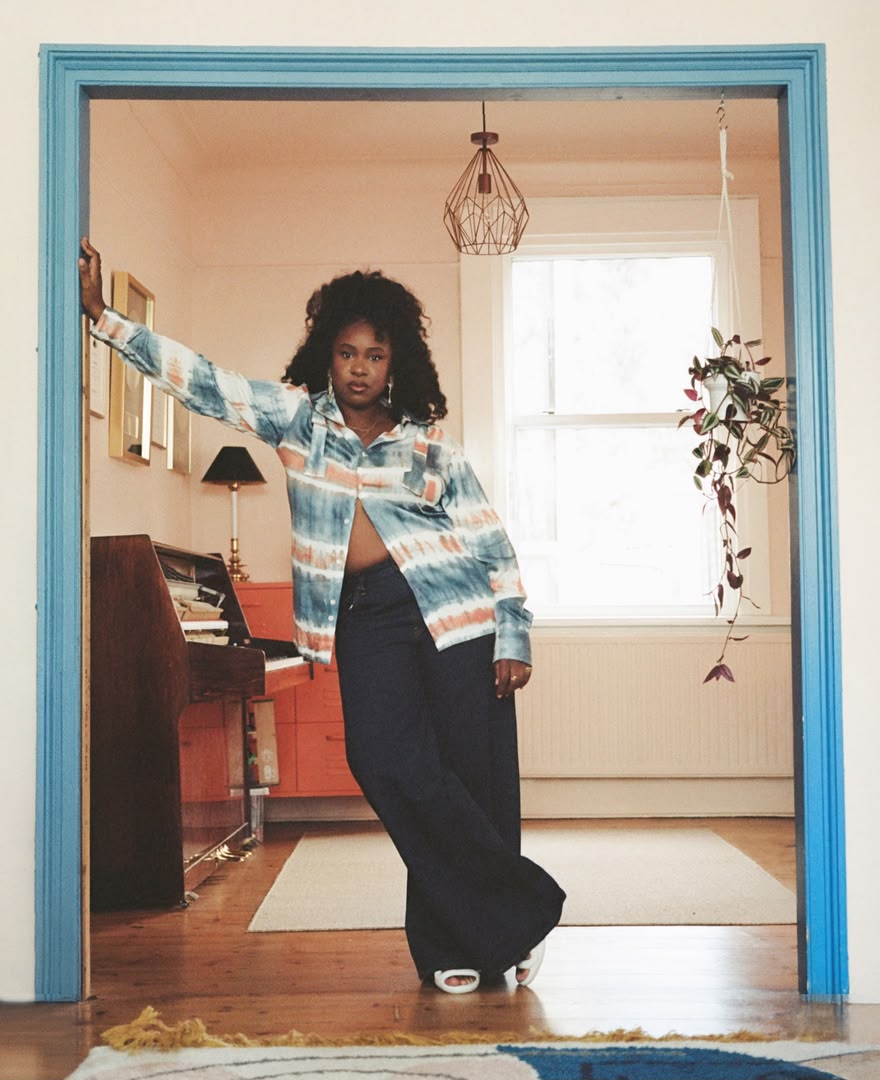
Home is a place that's completely different if you have to find it twice. For Akuvi it was never in the cards. Raised between Accra and Oslo, she was never quite Ghanaian enough, nor Norwegian enough. She inhabited an identity that wasn't given back to her by either country. In such a case most people are reduced in size. Yet, Akuvi decided to sing. As a student of life, she had acquired more lessons in her early years than most artists do in years. What she still didn't comprehend was the role she would play in the narrative of African music. That answer came accidentally in Johannesburg.

It was in a jam session that something hit home for Akuvi. There she discovered that the introspective neo-soul synths by Jhené Aiko and the Afrobeats rhythms by Davido, which she loved while growing up, weren’t enemies. She merged both sounds together and built her artistic image around it. The trajectory that followed is one that is not off the mark. Akuvi was one of the young women invited to the Forbes Under 30 Summit and Forbes Leading Women Summit, where music intersects culture, influence and currency. She was the headliner at Oslo World Festival, an event which was proof enough that her growing fan base already knew her show would be something different, her music, something to be felt in the human body. She was a tour opener for Shenseea, and featured with Stonebwoy. Billboard Africa and GQ Africa were impressed and so was Disney and Netflix.
Her new EP, Afrobeats for Emotional Gangsters, however, is no celebration of success. It's a rawer, more self-aware account of her experience with heartbreak and the singular pain of watching a cherished thing slowly decay.
Deeds caught up with Akuvi, to discuss Afrobeats for Emotional Gangsters, identity, navigating the industry and what’s keeping her inspired.

For readers discovering you for the first time, who is Akuvi beyond the headlines, streaming numbers and performances? What are the experiences and values that have shaped the artist you’ve become today?
I am a hyper sensitive, deep thinking romantic who loves melancholic Afrobeats and who happens to use music as my outlet for coping with a constant state of overstimulation. I am an explosive entertainer and a philosophical writer who loves to inspire people to embrace their emotions. My love for Afrobeats and alternative R&B were the building blocks of my hybrid genre as the two are a natural choice. I make what I like. My listeners are sexy over thinkers with complex and beautiful backgrounds in Africa and the diaspora. I’m shaped by my family, who are all musicians, as well as my never ending identity crisis with roots in both Norway and Ghana. All my music represents parts of me and my journey. Therefore, you’ll find recurring themes like belonging, purpose, heartbreak and anxiety in my art.
I am an explosive entertainer and a philosophical writer who loves to inspire people to embrace their emotions.
You grew up between Ghana and Norway. How has navigating those worlds influenced the way you see yourself and the stories you choose to tell through music?
Music has always been the only place that truly feels like home. It has always functioned as an embassy for me, whether I’m in Norway, Ghana or South Africa. Music is where I find belonging, inspiration, and an outlet for my inner world. I grew up extremely insecure about the fact that I didn’t really fit in anywhere, as well as my voice being in the deeper register. I know now that it is all my weirdness that makes me interesting and real. Not fitting in is simply an invitation to lead. It also helps that I relocated to the continent (I stayed in South Africa for 5 years and later moved to Ghana). As I am doing afro centric music, it makes a lot of sense to pursue my dreams in Ghana, the roots!

Afrobeats for Emotional Gangsters is a title that immediately grabs attention. What conversations were you hoping to start with this project, and why did now feel like the right time to have them?
I’ve always wanted to nail the type of Afrobeats for lovers who also love R&B, Jazz and Soul. Sometimes I feel misunderstood when I simply say that I make Afrobeats, as the genre is often associated with jolly, fun, feel-good vibes. I’ve realized that my listeners are similar to me, and I want them to feel seen and proud of being sensitive and emotional gangsters. Many people listen to sad music alone, and fun and fierce music in public. With my music you get to shed a tear and whine your waist at the same time. The gangster inserts some sort of pride in being a cryer haha. Furthermore, I feel the title captures the contrast that inherently lives in my recorded music but also my live performances. There is vulnerability but equal amounts of sass and aggression. I want people to embrace what it is to be human, just like how we allow children to switch from crying to smiling within seconds. Feeling is healing. Thirdly, being emotional and admitting it IS gangsta!
I’ve realized that my listeners are similar to me, and I want them to feel seen and proud of being sensitive and emotional gangsters.
The EP explores emotional complexity in a way that feels very intentional. What was happening in your life creatively, personally or emotionally that inspired this body of work?
The EP contains songs I’ve written over the course of the last two years, and reflects some deep pain I had to work through as I went through the biggest heartbreak of my life. Heartbreak and grief have many layers and I think the body of work reflects the different stages I’ve gone through. It goes from realizing that the end is near on “No Words”, to grieving the friendship that ultimately is the foundation of a relationship on “Strangers”, to healing and trying again on “Poison” and “Let Me Know”. The project mirrors the process I went through emotionally.
Nobody talks about how the ghost of past betrayal affects and distorts the hope one goes into a potential new relationship with. How crushing on someone can trigger anxiety rather than hope, or how being in an on-and off again situationship can be addictive. The EP became the only place I felt that I could truly be honest.
When you began creating Afrobeats for Emotional Gangsters, what was the vision you were trying to bring to life?
I’ve had a lot of breakthroughs in my career over the past year, and my main intention was to introduce myself to my new listeners who recently discovered me through my performances opening for Stonebwoy and Shenseea as well as my viral videos. I wanted a complete body of work that captures my sound. I wanted to capture the emotional and melancholic type of afrobeats as my signature sound, in a way that feels updated and refined.
The project effortlessly presents a refreshing take on Afrobeats. How do you approach genre in your music, and do you see yourself as part of a new generation of African artists who are redefining what Afrobeats can sound like?
When I started making music more than 10 years ago, I didn’t have any role models who did this particular sound. I had love for afrobeats and neo soul as two separate things. Jhene Aiko, the Internet and Frank Ocean would please my R&B ear, while Burna Boy, Davido etc would be my go-to afrobeats artists. It was through jam sessions in South Africa that I realized that I could mix the two, and so myself and my band did exactly that. It came out so unique and it felt satisfying, delivering vibes AND vulnerability. When artists like Tems, Omah Lay, and Gyakie came up, I felt so happy. It felt like I’d found my people and that I was a part of a very specific wave. I definitely think this niche has come to stay.

Your lead single, “Woah” featuring Mellissa has become a standout moment on the project. Walk us through how the song came together.
When Soulbase and I started working on the track, I immediately had an instinct to involve Mellissa. She does her afro-sexy sound, and seeing how smooth, cinematic and sensual the song was becoming, I was convinced it would be a perfect match. We sent it through and she absolutely killed her verse. Immediately, we started envisioning the visuals, and as predicted, it came out steaming hot, hehe. Shout out to Kwame Kodah, my favorite Ghanaian director of all time.
As a woman navigating the Ghanaian and broader African music industry, what realities do you think are still under-discussed when it comes to building a sustainable career?
I think what for instance Moliy is doing, and what Mellissa and I did with this track, is the beginning of a shift. For a long time it used to be the case that female artists, since we are few, would be compared and baited to compete with one another. I think this generation of female artists in Ghana are actively changing that by rooting for one another and collaborating. Look at Moliy, Shenseea, Moliy and Tyla, Mellissa and myself. We are demonstrating that working together is more powerful than trying to be the only one. I love to see it!
Do you feel there are expectations placed on female artists that their male counterparts are less likely to face? How have you learned to navigate those pressures while remaining authentic to yourself?
Both are expected to be really good at what they do, but for women, we also have to look extremely good while doing it. Glam, fashion and aesthetics happen to be things I am also passionate about, so for me personally I’m not mad at it. But generally speaking, if you see what kind of packaging women are expected to have for their talent (performances, costumes, beauty standards, bodies) you clearly see a difference. At the same time, I find it useful to view the visual aspect of the art and also the business as an asset. I have fun with the process and enjoy putting together shows, visuals, outfits that make me feel good and that becomes the visual representation of the sounds and my vision. I love putting it all together, especially when working with the right people.

African music is experiencing unprecedented global growth. As someone operating within that movement, where do you think the industry still needs to evolve, particularly when it comes to creating opportunities for women?
In my opinion, Ghana needs to be placed on the map to a way bigger extent than now. A lot of what Nigeria is credited for now, partially stems from Ghana. Don’t get me wrong, shout out to Nigeria and South Africa for being so assertive with their global ambitions! But what I would like to see is more of the countries represented. We have some global potential that I feel needs a more aggressive export approach. I personally am trying to make that happen by doing collabs, performing internationally and also organizing my own events, bringing together Africa and the diaspora. I’m hoping that my festival, the Dream Big Afro festival, will be a contribution to the export of especially Ghanaian music.
You recently launched the Dream Big Festival, an initiative that extends beyond music itself. What inspired the festival, and what impact do you hope it will have on young creatives and communities moving forward?
I grew up in Norway, a country that for a long time was very white and homogeneous. I’ve personally felt how lack of representation and inclusion does to one’s self image, confidence and identity. So for a long time I’ve been wanting to change the scene in Norway. It started with a headline show that I was hosting when it hit me that I can use this evening and stage to lift up other afrobeats artists in Norway as well. Based on the reception and the engagement coming from all the artists involved, the attendees and also industry people in both Norway and in Africa, I have decided to take this to the next level. Next year, the Dream Big festival will have both local and international acts, bridging the gap between Africa and the diaspora.
What excites you most about the next chapter of your artistic journey, both musically and personally?
I want to go deeper. We are already working on the next project, which will be Afrobeats for Emotional Gangsters Part 2. On this project, we delve deeper into the dark side of being an emotional baddie. Expect more fire and aggression, alongside the dreamy, cinematic afro soundscape we’ve created in Part 1. In Part 2, we are facing the dragon.
After the release of Afrobeats for Emotional Gangsters and the launch of Dream Big Festival, what can fans expect from Akuvi next, and what dreams are you currently chasing that people may not know about yet?
I’m excited to keep performing the new songs live. My headline show was only the beginning of a series of performances where we got to give the EP a physical manifestation. Bonding with fans through live performances is always very special, and it feels so good to bring choreography into the mix, it’s like I get to express the song all over again but in a physical way. I would never expose all my dreams, as I believe in doing rather than talking, but I will say this: I will keep doing things that scare me. So should you.
Photo Credit: Lydia tefara


.png)

