Fruché’s SS27 Collection Reclaims the Body Through Craft, Memory and Imperfection

Authored by

Some collections tell a story. Others ask a question. Fruché’s Spring/Summer 2027 collection, KLEG, manages to do both, delivering one of the most thoughtful presentations to emerge from Berlin Fashion Week this July.

Named after the Nigerian Pidgin expression K-leg, a term that literally refers to knock knees but has evolved to describe something considered “not quite right” or flawed, creative director Frank Aghuno transforms an everyday expression rooted in ridicule into a meditation on body image, identity and self-acceptance. In an industry that continues to privilege symmetry, proportion and increasingly homogenized beauty standards, KLEG proposes a different visual language, one that treats difference as a point of departure instead of as something to be corrected.
Fruché Unveils SS27 Collection ‘KLEG’ at Berlin Fashion Week

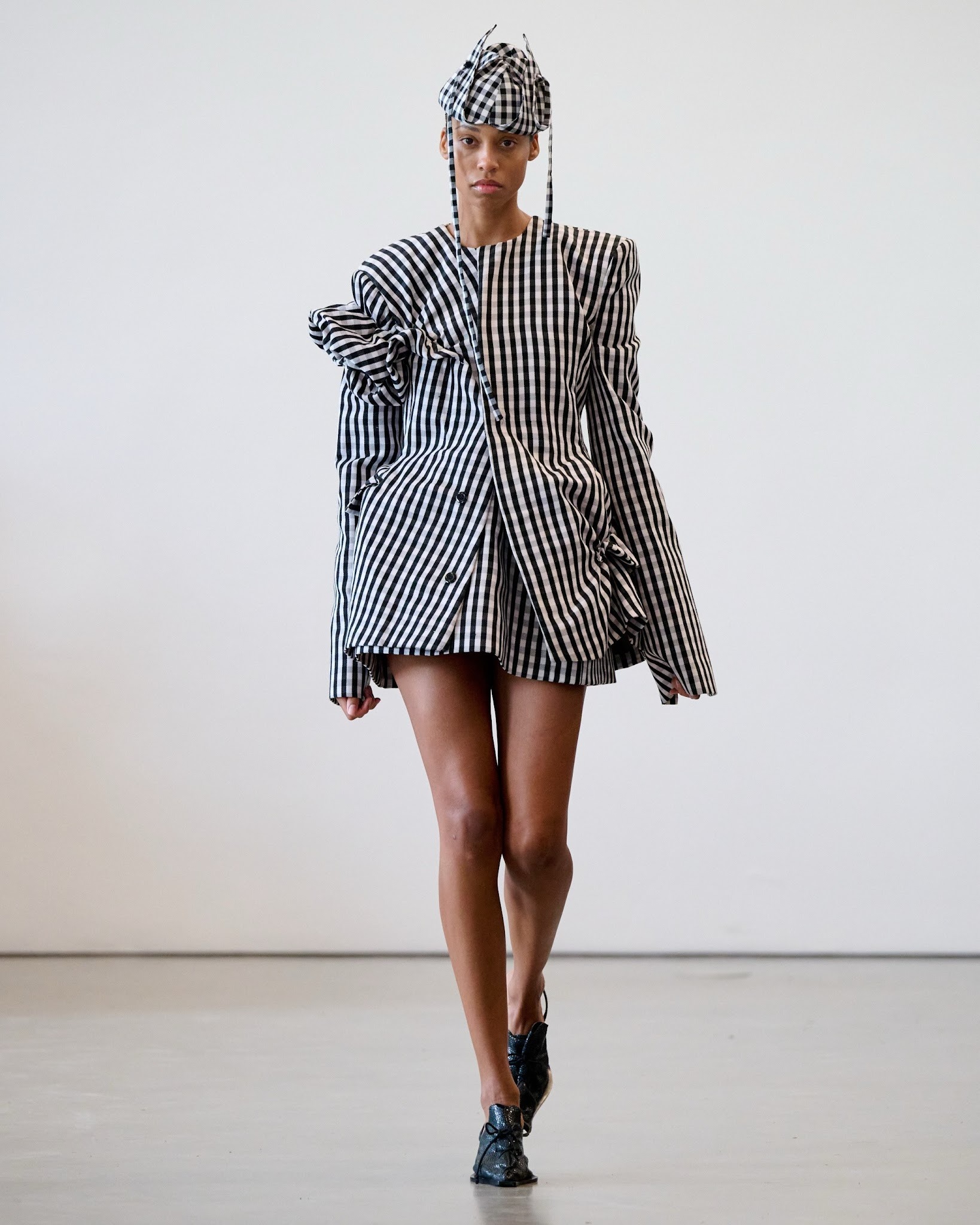
Aghuno roots the SS27 collection in memory. Looking back on his school years, he revisits a time before appearance became something to negotiate, when school uniforms fostered belonging rather than comparison. That memory manifests through gingham, a textile synonymous with school uniforms across Nigeria, reimagined through handwoven Aso Oke and resist-dyed Adire.

It is one of the collection’s strongest ideas. Rather than reproducing school uniforms literally, Fruché elevates an everyday fabric through traditional Nigerian craftsmanship, allowing nostalgia to exist alongside technical innovation. The transformation feels organic and grounds the collection in both lived experience and sentimentality.

Fruché Unveils SS27 Collection ‘KLEG’ at Berlin Fashion Week

What distinguishes KLEG from many concept-driven collections is that the distortion never feels arbitrary. Fashion has increasingly relied on exaggerated proportions and asymmetry as visual shorthand for experimentation, often without a clear conceptual purpose. Here, every shifted seam, enlarged proportion and irregular silhouette directly reinforces the collection’s central argument. The garments respond to the body’s natural irregularities instead of attempting to discipline or disguise them. The asymmetrical tailoring, exaggerated proportions and deliberately distorted forms draw from physical features that society often encourages people to conceal, and that coherence gives the collection remarkable clarity. There is no disconnect between concept and execution.

Fruché Unveils SS27 Collection ‘KLEG’ at Berlin Fashion Week

It also offers a subtle critique of fashion itself. Despite ongoing conversations around inclusivity, much of the industry still operates according to ideals of correction. Fruché rejects that premise entirely. KLEG does not ask how clothing can improve the body, but instead questions why the body should require improvement at all.

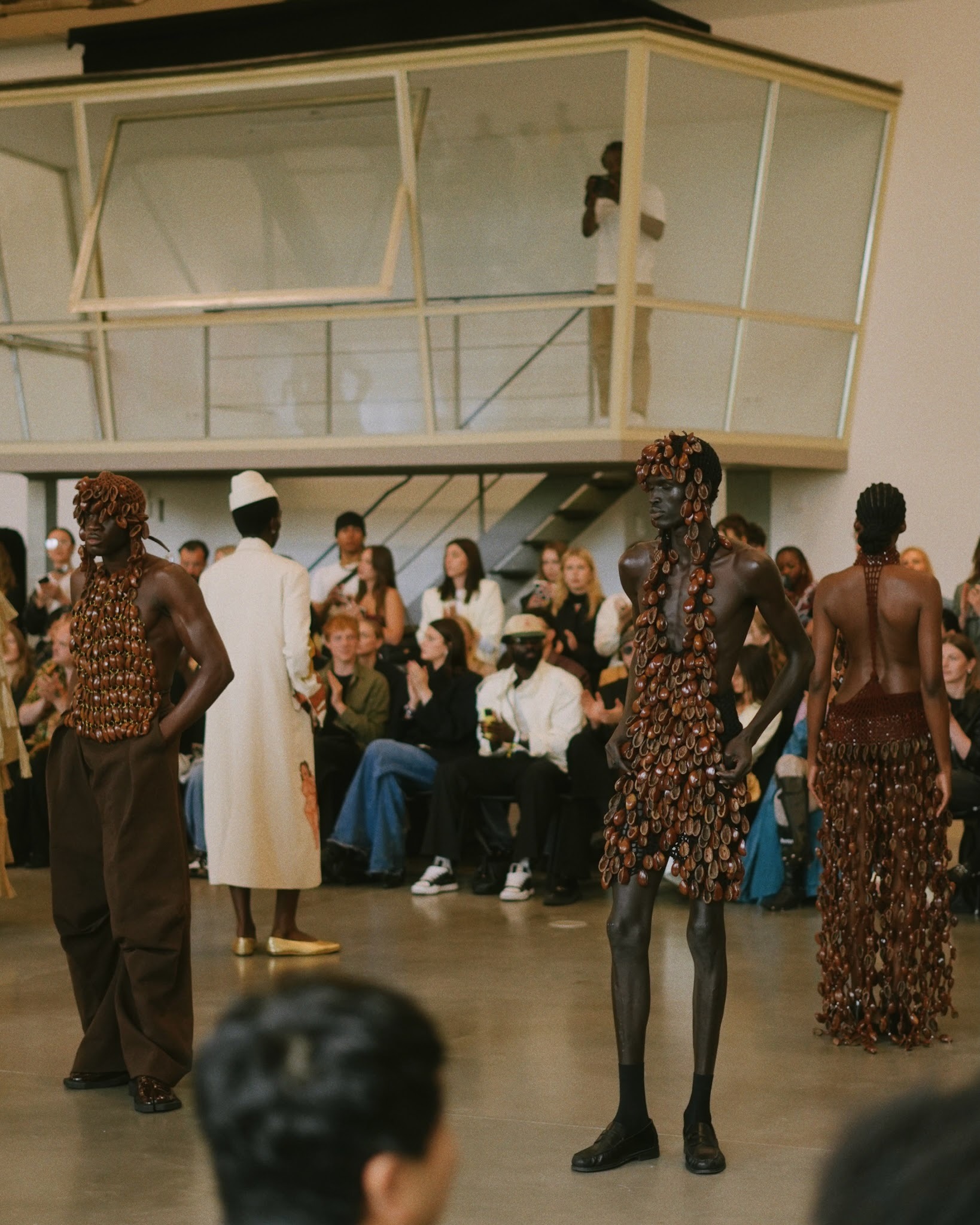
The collection’s craftsmanship strengthens that argument. Aso Oke weaving, resist-dyed Adire, beadwork and traditional wood carving are integrated into the garments as structural elements. These techniques are not presented as heritage for heritage’s sake; they actively shape the silhouettes and reinforce the collection’s exploration of the body as both canvas and archive.

Fruché Unveils SS27 Collection ‘KLEG’ at Berlin Fashion Week

Equally compelling is the collaborative nature of the project. Artist Fredrick Aghuno, known professionally as Dricky Stickman, hand-painted diverse body forms across silk and Katsina-woven Funtua cotton, extending the collection’s conversation around representation through textile. Sculptors Emmanuel Opeyemi and Oluwalere Israel Adewale produced a hand-carved wooden bodice and sculptural headpieces that dissolved the boundary between fashion and contemporary art without feeling overly theatrical. Fola Olopade’s crochet work introduced softness and tactility, while emerging Nigerian label Dukun translated childhood paper hats into textile accessories that echoed the collection’s reflections on youth and memory. Footwear collaborations with sustainable leather brands Afora Official, Kiing Daviid and Renaissance by Janet reimagined the familiar Nigerian school shoe and beautifully reinforced the collection’s nostalgic foundation.

Fruché Unveils SS27 Collection ‘KLEG’ at Berlin Fashion Week

The breadth of these collaborations could easily have fragmented the collection. Instead, they demonstrate a clear creative direction. Each contributor expands the narrative rather than competing with it, resulting in a collection that feels cohesive despite its many points of reference.

What ultimately makes KLEG so successful is its refusal to separate concept from construction. Too often, collections addressing identity or social issues rely on accompanying statements to explain their significance. Fruché allows the garments to carry the argument themselves. Every fabrication, silhouette and collaboration contributes to a singular narrative about memory, heritage and the politics of the body.
Fruché Unveils SS27 Collection ‘KLEG’ at Berlin Fashion Week

At a moment when fashion increasingly rewards spectacle and immediacy, KLEG offers something more enduring. It demonstrates that the most compelling collections are not necessarily those with the loudest concepts, but those where every design decision serves the same idea. Rather than presenting the body as something to refine, perfect or reshape, Fruché treats it as a living archive, marked by history, culture and experience. In doing so, KLEG becomes more than a collection about body image. It becomes a radical proposition for what fashion can look like when it stops trying to fix us.

Fruché’s SS27 Collection Reclaims the Body Through Craft, Memory and Imperfection

Authored by
This is some text inside of a div block.

Some collections tell a story. Others ask a question. Fruché’s Spring/Summer 2027 collection, KLEG, manages to do both, delivering one of the most thoughtful presentations to emerge from Berlin Fashion Week this July.

Named after the Nigerian Pidgin expression K-leg, a term that literally refers to knock knees but has evolved to describe something considered “not quite right” or flawed, creative director Frank Aghuno transforms an everyday expression rooted in ridicule into a meditation on body image, identity and self-acceptance. In an industry that continues to privilege symmetry, proportion and increasingly homogenized beauty standards, KLEG proposes a different visual language, one that treats difference as a point of departure instead of as something to be corrected.

Fruché Unveils SS27 Collection ‘KLEG’ at Berlin Fashion Week

Aghuno roots the SS27 collection in memory. Looking back on his school years, he revisits a time before appearance became something to negotiate, when school uniforms fostered belonging rather than comparison. That memory manifests through gingham, a textile synonymous with school uniforms across Nigeria, reimagined through handwoven Aso Oke and resist-dyed Adire.

It is one of the collection’s strongest ideas. Rather than reproducing school uniforms literally, Fruché elevates an everyday fabric through traditional Nigerian craftsmanship, allowing nostalgia to exist alongside technical innovation. The transformation feels organic and grounds the collection in both lived experience and sentimentality.

Fruché Unveils SS27 Collection ‘KLEG’ at Berlin Fashion Week

What distinguishes KLEG from many concept-driven collections is that the distortion never feels arbitrary. Fashion has increasingly relied on exaggerated proportions and asymmetry as visual shorthand for experimentation, often without a clear conceptual purpose. Here, every shifted seam, enlarged proportion and irregular silhouette directly reinforces the collection’s central argument. The garments respond to the body’s natural irregularities instead of attempting to discipline or disguise them. The asymmetrical tailoring, exaggerated proportions and deliberately distorted forms draw from physical features that society often encourages people to conceal, and that coherence gives the collection remarkable clarity. There is no disconnect between concept and execution.

Fruché Unveils SS27 Collection ‘KLEG’ at Berlin Fashion Week

It also offers a subtle critique of fashion itself. Despite ongoing conversations around inclusivity, much of the industry still operates according to ideals of correction. Fruché rejects that premise entirely. KLEG does not ask how clothing can improve the body, but instead questions why the body should require improvement at all.

The collection’s craftsmanship strengthens that argument. Aso Oke weaving, resist-dyed Adire, beadwork and traditional wood carving are integrated into the garments as structural elements. These techniques are not presented as heritage for heritage’s sake; they actively shape the silhouettes and reinforce the collection’s exploration of the body as both canvas and archive.

Fruché Unveils SS27 Collection ‘KLEG’ at Berlin Fashion Week

Equally compelling is the collaborative nature of the project. Artist Fredrick Aghuno, known professionally as Dricky Stickman, hand-painted diverse body forms across silk and Katsina-woven Funtua cotton, extending the collection’s conversation around representation through textile. Sculptors Emmanuel Opeyemi and Oluwalere Israel Adewale produced a hand-carved wooden bodice and sculptural headpieces that dissolved the boundary between fashion and contemporary art without feeling overly theatrical. Fola Olopade’s crochet work introduced softness and tactility, while emerging Nigerian label Dukun translated childhood paper hats into textile accessories that echoed the collection’s reflections on youth and memory. Footwear collaborations with sustainable leather brands Afora Official, Kiing Daviid and Renaissance by Janet reimagined the familiar Nigerian school shoe and beautifully reinforced the collection’s nostalgic foundation.

Fruché Unveils SS27 Collection ‘KLEG’ at Berlin Fashion Week

The breadth of these collaborations could easily have fragmented the collection. Instead, they demonstrate a clear creative direction. Each contributor expands the narrative rather than competing with it, resulting in a collection that feels cohesive despite its many points of reference.

What ultimately makes KLEG so successful is its refusal to separate concept from construction. Too often, collections addressing identity or social issues rely on accompanying statements to explain their significance. Fruché allows the garments to carry the argument themselves. Every fabrication, silhouette and collaboration contributes to a singular narrative about memory, heritage and the politics of the body.

Fruché Unveils SS27 Collection ‘KLEG’ at Berlin Fashion Week

At a moment when fashion increasingly rewards spectacle and immediacy, KLEG offers something more enduring. It demonstrates that the most compelling collections are not necessarily those with the loudest concepts, but those where every design decision serves the same idea. Rather than presenting the body as something to refine, perfect or reshape, Fruché treats it as a living archive, marked by history, culture and experience. In doing so, KLEG becomes more than a collection about body image. It becomes a radical proposition for what fashion can look like when it stops trying to fix us.
This is some text inside of a div block.

Fruché’s SS27 Collection Reclaims the Body Through Craft, Memory and Imperfection

Authored by

Some collections tell a story. Others ask a question. Fruché’s Spring/Summer 2027 collection, KLEG, manages to do both, delivering one of the most thoughtful presentations to emerge from Berlin Fashion Week this July.

Named after the Nigerian Pidgin expression K-leg, a term that literally refers to knock knees but has evolved to describe something considered “not quite right” or flawed, creative director Frank Aghuno transforms an everyday expression rooted in ridicule into a meditation on body image, identity and self-acceptance. In an industry that continues to privilege symmetry, proportion and increasingly homogenized beauty standards, KLEG proposes a different visual language, one that treats difference as a point of departure instead of as something to be corrected.

Fruché Unveils SS27 Collection ‘KLEG’ at Berlin Fashion Week

Aghuno roots the SS27 collection in memory. Looking back on his school years, he revisits a time before appearance became something to negotiate, when school uniforms fostered belonging rather than comparison. That memory manifests through gingham, a textile synonymous with school uniforms across Nigeria, reimagined through handwoven Aso Oke and resist-dyed Adire.

It is one of the collection’s strongest ideas. Rather than reproducing school uniforms literally, Fruché elevates an everyday fabric through traditional Nigerian craftsmanship, allowing nostalgia to exist alongside technical innovation. The transformation feels organic and grounds the collection in both lived experience and sentimentality.

Fruché Unveils SS27 Collection ‘KLEG’ at Berlin Fashion Week

What distinguishes KLEG from many concept-driven collections is that the distortion never feels arbitrary. Fashion has increasingly relied on exaggerated proportions and asymmetry as visual shorthand for experimentation, often without a clear conceptual purpose. Here, every shifted seam, enlarged proportion and irregular silhouette directly reinforces the collection’s central argument. The garments respond to the body’s natural irregularities instead of attempting to discipline or disguise them. The asymmetrical tailoring, exaggerated proportions and deliberately distorted forms draw from physical features that society often encourages people to conceal, and that coherence gives the collection remarkable clarity. There is no disconnect between concept and execution.

Fruché Unveils SS27 Collection ‘KLEG’ at Berlin Fashion Week

It also offers a subtle critique of fashion itself. Despite ongoing conversations around inclusivity, much of the industry still operates according to ideals of correction. Fruché rejects that premise entirely. KLEG does not ask how clothing can improve the body, but instead questions why the body should require improvement at all.

The collection’s craftsmanship strengthens that argument. Aso Oke weaving, resist-dyed Adire, beadwork and traditional wood carving are integrated into the garments as structural elements. These techniques are not presented as heritage for heritage’s sake; they actively shape the silhouettes and reinforce the collection’s exploration of the body as both canvas and archive.

Fruché Unveils SS27 Collection ‘KLEG’ at Berlin Fashion Week

Equally compelling is the collaborative nature of the project. Artist Fredrick Aghuno, known professionally as Dricky Stickman, hand-painted diverse body forms across silk and Katsina-woven Funtua cotton, extending the collection’s conversation around representation through textile. Sculptors Emmanuel Opeyemi and Oluwalere Israel Adewale produced a hand-carved wooden bodice and sculptural headpieces that dissolved the boundary between fashion and contemporary art without feeling overly theatrical. Fola Olopade’s crochet work introduced softness and tactility, while emerging Nigerian label Dukun translated childhood paper hats into textile accessories that echoed the collection’s reflections on youth and memory. Footwear collaborations with sustainable leather brands Afora Official, Kiing Daviid and Renaissance by Janet reimagined the familiar Nigerian school shoe and beautifully reinforced the collection’s nostalgic foundation.

Fruché Unveils SS27 Collection ‘KLEG’ at Berlin Fashion Week

The breadth of these collaborations could easily have fragmented the collection. Instead, they demonstrate a clear creative direction. Each contributor expands the narrative rather than competing with it, resulting in a collection that feels cohesive despite its many points of reference.

What ultimately makes KLEG so successful is its refusal to separate concept from construction. Too often, collections addressing identity or social issues rely on accompanying statements to explain their significance. Fruché allows the garments to carry the argument themselves. Every fabrication, silhouette and collaboration contributes to a singular narrative about memory, heritage and the politics of the body.

Fruché Unveils SS27 Collection ‘KLEG’ at Berlin Fashion Week

At a moment when fashion increasingly rewards spectacle and immediacy, KLEG offers something more enduring. It demonstrates that the most compelling collections are not necessarily those with the loudest concepts, but those where every design decision serves the same idea. Rather than presenting the body as something to refine, perfect or reshape, Fruché treats it as a living archive, marked by history, culture and experience. In doing so, KLEG becomes more than a collection about body image. It becomes a radical proposition for what fashion can look like when it stops trying to fix us.

Other Stories
London
London
Lagos
London
Newyork
London
Shop
Join the community.
You are now subscribed to receive updates.
Oops! Something went wrong while submitting the form.