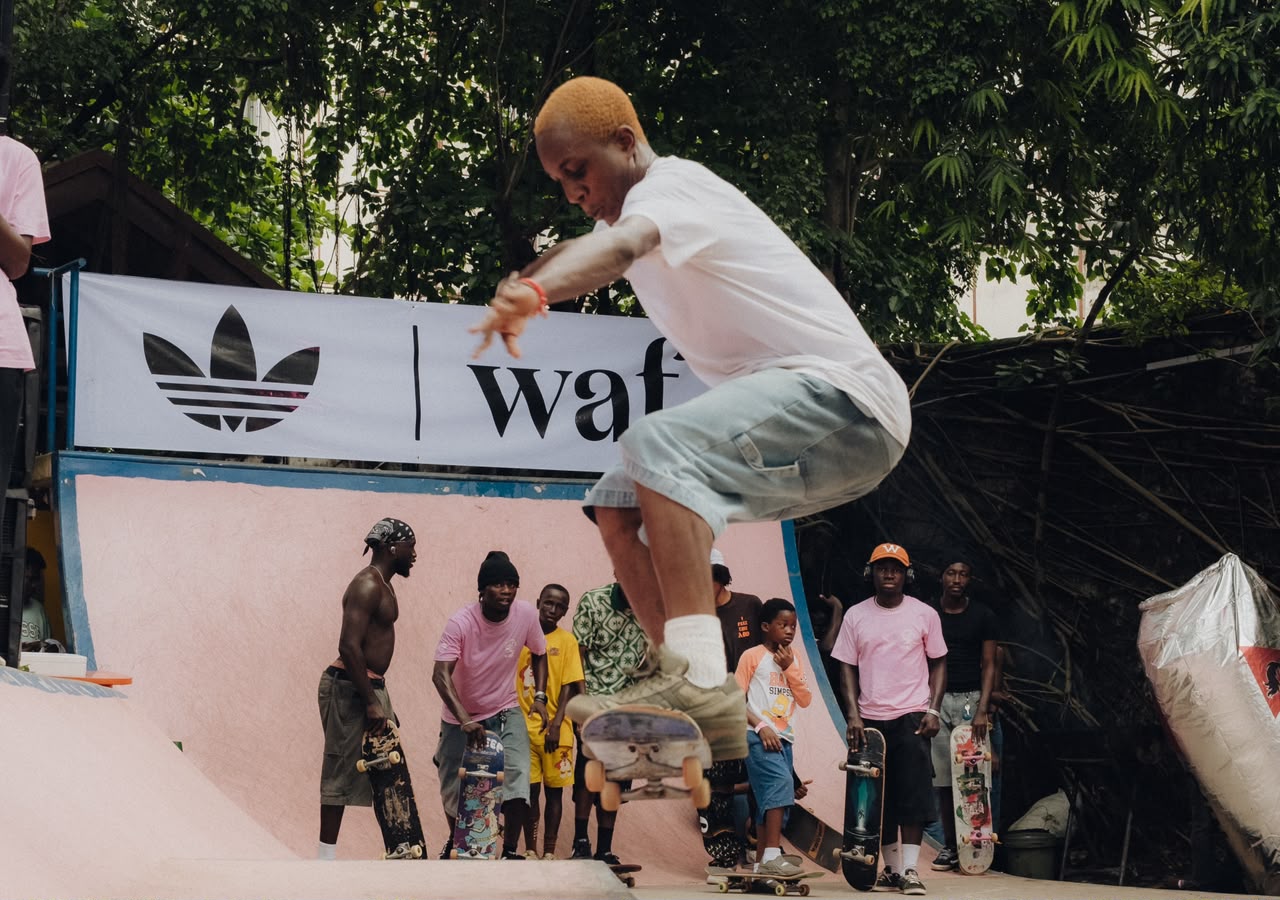
Jomi Marcus-Bello: The Unspoken Secret of Success

Authored by

Jomi Marcus-Bello started Wafflesncream in Leeds, in 2008, alongside his brother and a shared obsession with skateboarding. He brought it back to Lagos, built a community on an island with no skate parks and roads that make skating a daily negotiation. He converted a former colonial prison into a skate park, and fourteen years later became the first African skate community to design the Adidas Superstar ADV. 

The shoe - grey upper from Lagos Island's industrial landscape, translucent pink outsole from the sky near the sea, breathable panels for the actual humidity it will be skated in- is now in the hands of the global market. 

Success, by his own definition, is paying salaries and keeping the lights on. Catching up with Deeds ahead of the global release, we spoke about building without investors, what the Adidas collaboration actually meant, and why Freedom Park is the most honest thing Wafflesandcream has brought to life.

Sophia for Deeds: For anyone reading this and discovering you and waf. For the first time, how would you introduce yourself and what wafflesncream is?

I think we are just storytellers trying to speak about Lagos, Nigeria, and Africa as a whole. I think we're just trying to create beautiful products and tell incredible stories, in and around the average skateboarder's life and their ambitions and their tastes. If anybody's engaging well for the first time, they'll see that we've been. We're literally from grass to grace. We've had no investors, but a few assists here and there. We made it with people. Nobody ever makes it on their own. It’s been an up-and-down story. I think it's a story of the African youth and their ambitions and his inner jokes, his exploration, through the eyes of the skateboarder.

You started waf. in Leeds in 2008, then brought it back to Lagos. What made you come back and build a skate scene in a city with no skate parks, no pavements, and roads that make skating feel like a daily negotiation?

I was exposed to it by my mom. I think it was when I discovered it properly and started to enjoy the lifestyle and the friends I made. It was something that I wanted to continue. I didn't want to have to move back to Nigeria and then have it stopped.  I felt like I wasn't the only one that had this kind of mindset. I was just trying to look for my tribe. I met a few people and we started designing and enjoying the new kind of, like, way of thinking around products and lifestyle.

In over fifty years of the adidas Superstar, no African skate community has ever designed one. When Adidas came to waf., what was your first reaction, and what was the first design decision you made?

Honestly, our first reaction was gratitude, we were flattered but we'd also been down this road before. We had worked on international projects with brands like Coke and Guinness in the past, so we already had a sense of what it meant to represent something of that scale. Those experiences gave us the confidence to walk into this the right way, not overthinking it, not trying to overdo it or force something that wasn't authentic. We treated it like any other collaboration, because that's what got us here in the first place.

When it came to the silhouette, choosing the Superstar felt obvious. When you're working with a brand like adidas, there's something powerful about starting with the original, their classic. And it just so happened that around that time, adidas was already leaning back into the Superstar story, so it felt like the right moment.

But the real question for us was: how does Lagos actually show up in a shoe?

A lot of people expected us to go the obvious route, yellow, Ankara prints or loud colors. But we wanted to capture what Lagos feels like, not just what it looks like on the surface. Lagos is humid. Our biggest competition isn't another sneaker brand, it's slippers. Palm slippers. Because comfort here often means kicking off your shoes. Our streets, our environment, they're not always generous to your feet. So we had to design with that reality in mind.

The toe cap already gives you that shell-like protection, but we made sure to think through breathability too, that's why we used mesh on the sides and through the inner concave, so the foot can breathe. We added an elastic support inside to hold the foot securely, not just for skating, but for movement in general, running, catching a ball, whatever life in Lagos demands.

The gray represents Lagos Island, where the skate park is, and Surulere too. Those spaces gave us so much when we were coming up, letting us skate under the stadium staircase, generous with the room they gave us to exist and create. So the gray carries different patinas, almost like cracked leather, telling that story.
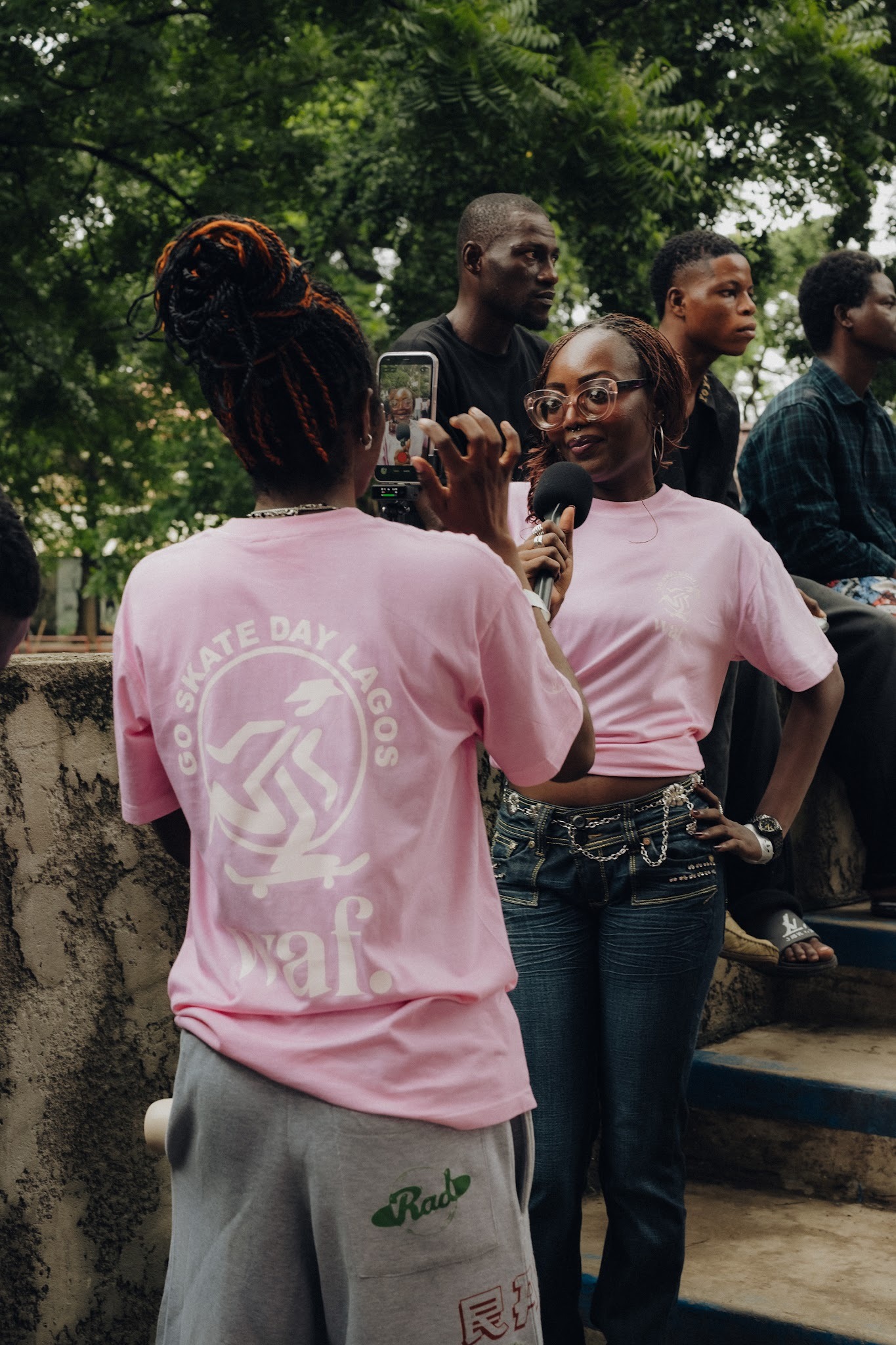
Credit: Wafflesncream

You opened Lagos’s first skatepark at Freedom Park in 2024, on the grounds of an old colonial prison. That detail is not accidental. What does it mean to build something for young Lagosians in that specific space?

I mean, it's crazy with Lagos Island. It's crazy because that's where we first used to congregate to skate. Freedom Park security guards were not really kind to us. They would seize our boards. They would do all sorts because they saw us as a nuisance. This was happening around 2015 or 2017. But the beautiful thing was that Covid hit, and we had formed a sort of relationship. They asked us if we could work on a skate park. We were like, yes, of course we can. The crazy thing is that we started doing a little bit of history on the grounds where the skate park is actually built.  

Let me start with this. Where our skate shop is the warden's office, where you get sentenced to that prison or convicted to, and that is where you're going to serve. Our skate shop is actually where people were getting checked in then. The skate park is where they get stripped down. It was the metal workshop where people would smelt metal. So when we're digging and back then, the metals were very heavy, we're digging to, you know, we had to sand fill. I don't want to get into the technicalities of the construction, but we did find jail gates. We found metal parts. We also found different things that showed the history of the space, which was kind of crazy. And it's in the Freedom Park Museum at the moment.  We found out that there was a protest at that place as well, where they were.  

 The prisoners were not being taken care of properly. They revolted on that very land.  So that land has a rebellious spirit to it. They broke down the wall. Then they had to bring in bricks from London to rebuild it.  And then also it's beautiful. It's like a concave. It feels like you're in a jungle. We made sure that we did not interfere too much with the trees and plantation; we just simply inserted the skate park in there. I know Awolowo served in that prison, so he must have gone through our shop at some point. I know other prisoners were political prisoners who were there too. It was a prison for 100 years.It's crazy because we are in the warden's office, and where they went to get disciplined is now a place of leisure and commerce.

waf. has always sat at the intersection of skateboarding, fashion, music, art, and community rather than being just a skate brand. Was that always the vision, or did it evolve?

I think it's one in itself.  Skateboarding because it's a culture. It's not just an activity. Just like belonging to any other culture, it’s not just about the language. It’s the way you dress, what you eat, the respect you show, how you conduct yourself, the festivals, the tone, how you raise a child, and your overall POV on life.

I think every culture deserves that same diversity and complexity. You can be a skateboarder, but you can also be a photographer or be into fashion. It’s more of an attitude and a language than just a physical thing.

The campaign for the Superstar ADV was shot entirely on Lagos Island, featuring waf. community members - not imported faces or global ambassadors. How important was that decision to you?

I mean, it's everything in it. We wanted to be truly authentic to ourselves.  Like I said. I think when the Collaborator comes, I don't think it's when you start to try and over-imagine. I think that's when you just have to simplify things. It was an opportunity to show where we are from, who we are authentically. Adidas has been an amplifier and a good collaborator. I think what Lagos Island has done for us is legacy stuff. It's stuff that hopefully our children's children will be able to enjoy. I think it's only right to always reflect that.  No Space in Lagos or Nigeria gave us a chance. Lagos Island did. It gave us a home; it gave us a facility; it gave us the training ground. It gave us friends; it gave us meaning; it gave us aesthetics. It gave us everything. We don't need to import faces if we want to tell our stories. I think if we're going to import faces, they will be people that have come from within it, if that makes sense. It’s not just Lagos Island people.  Lagos Island in itself as a location. A lot of people who we started with have kind of branched out, and they still carry waf for Lagos Island in their hearts.
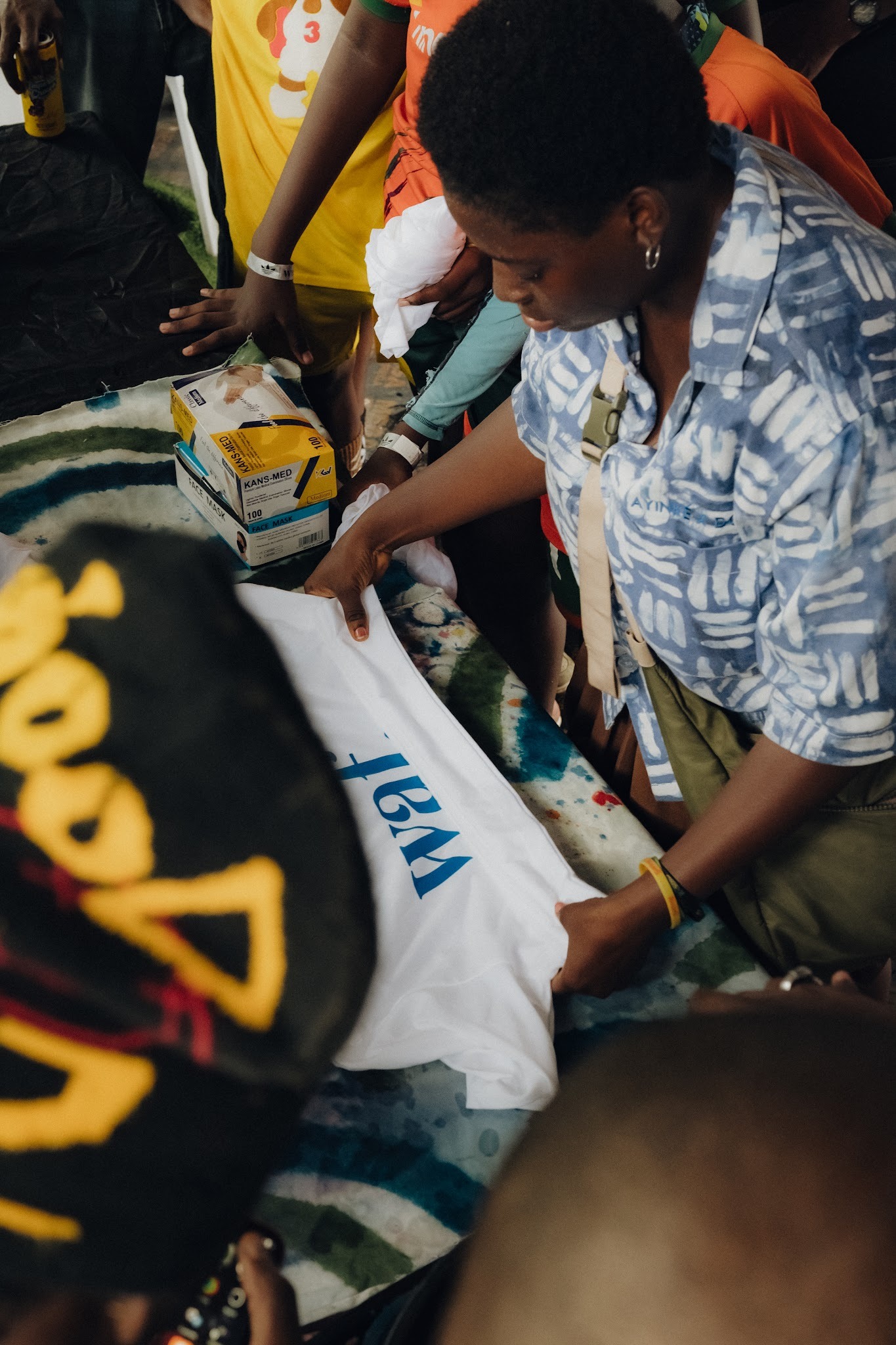
Credit: Wafflesncream

You have said that African youth shouldn’t rely on international brands to develop products for the African market, that they should do it themselves. Does this adidas collaboration complicate that position or confirm it?

It doesn't complicate it. I think I'll be stupid if the world is global. It was a global village. I'd be stupid if we said, oh, adidas, come and make shoes here. We simply don't have the technology or the discipline. We don't have the infrastructure or. The infrastructure is not a priority for this market. Adidas is a global brand. They've worked with countless people. But I think even if adidas has paid its dues, it has done local things to kind of prove themselves. They created athletes, then also the consideration for them allowing us to play with the silhouettes is also localizing the international shoe, even down to material choices, because leather is leather, regardless of where you are in the world. But how its approach is local. We did our best to kind of localize that thinking, if that makes sense. It's also equally as valid. I think you can also embody something that materials can be imported, but the idea can be localized.

Fourteen years of building without institutional backing or mainstream recognition, and now a global Adidas collaboration. What do you want the young skaters in Lagos who watched you build this from nothing to take from this moment?

First and foremost, we haven't arrived. I think let's not get it misconstrued. We still have our challenges and we're still working as hard as we can to get to where we want to go. So I don't want anybody to feel like this is a pedestal. This is like where you want to be. You might not even have this collaboration and still thrive. We're grateful, we're happy. It signifies growth and, you know, elevation or whatever that comes with this. But that is not the goal. It's the cherry on top.  It's not the cake. Do you understand? 

So I would employ every young person to build their cake, to build ideas. First and foremost, make sure that the people around you are supportive. Because you can't make it for yourself. You can have your own POV. You don't listen to people that don't get it.  I think it's a very bad trap and sometimes your parents and close family and friends may not get it. Yes, find your tribe. I think you should also learn to support each other.  It's not just a take, take. I think the beauty of waf is that we've given, giving, giving. And if this is what we take from it, then so be it. But we give and we continue to give and support. Support your friends, support your industry. When I say your industry, I mean like the tailors that you work with. Support the people.  Like no one's watching.  Yeah, so far they're part of your process, they're part of your community, celebrate them. When you're doing anything, bring your tailor, bring them to the launch, let them see what you're doing. There's a weird thing in Nigeria where everybody tries to gatekeep and we don't do as bad as other societies, but where people don't want to share processes and share findings. I have a theory.  If two people are struggling with the same thing, you are competing. You're both idiots. If you're struggling, you should both be supporting each other, leveraging off. You know, whether you're buying T-shirts, getting blanks together or printing different things, whether you're bringing in the shipment with the same shipper so it can be cheaper for you, find collaborators.  It doesn't have to be Adidas, WAF for it to be a collaboration. We collaborate every step of the way, down to staff, down to thinking. I think young people need to realize that they're not alone.  You can't build alone, and instant gratification is cool because you want to feel good, you want that dopamine hit. But at the same time, you need to find out why you're doing it.  

So when these big wins come, you don't get lost in the sauce.

And we have been lost in the sauce before.  We think we've arrived and it has been shot up in a. I know that it's a marathon.  It's not a.  It's not some sort of.  There's no end goal. You're going to create and design till your dying day. I know a lot of designers and creators that are still creating to the year 80. This is not a job. This is a mental shift. I don't know how intense people are. But me, I say you'll be able to lose a finger for it or even die for it. These are ideas. This is a little bit of you're putting into the world and you don't have to always be the one to do it.  You can find someone to support. 

There's a weird romanticized version of you being the hero all the time. You can be someone's Robin. You don't have to be Batman all the time. You can be the sidekick, because, trust me, Batman cannot function without Robin or Alfred. You can be Alfred. You can be Uncle, Uncle Phil to Fresh Prince. You can be May to Spider Man. You understand everybody has a support system.  Ninja Turtle, Splinter and April. You understand you need at least two or three or four people who are ready to go down with you. But are you going to be the person taking the risk or are you going to support the person taking it? I'm sorry, I'm getting passionate about it because it's like an opportunity to speak to a wider audience when it comes to humanizing this thing.  Understand that nobody can save you. I can't make you rich because there's a thing in Nigeria where everybody wants to make it in life and be rich.  But what does even success look like for you?  Success to us may not even be money. 

Money to us is not the ultimate success. Money is good and we want to make money, I understand: you are not alone, and you cannot build alone. sustainable so we can keep going. But for me, so far all our guys are getting paid a salary. The rent is being paid and we can create the next thing and make a little cherry on top. To me, that's successful.  I don't believe in, I must wear a diamond chain. All of a sudden all of us are like balling. That's not success for us. Success is being able to do it again and again and again. And it's a privilege to understand that. Also creativity is a privilege and a calling to kind of do for people. To buy into your point of view. 

What comes next for waf. - beyond the Superstar ADV?

I don't want to give it out because then it spoils the fun.  But I'll say this. We've not really been in the studio for a very long time. We got lost chasing the wrong things and working with the wrong opportunities. So I think we're back in the studio now and we want to tell more stories. So expect more product offerings and stuff from us. I think it's going to be fun. I think, let's see what happens. We're still having fun. We have more stories to tell. 

Cover Credit: Wafflesncream
Jomi Marcus-Bello: The Unspoken Secret of Success

Authored by
This is some text inside of a div block.

Jomi Marcus-Bello started Wafflesncream in Leeds, in 2008, alongside his brother and a shared obsession with skateboarding. He brought it back to Lagos, built a community on an island with no skate parks and roads that make skating a daily negotiation. He converted a former colonial prison into a skate park, and fourteen years later became the first African skate community to design the Adidas Superstar ADV. 

The shoe - grey upper from Lagos Island's industrial landscape, translucent pink outsole from the sky near the sea, breathable panels for the actual humidity it will be skated in- is now in the hands of the global market. 

Success, by his own definition, is paying salaries and keeping the lights on. Catching up with Deeds ahead of the global release, we spoke about building without investors, what the Adidas collaboration actually meant, and why Freedom Park is the most honest thing Wafflesandcream has brought to life.

Sophia for Deeds: For anyone reading this and discovering you and waf. For the first time, how would you introduce yourself and what wafflesncream is?

I think we are just storytellers trying to speak about Lagos, Nigeria, and Africa as a whole. I think we're just trying to create beautiful products and tell incredible stories, in and around the average skateboarder's life and their ambitions and their tastes. If anybody's engaging well for the first time, they'll see that we've been. We're literally from grass to grace. We've had no investors, but a few assists here and there. We made it with people. Nobody ever makes it on their own. It’s been an up-and-down story. I think it's a story of the African youth and their ambitions and his inner jokes, his exploration, through the eyes of the skateboarder.

You started waf. in Leeds in 2008, then brought it back to Lagos. What made you come back and build a skate scene in a city with no skate parks, no pavements, and roads that make skating feel like a daily negotiation?

I was exposed to it by my mom. I think it was when I discovered it properly and started to enjoy the lifestyle and the friends I made. It was something that I wanted to continue. I didn't want to have to move back to Nigeria and then have it stopped.  I felt like I wasn't the only one that had this kind of mindset. I was just trying to look for my tribe. I met a few people and we started designing and enjoying the new kind of, like, way of thinking around products and lifestyle.

In over fifty years of the adidas Superstar, no African skate community has ever designed one. When Adidas came to waf., what was your first reaction, and what was the first design decision you made?

Honestly, our first reaction was gratitude, we were flattered but we'd also been down this road before. We had worked on international projects with brands like Coke and Guinness in the past, so we already had a sense of what it meant to represent something of that scale. Those experiences gave us the confidence to walk into this the right way, not overthinking it, not trying to overdo it or force something that wasn't authentic. We treated it like any other collaboration, because that's what got us here in the first place.

When it came to the silhouette, choosing the Superstar felt obvious. When you're working with a brand like adidas, there's something powerful about starting with the original, their classic. And it just so happened that around that time, adidas was already leaning back into the Superstar story, so it felt like the right moment.

But the real question for us was: how does Lagos actually show up in a shoe?

A lot of people expected us to go the obvious route, yellow, Ankara prints or loud colors. But we wanted to capture what Lagos feels like, not just what it looks like on the surface. Lagos is humid. Our biggest competition isn't another sneaker brand, it's slippers. Palm slippers. Because comfort here often means kicking off your shoes. Our streets, our environment, they're not always generous to your feet. So we had to design with that reality in mind.

The toe cap already gives you that shell-like protection, but we made sure to think through breathability too, that's why we used mesh on the sides and through the inner concave, so the foot can breathe. We added an elastic support inside to hold the foot securely, not just for skating, but for movement in general, running, catching a ball, whatever life in Lagos demands.

The gray represents Lagos Island, where the skate park is, and Surulere too. Those spaces gave us so much when we were coming up, letting us skate under the stadium staircase, generous with the room they gave us to exist and create. So the gray carries different patinas, almost like cracked leather, telling that story.

Credit: Wafflesncream

You opened Lagos’s first skatepark at Freedom Park in 2024, on the grounds of an old colonial prison. That detail is not accidental. What does it mean to build something for young Lagosians in that specific space?

I mean, it's crazy with Lagos Island. It's crazy because that's where we first used to congregate to skate. Freedom Park security guards were not really kind to us. They would seize our boards. They would do all sorts because they saw us as a nuisance. This was happening around 2015 or 2017. But the beautiful thing was that Covid hit, and we had formed a sort of relationship. They asked us if we could work on a skate park. We were like, yes, of course we can. The crazy thing is that we started doing a little bit of history on the grounds where the skate park is actually built.  

Let me start with this. Where our skate shop is the warden's office, where you get sentenced to that prison or convicted to, and that is where you're going to serve. Our skate shop is actually where people were getting checked in then. The skate park is where they get stripped down. It was the metal workshop where people would smelt metal. So when we're digging and back then, the metals were very heavy, we're digging to, you know, we had to sand fill. I don't want to get into the technicalities of the construction, but we did find jail gates. We found metal parts. We also found different things that showed the history of the space, which was kind of crazy. And it's in the Freedom Park Museum at the moment.  We found out that there was a protest at that place as well, where they were.  

 The prisoners were not being taken care of properly. They revolted on that very land.  So that land has a rebellious spirit to it. They broke down the wall. Then they had to bring in bricks from London to rebuild it.  And then also it's beautiful. It's like a concave. It feels like you're in a jungle. We made sure that we did not interfere too much with the trees and plantation; we just simply inserted the skate park in there. I know Awolowo served in that prison, so he must have gone through our shop at some point. I know other prisoners were political prisoners who were there too. It was a prison for 100 years.It's crazy because we are in the warden's office, and where they went to get disciplined is now a place of leisure and commerce.

waf. has always sat at the intersection of skateboarding, fashion, music, art, and community rather than being just a skate brand. Was that always the vision, or did it evolve?

I think it's one in itself.  Skateboarding because it's a culture. It's not just an activity. Just like belonging to any other culture, it’s not just about the language. It’s the way you dress, what you eat, the respect you show, how you conduct yourself, the festivals, the tone, how you raise a child, and your overall POV on life.

I think every culture deserves that same diversity and complexity. You can be a skateboarder, but you can also be a photographer or be into fashion. It’s more of an attitude and a language than just a physical thing.

The campaign for the Superstar ADV was shot entirely on Lagos Island, featuring waf. community members - not imported faces or global ambassadors. How important was that decision to you?

I mean, it's everything in it. We wanted to be truly authentic to ourselves.  Like I said. I think when the Collaborator comes, I don't think it's when you start to try and over-imagine. I think that's when you just have to simplify things. It was an opportunity to show where we are from, who we are authentically. Adidas has been an amplifier and a good collaborator. I think what Lagos Island has done for us is legacy stuff. It's stuff that hopefully our children's children will be able to enjoy. I think it's only right to always reflect that.  No Space in Lagos or Nigeria gave us a chance. Lagos Island did. It gave us a home; it gave us a facility; it gave us the training ground. It gave us friends; it gave us meaning; it gave us aesthetics. It gave us everything. We don't need to import faces if we want to tell our stories. I think if we're going to import faces, they will be people that have come from within it, if that makes sense. It’s not just Lagos Island people.  Lagos Island in itself as a location. A lot of people who we started with have kind of branched out, and they still carry waf for Lagos Island in their hearts.

Credit: Wafflesncream

You have said that African youth shouldn’t rely on international brands to develop products for the African market, that they should do it themselves. Does this adidas collaboration complicate that position or confirm it?

It doesn't complicate it. I think I'll be stupid if the world is global. It was a global village. I'd be stupid if we said, oh, adidas, come and make shoes here. We simply don't have the technology or the discipline. We don't have the infrastructure or. The infrastructure is not a priority for this market. Adidas is a global brand. They've worked with countless people. But I think even if adidas has paid its dues, it has done local things to kind of prove themselves. They created athletes, then also the consideration for them allowing us to play with the silhouettes is also localizing the international shoe, even down to material choices, because leather is leather, regardless of where you are in the world. But how its approach is local. We did our best to kind of localize that thinking, if that makes sense. It's also equally as valid. I think you can also embody something that materials can be imported, but the idea can be localized.

Fourteen years of building without institutional backing or mainstream recognition, and now a global Adidas collaboration. What do you want the young skaters in Lagos who watched you build this from nothing to take from this moment?

First and foremost, we haven't arrived. I think let's not get it misconstrued. We still have our challenges and we're still working as hard as we can to get to where we want to go. So I don't want anybody to feel like this is a pedestal. This is like where you want to be. You might not even have this collaboration and still thrive. We're grateful, we're happy. It signifies growth and, you know, elevation or whatever that comes with this. But that is not the goal. It's the cherry on top.  It's not the cake. Do you understand? 

So I would employ every young person to build their cake, to build ideas. First and foremost, make sure that the people around you are supportive. Because you can't make it for yourself. You can have your own POV. You don't listen to people that don't get it.  I think it's a very bad trap and sometimes your parents and close family and friends may not get it. Yes, find your tribe. I think you should also learn to support each other.  It's not just a take, take. I think the beauty of waf is that we've given, giving, giving. And if this is what we take from it, then so be it. But we give and we continue to give and support. Support your friends, support your industry. When I say your industry, I mean like the tailors that you work with. Support the people.  Like no one's watching.  Yeah, so far they're part of your process, they're part of your community, celebrate them. When you're doing anything, bring your tailor, bring them to the launch, let them see what you're doing. There's a weird thing in Nigeria where everybody tries to gatekeep and we don't do as bad as other societies, but where people don't want to share processes and share findings. I have a theory.  If two people are struggling with the same thing, you are competing. You're both idiots. If you're struggling, you should both be supporting each other, leveraging off. You know, whether you're buying T-shirts, getting blanks together or printing different things, whether you're bringing in the shipment with the same shipper so it can be cheaper for you, find collaborators.  It doesn't have to be Adidas, WAF for it to be a collaboration. We collaborate every step of the way, down to staff, down to thinking. I think young people need to realize that they're not alone.  You can't build alone, and instant gratification is cool because you want to feel good, you want that dopamine hit. But at the same time, you need to find out why you're doing it.  

So when these big wins come, you don't get lost in the sauce.

And we have been lost in the sauce before.  We think we've arrived and it has been shot up in a. I know that it's a marathon.  It's not a.  It's not some sort of.  There's no end goal. You're going to create and design till your dying day. I know a lot of designers and creators that are still creating to the year 80. This is not a job. This is a mental shift. I don't know how intense people are. But me, I say you'll be able to lose a finger for it or even die for it. These are ideas. This is a little bit of you're putting into the world and you don't have to always be the one to do it.  You can find someone to support. 

There's a weird romanticized version of you being the hero all the time. You can be someone's Robin. You don't have to be Batman all the time. You can be the sidekick, because, trust me, Batman cannot function without Robin or Alfred. You can be Alfred. You can be Uncle, Uncle Phil to Fresh Prince. You can be May to Spider Man. You understand everybody has a support system.  Ninja Turtle, Splinter and April. You understand you need at least two or three or four people who are ready to go down with you. But are you going to be the person taking the risk or are you going to support the person taking it? I'm sorry, I'm getting passionate about it because it's like an opportunity to speak to a wider audience when it comes to humanizing this thing.  Understand that nobody can save you. I can't make you rich because there's a thing in Nigeria where everybody wants to make it in life and be rich.  But what does even success look like for you?  Success to us may not even be money. 

Money to us is not the ultimate success. Money is good and we want to make money, I understand: you are not alone, and you cannot build alone. sustainable so we can keep going. But for me, so far all our guys are getting paid a salary. The rent is being paid and we can create the next thing and make a little cherry on top. To me, that's successful.  I don't believe in, I must wear a diamond chain. All of a sudden all of us are like balling. That's not success for us. Success is being able to do it again and again and again. And it's a privilege to understand that. Also creativity is a privilege and a calling to kind of do for people. To buy into your point of view. 

What comes next for waf. - beyond the Superstar ADV?

I don't want to give it out because then it spoils the fun.  But I'll say this. We've not really been in the studio for a very long time. We got lost chasing the wrong things and working with the wrong opportunities. So I think we're back in the studio now and we want to tell more stories. So expect more product offerings and stuff from us. I think it's going to be fun. I think, let's see what happens. We're still having fun. We have more stories to tell. 

Cover Credit: Wafflesncream
This is some text inside of a div block.

Jomi Marcus-Bello: The Unspoken Secret of Success

Authored by

Jomi Marcus-Bello started Wafflesncream in Leeds, in 2008, alongside his brother and a shared obsession with skateboarding. He brought it back to Lagos, built a community on an island with no skate parks and roads that make skating a daily negotiation. He converted a former colonial prison into a skate park, and fourteen years later became the first African skate community to design the Adidas Superstar ADV. 

The shoe - grey upper from Lagos Island's industrial landscape, translucent pink outsole from the sky near the sea, breathable panels for the actual humidity it will be skated in- is now in the hands of the global market. 

Success, by his own definition, is paying salaries and keeping the lights on. Catching up with Deeds ahead of the global release, we spoke about building without investors, what the Adidas collaboration actually meant, and why Freedom Park is the most honest thing Wafflesandcream has brought to life.

Sophia for Deeds: For anyone reading this and discovering you and waf. For the first time, how would you introduce yourself and what wafflesncream is?

I think we are just storytellers trying to speak about Lagos, Nigeria, and Africa as a whole. I think we're just trying to create beautiful products and tell incredible stories, in and around the average skateboarder's life and their ambitions and their tastes. If anybody's engaging well for the first time, they'll see that we've been. We're literally from grass to grace. We've had no investors, but a few assists here and there. We made it with people. Nobody ever makes it on their own. It’s been an up-and-down story. I think it's a story of the African youth and their ambitions and his inner jokes, his exploration, through the eyes of the skateboarder.

You started waf. in Leeds in 2008, then brought it back to Lagos. What made you come back and build a skate scene in a city with no skate parks, no pavements, and roads that make skating feel like a daily negotiation?

I was exposed to it by my mom. I think it was when I discovered it properly and started to enjoy the lifestyle and the friends I made. It was something that I wanted to continue. I didn't want to have to move back to Nigeria and then have it stopped.  I felt like I wasn't the only one that had this kind of mindset. I was just trying to look for my tribe. I met a few people and we started designing and enjoying the new kind of, like, way of thinking around products and lifestyle.

In over fifty years of the adidas Superstar, no African skate community has ever designed one. When Adidas came to waf., what was your first reaction, and what was the first design decision you made?

Honestly, our first reaction was gratitude, we were flattered but we'd also been down this road before. We had worked on international projects with brands like Coke and Guinness in the past, so we already had a sense of what it meant to represent something of that scale. Those experiences gave us the confidence to walk into this the right way, not overthinking it, not trying to overdo it or force something that wasn't authentic. We treated it like any other collaboration, because that's what got us here in the first place.

When it came to the silhouette, choosing the Superstar felt obvious. When you're working with a brand like adidas, there's something powerful about starting with the original, their classic. And it just so happened that around that time, adidas was already leaning back into the Superstar story, so it felt like the right moment.

But the real question for us was: how does Lagos actually show up in a shoe?

A lot of people expected us to go the obvious route, yellow, Ankara prints or loud colors. But we wanted to capture what Lagos feels like, not just what it looks like on the surface. Lagos is humid. Our biggest competition isn't another sneaker brand, it's slippers. Palm slippers. Because comfort here often means kicking off your shoes. Our streets, our environment, they're not always generous to your feet. So we had to design with that reality in mind.

The toe cap already gives you that shell-like protection, but we made sure to think through breathability too, that's why we used mesh on the sides and through the inner concave, so the foot can breathe. We added an elastic support inside to hold the foot securely, not just for skating, but for movement in general, running, catching a ball, whatever life in Lagos demands.

The gray represents Lagos Island, where the skate park is, and Surulere too. Those spaces gave us so much when we were coming up, letting us skate under the stadium staircase, generous with the room they gave us to exist and create. So the gray carries different patinas, almost like cracked leather, telling that story.

Credit: Wafflesncream

You opened Lagos’s first skatepark at Freedom Park in 2024, on the grounds of an old colonial prison. That detail is not accidental. What does it mean to build something for young Lagosians in that specific space?

I mean, it's crazy with Lagos Island. It's crazy because that's where we first used to congregate to skate. Freedom Park security guards were not really kind to us. They would seize our boards. They would do all sorts because they saw us as a nuisance. This was happening around 2015 or 2017. But the beautiful thing was that Covid hit, and we had formed a sort of relationship. They asked us if we could work on a skate park. We were like, yes, of course we can. The crazy thing is that we started doing a little bit of history on the grounds where the skate park is actually built.  

Let me start with this. Where our skate shop is the warden's office, where you get sentenced to that prison or convicted to, and that is where you're going to serve. Our skate shop is actually where people were getting checked in then. The skate park is where they get stripped down. It was the metal workshop where people would smelt metal. So when we're digging and back then, the metals were very heavy, we're digging to, you know, we had to sand fill. I don't want to get into the technicalities of the construction, but we did find jail gates. We found metal parts. We also found different things that showed the history of the space, which was kind of crazy. And it's in the Freedom Park Museum at the moment.  We found out that there was a protest at that place as well, where they were.  

 The prisoners were not being taken care of properly. They revolted on that very land.  So that land has a rebellious spirit to it. They broke down the wall. Then they had to bring in bricks from London to rebuild it.  And then also it's beautiful. It's like a concave. It feels like you're in a jungle. We made sure that we did not interfere too much with the trees and plantation; we just simply inserted the skate park in there. I know Awolowo served in that prison, so he must have gone through our shop at some point. I know other prisoners were political prisoners who were there too. It was a prison for 100 years.It's crazy because we are in the warden's office, and where they went to get disciplined is now a place of leisure and commerce.

waf. has always sat at the intersection of skateboarding, fashion, music, art, and community rather than being just a skate brand. Was that always the vision, or did it evolve?

I think it's one in itself.  Skateboarding because it's a culture. It's not just an activity. Just like belonging to any other culture, it’s not just about the language. It’s the way you dress, what you eat, the respect you show, how you conduct yourself, the festivals, the tone, how you raise a child, and your overall POV on life.

I think every culture deserves that same diversity and complexity. You can be a skateboarder, but you can also be a photographer or be into fashion. It’s more of an attitude and a language than just a physical thing.

The campaign for the Superstar ADV was shot entirely on Lagos Island, featuring waf. community members - not imported faces or global ambassadors. How important was that decision to you?

I mean, it's everything in it. We wanted to be truly authentic to ourselves.  Like I said. I think when the Collaborator comes, I don't think it's when you start to try and over-imagine. I think that's when you just have to simplify things. It was an opportunity to show where we are from, who we are authentically. Adidas has been an amplifier and a good collaborator. I think what Lagos Island has done for us is legacy stuff. It's stuff that hopefully our children's children will be able to enjoy. I think it's only right to always reflect that.  No Space in Lagos or Nigeria gave us a chance. Lagos Island did. It gave us a home; it gave us a facility; it gave us the training ground. It gave us friends; it gave us meaning; it gave us aesthetics. It gave us everything. We don't need to import faces if we want to tell our stories. I think if we're going to import faces, they will be people that have come from within it, if that makes sense. It’s not just Lagos Island people.  Lagos Island in itself as a location. A lot of people who we started with have kind of branched out, and they still carry waf for Lagos Island in their hearts.

Credit: Wafflesncream

You have said that African youth shouldn’t rely on international brands to develop products for the African market, that they should do it themselves. Does this adidas collaboration complicate that position or confirm it?

It doesn't complicate it. I think I'll be stupid if the world is global. It was a global village. I'd be stupid if we said, oh, adidas, come and make shoes here. We simply don't have the technology or the discipline. We don't have the infrastructure or. The infrastructure is not a priority for this market. Adidas is a global brand. They've worked with countless people. But I think even if adidas has paid its dues, it has done local things to kind of prove themselves. They created athletes, then also the consideration for them allowing us to play with the silhouettes is also localizing the international shoe, even down to material choices, because leather is leather, regardless of where you are in the world. But how its approach is local. We did our best to kind of localize that thinking, if that makes sense. It's also equally as valid. I think you can also embody something that materials can be imported, but the idea can be localized.

Fourteen years of building without institutional backing or mainstream recognition, and now a global Adidas collaboration. What do you want the young skaters in Lagos who watched you build this from nothing to take from this moment?

First and foremost, we haven't arrived. I think let's not get it misconstrued. We still have our challenges and we're still working as hard as we can to get to where we want to go. So I don't want anybody to feel like this is a pedestal. This is like where you want to be. You might not even have this collaboration and still thrive. We're grateful, we're happy. It signifies growth and, you know, elevation or whatever that comes with this. But that is not the goal. It's the cherry on top.  It's not the cake. Do you understand? 

So I would employ every young person to build their cake, to build ideas. First and foremost, make sure that the people around you are supportive. Because you can't make it for yourself. You can have your own POV. You don't listen to people that don't get it.  I think it's a very bad trap and sometimes your parents and close family and friends may not get it. Yes, find your tribe. I think you should also learn to support each other.  It's not just a take, take. I think the beauty of waf is that we've given, giving, giving. And if this is what we take from it, then so be it. But we give and we continue to give and support. Support your friends, support your industry. When I say your industry, I mean like the tailors that you work with. Support the people.  Like no one's watching.  Yeah, so far they're part of your process, they're part of your community, celebrate them. When you're doing anything, bring your tailor, bring them to the launch, let them see what you're doing. There's a weird thing in Nigeria where everybody tries to gatekeep and we don't do as bad as other societies, but where people don't want to share processes and share findings. I have a theory.  If two people are struggling with the same thing, you are competing. You're both idiots. If you're struggling, you should both be supporting each other, leveraging off. You know, whether you're buying T-shirts, getting blanks together or printing different things, whether you're bringing in the shipment with the same shipper so it can be cheaper for you, find collaborators.  It doesn't have to be Adidas, WAF for it to be a collaboration. We collaborate every step of the way, down to staff, down to thinking. I think young people need to realize that they're not alone.  You can't build alone, and instant gratification is cool because you want to feel good, you want that dopamine hit. But at the same time, you need to find out why you're doing it.  

So when these big wins come, you don't get lost in the sauce.

And we have been lost in the sauce before.  We think we've arrived and it has been shot up in a. I know that it's a marathon.  It's not a.  It's not some sort of.  There's no end goal. You're going to create and design till your dying day. I know a lot of designers and creators that are still creating to the year 80. This is not a job. This is a mental shift. I don't know how intense people are. But me, I say you'll be able to lose a finger for it or even die for it. These are ideas. This is a little bit of you're putting into the world and you don't have to always be the one to do it.  You can find someone to support. 

There's a weird romanticized version of you being the hero all the time. You can be someone's Robin. You don't have to be Batman all the time. You can be the sidekick, because, trust me, Batman cannot function without Robin or Alfred. You can be Alfred. You can be Uncle, Uncle Phil to Fresh Prince. You can be May to Spider Man. You understand everybody has a support system.  Ninja Turtle, Splinter and April. You understand you need at least two or three or four people who are ready to go down with you. But are you going to be the person taking the risk or are you going to support the person taking it? I'm sorry, I'm getting passionate about it because it's like an opportunity to speak to a wider audience when it comes to humanizing this thing.  Understand that nobody can save you. I can't make you rich because there's a thing in Nigeria where everybody wants to make it in life and be rich.  But what does even success look like for you?  Success to us may not even be money. 

Money to us is not the ultimate success. Money is good and we want to make money, I understand: you are not alone, and you cannot build alone. sustainable so we can keep going. But for me, so far all our guys are getting paid a salary. The rent is being paid and we can create the next thing and make a little cherry on top. To me, that's successful.  I don't believe in, I must wear a diamond chain. All of a sudden all of us are like balling. That's not success for us. Success is being able to do it again and again and again. And it's a privilege to understand that. Also creativity is a privilege and a calling to kind of do for people. To buy into your point of view. 

What comes next for waf. - beyond the Superstar ADV?

I don't want to give it out because then it spoils the fun.  But I'll say this. We've not really been in the studio for a very long time. We got lost chasing the wrong things and working with the wrong opportunities. So I think we're back in the studio now and we want to tell more stories. So expect more product offerings and stuff from us. I think it's going to be fun. I think, let's see what happens. We're still having fun. We have more stories to tell. 

Cover Credit: Wafflesncream
Other Stories
London
London
Lagos
London
Newyork
London
Shop
Join the community.
You are now subscribed to receive updates.
Oops! Something went wrong while submitting the form.
Subscribe