When African Designers Shift Berlin Fashion Week’s Narrative, Who is Listening?

Authored by

At AW26, Orange Culture, Buzigahill and Kenneth Ize brought conversations around ownership, lineage and joy to the forefront of the runway

Berlin Fashion Week AW26 unfolded as a study in contrast. On one side, the expected pillars of German and European fashion. On the other, an expanding international presence that continues to reshape the city’s rhythm. Beyond expanding representation, this season showed a definitive shift in influence, with African designers helping redefine the cultural direction and emotional tone of Berlin’s runway.

This season’s calendar brought together labels such as GmbH, Richert Beil, William Fan and Marc Cain alongside a new generation of designers navigating craft, politics and identity through contemporary silhouettes. With the presentations, Berlin continues to position itself as a platform for independent voices, sustainability-led practices and cross-cultural exchange, though the durability of that positioning remains an open question.

Within that framework, three Black-founded brands carried particular clarity of vision. Orange Culture by Adebayo Oke-Lawal, Buzigahill by Bobby Kolade and Kenneth Ize were selected as part of the Berlin Contemporary AW26 cohort, a prize initiative supporting emerging and independent labels through production funding and institutional visibility.

At BFW AW26, their presentations did not offer a singular narrative. Instead, they revealed different tensions shaping contemporary African fashion. Orange Culture refined a deeply emotional design language rooted in gender fluidity and memory. Buzigahill sustained its critique of secondhand clothing economies through reconstruction and material interrogation. Kenneth Ize continued his dialogue between heritage textile and contemporary tailoring, emphasizing refinement while raising questions of progression.

Together, their presentations were refreshing and it showed Berlin’s gradual shift toward a more globally attentive fashion week, where conversations around memory, ownership, sustainability and cultural lineage occupy central space on the runway and influence its direction as much as its diversity.

Kenneth Ize 
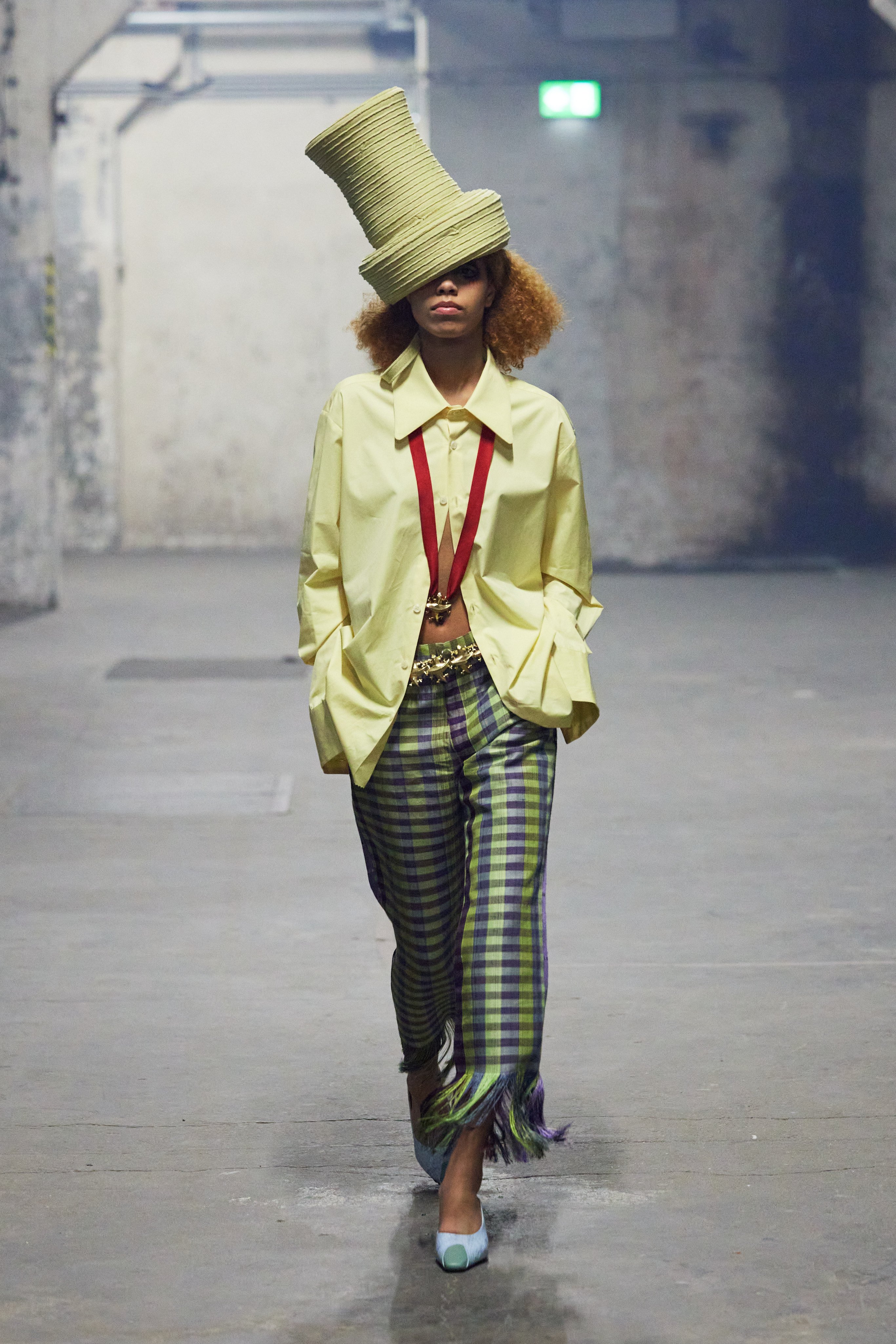
For Autumn/Winter 2026, Nigerian designer Kenneth Ize titled his collection JOY. The word feels simple at first. On the runway, it unfolds as something layered with togetherness, vulnerability, celebration and softness. With collaborators including stylist KK Obi, Ize's presentation felt communal, almost like being invited into an emotional interior of the brand.

As expected, the tailoring was lean and elegant, then subtly undone. Some pieces studied contrast, presenting one mood at the front and another at the back. The tension between restraint and release was most visible in the trench coats and sculptural hats that framed the collection. Traditional aso oke moved through the garments, allowing heritage textiles to meet materials associated with everyday wear, creating silhouettes that felt grounded and recognizably Ize. Where the collection felt strongest was in its sincerity. There was no pressure to over-perform the concept. There was also something childlike in the presentation. Playful makeup. Lightness in the pacing. The collection approached joy as an intrinsic emotion - raw, communal, and expressed through craft and form.

Buzigahill
At Berlin Fashion Week, Kampala-based label Buzigahill, by Bobby Kolade, unveiled its twelfth edition of “RETURN TO SENDER,” an ongoing project confronting the afterlife of clothing. Both the brand and the collection respond directly to the influx of secondhand garments that enter Uganda, reshaping local industry and consumption in negative ways.

For their 12th edition, the label shifted toward memory. Kolade looked to photographs from the 1960s and 1970s in East Africa, especially images of his grandparents and their peers. Their posture. Their tailoring. For many East African millennials, those photographs are especially nostalgic, a longing for a moment that feels grounded and self-possessed. The collection reads as reclamation, asking who owns style, history and narrative, and how those threads can be rewoven into contemporary fashion.

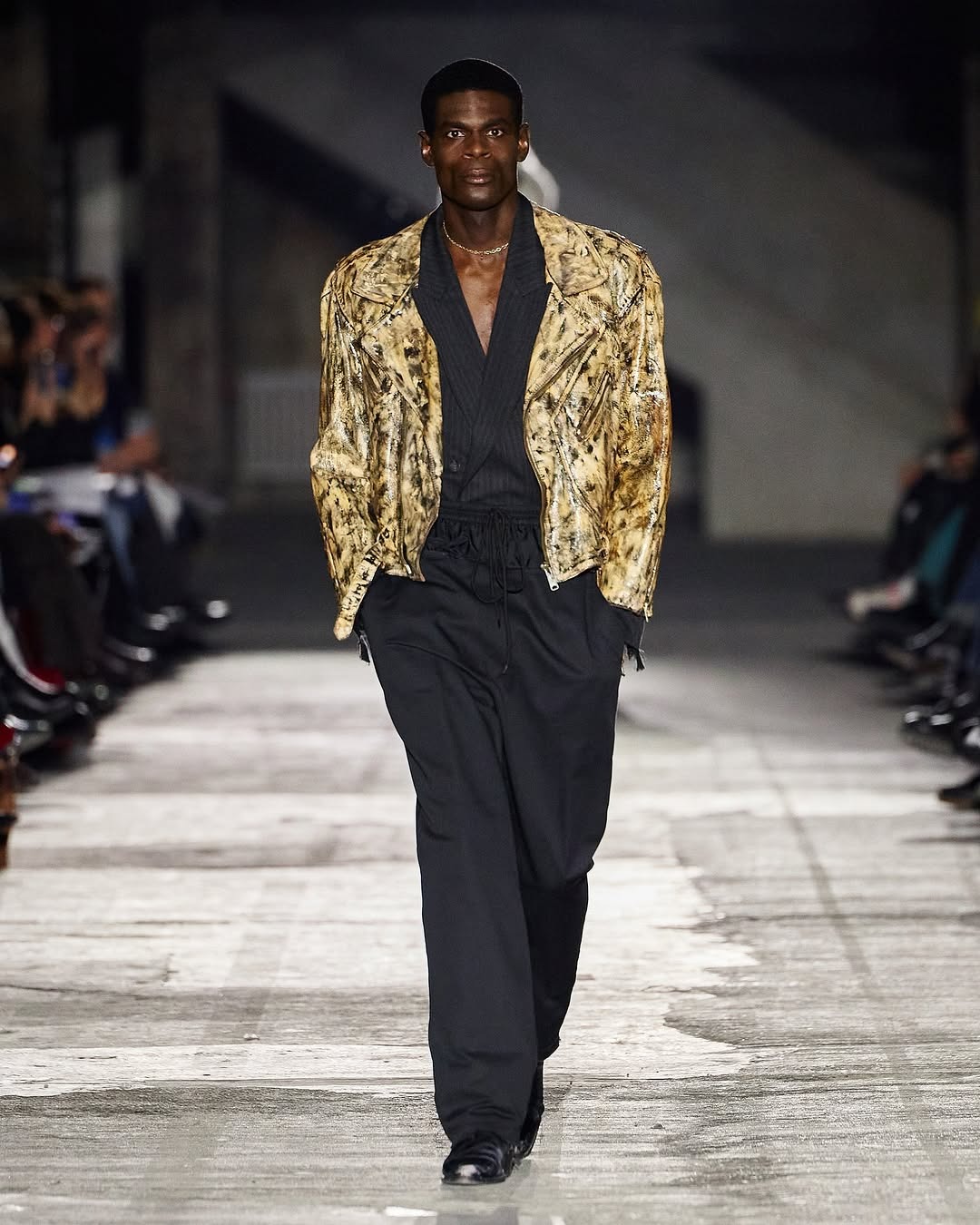
The opening look set the tone of the collection. A distressed leather biker jacket, treated over 28 hours with sandpaper, red soil, paint and varnish paired with a reversed suit jacket, deconstructed and reassembled with raw seams exposed on the exterior, and “boda boda” chinos which replaced traditional waistbands with one made from track offcuts.

Conceptually, Buzigahill was one of the most urgent voices on the Berlin schedule. The critique is clear and embodied. Where the presentation struggled was in collective cohesion. The garments read as self-contained experiments instead of components of a larger visual narrative. Although, fringing and surface manipulation appeared throughout, it functioned more as recurring techniques. Nonetheless, the clothes felt innovative and sharply contemporary, and with their BFW showing, Buzigahill continues to operate as a demand, a critique and a design method, stitched directly into their seams.

Orange Culture
“Backyards of Memory is a return not just to a place, but to a feeling,” Oke-Lawal writes. 

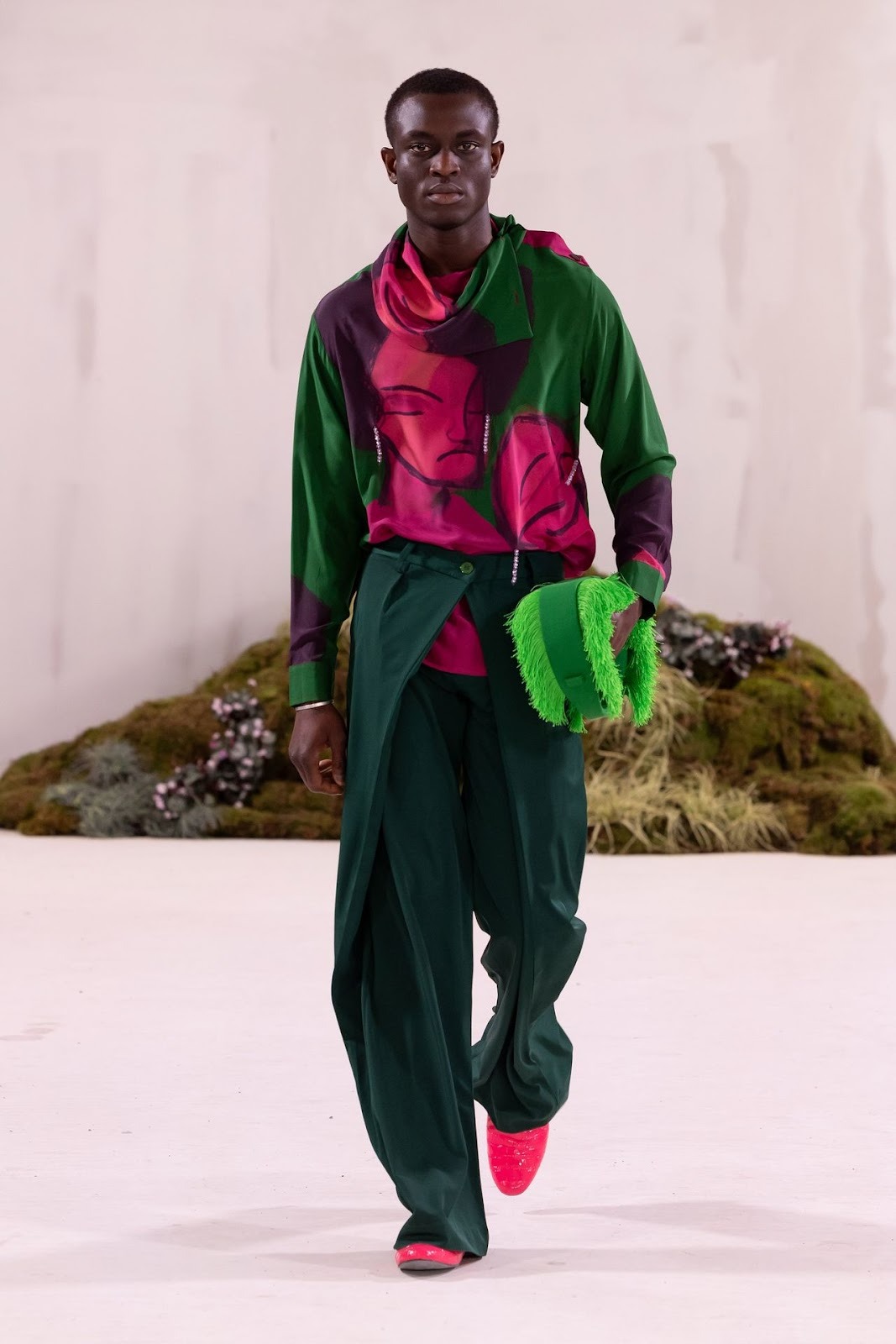
For Autumn/Winter 2026, the Lagos-based label unveiled Backyards of Memory, a collection shaped by remembrance. Self-taught designer and founder Adebayo Oke-Lawal returns for his second season at Berlin Fashion Week, still bold, still saturated in colour and still rooted in texture. The collection continues a conversation he began at Lagos Fashion Week in November, a tribute to his mother. Now at BFW AW26, memory becomes landscape and that sentiment translates directly into the clothes, with flowing fabrics, prints, and colour that feels fearless and unreserved. 

Colour remained the collection’s most immediate strength. Custom textile, developed in collaboration with artist Sisiano Paolo, ran through the collection. Saturation and print layering created visual warmth, while flowing cuts sustained Orange Culture’s rejection of rigid tailoring conventions. Handwoven techniques were also seen across the collection, and handcrafted, fringed-edge bags created with Lagos brand Kisara added texture and tactility, tying the looks together.

From the print accents to sequin skirts and macramé dresses, the collection was unmistakably Orange Culture, but the collection’s visual language occasionally settled into predictability for the brand. Backyards of Memory succeeded as atmosphere and storytelling, while leaving open the question of how Orange Culture might translate that emotional depth into sharper structural evolution.

Across the three presentations, what emerged was a set of tensions that felt reflective of contemporary African fashion itself. Kenneth Ize showed the strength and limits of refinement, Buzigahill exposed the difficulty of translating conceptual urgency into cohesive runway storytelling, and Orange Culture affirmed the emotional resonance of a design language now facing the pressure of evolution.

Berlin Fashion Week has created space for practice, where designers could be seen within growth, experimentation and unresolved ideas instead of symbolic representation. The shift feels tangible but unfinished, leaving Berlin’s future fashion week identity dependent on whether this visibility develops into sustained structural support and not just seasonal emphasis. Together, Kenneth Ize, Orange culture and Buzigahill’s presence shows a fashion week intent on building a platform where cultural specificity and global dialogue stand on equal footing. With that momentum, our eyes are already set on July and the SS27 presentations to come.
When African Designers Shift Berlin Fashion Week’s Narrative, Who is Listening?

Authored by
This is some text inside of a div block.

At AW26, Orange Culture, Buzigahill and Kenneth Ize brought conversations around ownership, lineage and joy to the forefront of the runway

Berlin Fashion Week AW26 unfolded as a study in contrast. On one side, the expected pillars of German and European fashion. On the other, an expanding international presence that continues to reshape the city’s rhythm. Beyond expanding representation, this season showed a definitive shift in influence, with African designers helping redefine the cultural direction and emotional tone of Berlin’s runway.

This season’s calendar brought together labels such as GmbH, Richert Beil, William Fan and Marc Cain alongside a new generation of designers navigating craft, politics and identity through contemporary silhouettes. With the presentations, Berlin continues to position itself as a platform for independent voices, sustainability-led practices and cross-cultural exchange, though the durability of that positioning remains an open question.

Within that framework, three Black-founded brands carried particular clarity of vision. Orange Culture by Adebayo Oke-Lawal, Buzigahill by Bobby Kolade and Kenneth Ize were selected as part of the Berlin Contemporary AW26 cohort, a prize initiative supporting emerging and independent labels through production funding and institutional visibility.

At BFW AW26, their presentations did not offer a singular narrative. Instead, they revealed different tensions shaping contemporary African fashion. Orange Culture refined a deeply emotional design language rooted in gender fluidity and memory. Buzigahill sustained its critique of secondhand clothing economies through reconstruction and material interrogation. Kenneth Ize continued his dialogue between heritage textile and contemporary tailoring, emphasizing refinement while raising questions of progression.

Together, their presentations were refreshing and it showed Berlin’s gradual shift toward a more globally attentive fashion week, where conversations around memory, ownership, sustainability and cultural lineage occupy central space on the runway and influence its direction as much as its diversity.

Kenneth Ize 

For Autumn/Winter 2026, Nigerian designer Kenneth Ize titled his collection JOY. The word feels simple at first. On the runway, it unfolds as something layered with togetherness, vulnerability, celebration and softness. With collaborators including stylist KK Obi, Ize's presentation felt communal, almost like being invited into an emotional interior of the brand.

As expected, the tailoring was lean and elegant, then subtly undone. Some pieces studied contrast, presenting one mood at the front and another at the back. The tension between restraint and release was most visible in the trench coats and sculptural hats that framed the collection. Traditional aso oke moved through the garments, allowing heritage textiles to meet materials associated with everyday wear, creating silhouettes that felt grounded and recognizably Ize. Where the collection felt strongest was in its sincerity. There was no pressure to over-perform the concept. There was also something childlike in the presentation. Playful makeup. Lightness in the pacing. The collection approached joy as an intrinsic emotion - raw, communal, and expressed through craft and form.

Buzigahill

At Berlin Fashion Week, Kampala-based label Buzigahill, by Bobby Kolade, unveiled its twelfth edition of “RETURN TO SENDER,” an ongoing project confronting the afterlife of clothing. Both the brand and the collection respond directly to the influx of secondhand garments that enter Uganda, reshaping local industry and consumption in negative ways.

For their 12th edition, the label shifted toward memory. Kolade looked to photographs from the 1960s and 1970s in East Africa, especially images of his grandparents and their peers. Their posture. Their tailoring. For many East African millennials, those photographs are especially nostalgic, a longing for a moment that feels grounded and self-possessed. The collection reads as reclamation, asking who owns style, history and narrative, and how those threads can be rewoven into contemporary fashion.

The opening look set the tone of the collection. A distressed leather biker jacket, treated over 28 hours with sandpaper, red soil, paint and varnish paired with a reversed suit jacket, deconstructed and reassembled with raw seams exposed on the exterior, and “boda boda” chinos which replaced traditional waistbands with one made from track offcuts.

Conceptually, Buzigahill was one of the most urgent voices on the Berlin schedule. The critique is clear and embodied. Where the presentation struggled was in collective cohesion. The garments read as self-contained experiments instead of components of a larger visual narrative. Although, fringing and surface manipulation appeared throughout, it functioned more as recurring techniques. Nonetheless, the clothes felt innovative and sharply contemporary, and with their BFW showing, Buzigahill continues to operate as a demand, a critique and a design method, stitched directly into their seams.

Orange Culture

“Backyards of Memory is a return not just to a place, but to a feeling,” Oke-Lawal writes. 

For Autumn/Winter 2026, the Lagos-based label unveiled Backyards of Memory, a collection shaped by remembrance. Self-taught designer and founder Adebayo Oke-Lawal returns for his second season at Berlin Fashion Week, still bold, still saturated in colour and still rooted in texture. The collection continues a conversation he began at Lagos Fashion Week in November, a tribute to his mother. Now at BFW AW26, memory becomes landscape and that sentiment translates directly into the clothes, with flowing fabrics, prints, and colour that feels fearless and unreserved. 

Colour remained the collection’s most immediate strength. Custom textile, developed in collaboration with artist Sisiano Paolo, ran through the collection. Saturation and print layering created visual warmth, while flowing cuts sustained Orange Culture’s rejection of rigid tailoring conventions. Handwoven techniques were also seen across the collection, and handcrafted, fringed-edge bags created with Lagos brand Kisara added texture and tactility, tying the looks together.

From the print accents to sequin skirts and macramé dresses, the collection was unmistakably Orange Culture, but the collection’s visual language occasionally settled into predictability for the brand. Backyards of Memory succeeded as atmosphere and storytelling, while leaving open the question of how Orange Culture might translate that emotional depth into sharper structural evolution.

Across the three presentations, what emerged was a set of tensions that felt reflective of contemporary African fashion itself. Kenneth Ize showed the strength and limits of refinement, Buzigahill exposed the difficulty of translating conceptual urgency into cohesive runway storytelling, and Orange Culture affirmed the emotional resonance of a design language now facing the pressure of evolution.

Berlin Fashion Week has created space for practice, where designers could be seen within growth, experimentation and unresolved ideas instead of symbolic representation. The shift feels tangible but unfinished, leaving Berlin’s future fashion week identity dependent on whether this visibility develops into sustained structural support and not just seasonal emphasis. Together, Kenneth Ize, Orange culture and Buzigahill’s presence shows a fashion week intent on building a platform where cultural specificity and global dialogue stand on equal footing. With that momentum, our eyes are already set on July and the SS27 presentations to come.
This is some text inside of a div block.

When African Designers Shift Berlin Fashion Week’s Narrative, Who is Listening?

Authored by

At AW26, Orange Culture, Buzigahill and Kenneth Ize brought conversations around ownership, lineage and joy to the forefront of the runway

Berlin Fashion Week AW26 unfolded as a study in contrast. On one side, the expected pillars of German and European fashion. On the other, an expanding international presence that continues to reshape the city’s rhythm. Beyond expanding representation, this season showed a definitive shift in influence, with African designers helping redefine the cultural direction and emotional tone of Berlin’s runway.

This season’s calendar brought together labels such as GmbH, Richert Beil, William Fan and Marc Cain alongside a new generation of designers navigating craft, politics and identity through contemporary silhouettes. With the presentations, Berlin continues to position itself as a platform for independent voices, sustainability-led practices and cross-cultural exchange, though the durability of that positioning remains an open question.

Within that framework, three Black-founded brands carried particular clarity of vision. Orange Culture by Adebayo Oke-Lawal, Buzigahill by Bobby Kolade and Kenneth Ize were selected as part of the Berlin Contemporary AW26 cohort, a prize initiative supporting emerging and independent labels through production funding and institutional visibility.

At BFW AW26, their presentations did not offer a singular narrative. Instead, they revealed different tensions shaping contemporary African fashion. Orange Culture refined a deeply emotional design language rooted in gender fluidity and memory. Buzigahill sustained its critique of secondhand clothing economies through reconstruction and material interrogation. Kenneth Ize continued his dialogue between heritage textile and contemporary tailoring, emphasizing refinement while raising questions of progression.

Together, their presentations were refreshing and it showed Berlin’s gradual shift toward a more globally attentive fashion week, where conversations around memory, ownership, sustainability and cultural lineage occupy central space on the runway and influence its direction as much as its diversity.

Kenneth Ize 

For Autumn/Winter 2026, Nigerian designer Kenneth Ize titled his collection JOY. The word feels simple at first. On the runway, it unfolds as something layered with togetherness, vulnerability, celebration and softness. With collaborators including stylist KK Obi, Ize's presentation felt communal, almost like being invited into an emotional interior of the brand.

As expected, the tailoring was lean and elegant, then subtly undone. Some pieces studied contrast, presenting one mood at the front and another at the back. The tension between restraint and release was most visible in the trench coats and sculptural hats that framed the collection. Traditional aso oke moved through the garments, allowing heritage textiles to meet materials associated with everyday wear, creating silhouettes that felt grounded and recognizably Ize. Where the collection felt strongest was in its sincerity. There was no pressure to over-perform the concept. There was also something childlike in the presentation. Playful makeup. Lightness in the pacing. The collection approached joy as an intrinsic emotion - raw, communal, and expressed through craft and form.

Buzigahill

At Berlin Fashion Week, Kampala-based label Buzigahill, by Bobby Kolade, unveiled its twelfth edition of “RETURN TO SENDER,” an ongoing project confronting the afterlife of clothing. Both the brand and the collection respond directly to the influx of secondhand garments that enter Uganda, reshaping local industry and consumption in negative ways.

For their 12th edition, the label shifted toward memory. Kolade looked to photographs from the 1960s and 1970s in East Africa, especially images of his grandparents and their peers. Their posture. Their tailoring. For many East African millennials, those photographs are especially nostalgic, a longing for a moment that feels grounded and self-possessed. The collection reads as reclamation, asking who owns style, history and narrative, and how those threads can be rewoven into contemporary fashion.

The opening look set the tone of the collection. A distressed leather biker jacket, treated over 28 hours with sandpaper, red soil, paint and varnish paired with a reversed suit jacket, deconstructed and reassembled with raw seams exposed on the exterior, and “boda boda” chinos which replaced traditional waistbands with one made from track offcuts.

Conceptually, Buzigahill was one of the most urgent voices on the Berlin schedule. The critique is clear and embodied. Where the presentation struggled was in collective cohesion. The garments read as self-contained experiments instead of components of a larger visual narrative. Although, fringing and surface manipulation appeared throughout, it functioned more as recurring techniques. Nonetheless, the clothes felt innovative and sharply contemporary, and with their BFW showing, Buzigahill continues to operate as a demand, a critique and a design method, stitched directly into their seams.

Orange Culture

“Backyards of Memory is a return not just to a place, but to a feeling,” Oke-Lawal writes. 

For Autumn/Winter 2026, the Lagos-based label unveiled Backyards of Memory, a collection shaped by remembrance. Self-taught designer and founder Adebayo Oke-Lawal returns for his second season at Berlin Fashion Week, still bold, still saturated in colour and still rooted in texture. The collection continues a conversation he began at Lagos Fashion Week in November, a tribute to his mother. Now at BFW AW26, memory becomes landscape and that sentiment translates directly into the clothes, with flowing fabrics, prints, and colour that feels fearless and unreserved. 

Colour remained the collection’s most immediate strength. Custom textile, developed in collaboration with artist Sisiano Paolo, ran through the collection. Saturation and print layering created visual warmth, while flowing cuts sustained Orange Culture’s rejection of rigid tailoring conventions. Handwoven techniques were also seen across the collection, and handcrafted, fringed-edge bags created with Lagos brand Kisara added texture and tactility, tying the looks together.

From the print accents to sequin skirts and macramé dresses, the collection was unmistakably Orange Culture, but the collection’s visual language occasionally settled into predictability for the brand. Backyards of Memory succeeded as atmosphere and storytelling, while leaving open the question of how Orange Culture might translate that emotional depth into sharper structural evolution.

Across the three presentations, what emerged was a set of tensions that felt reflective of contemporary African fashion itself. Kenneth Ize showed the strength and limits of refinement, Buzigahill exposed the difficulty of translating conceptual urgency into cohesive runway storytelling, and Orange Culture affirmed the emotional resonance of a design language now facing the pressure of evolution.

Berlin Fashion Week has created space for practice, where designers could be seen within growth, experimentation and unresolved ideas instead of symbolic representation. The shift feels tangible but unfinished, leaving Berlin’s future fashion week identity dependent on whether this visibility develops into sustained structural support and not just seasonal emphasis. Together, Kenneth Ize, Orange culture and Buzigahill’s presence shows a fashion week intent on building a platform where cultural specificity and global dialogue stand on equal footing. With that momentum, our eyes are already set on July and the SS27 presentations to come.

Other Stories
London
London
Lagos
London
Newyork
London
Shop
Join the community.
You are now subscribed to receive updates.
Oops! Something went wrong while submitting the form.