.svg)

.jpg)
The Story of a French-Ivorian artist winning against all odds
When thinking of contemporary artists and the modern wave of Neo-pop art, who are the first names that come to mind? KAWS? Maybe Takashi Murakami? Truthfully, their easily recognizable characters, such as the skeleton Mickey Mouse and the rainbow flower, are objects adored by both art and youth culture enthusiasts alike. Today, they participate in the art world as much as fashion, pop culture, sneakers, and so many more avenues and doors that have opened as a result of what we can only describe as a highly marketable brand image they managed to create for themselves. Little did the world know that secretly, there was a self-taught artist from Toulouse scribbling in his garage, paving his own way for years in the background.
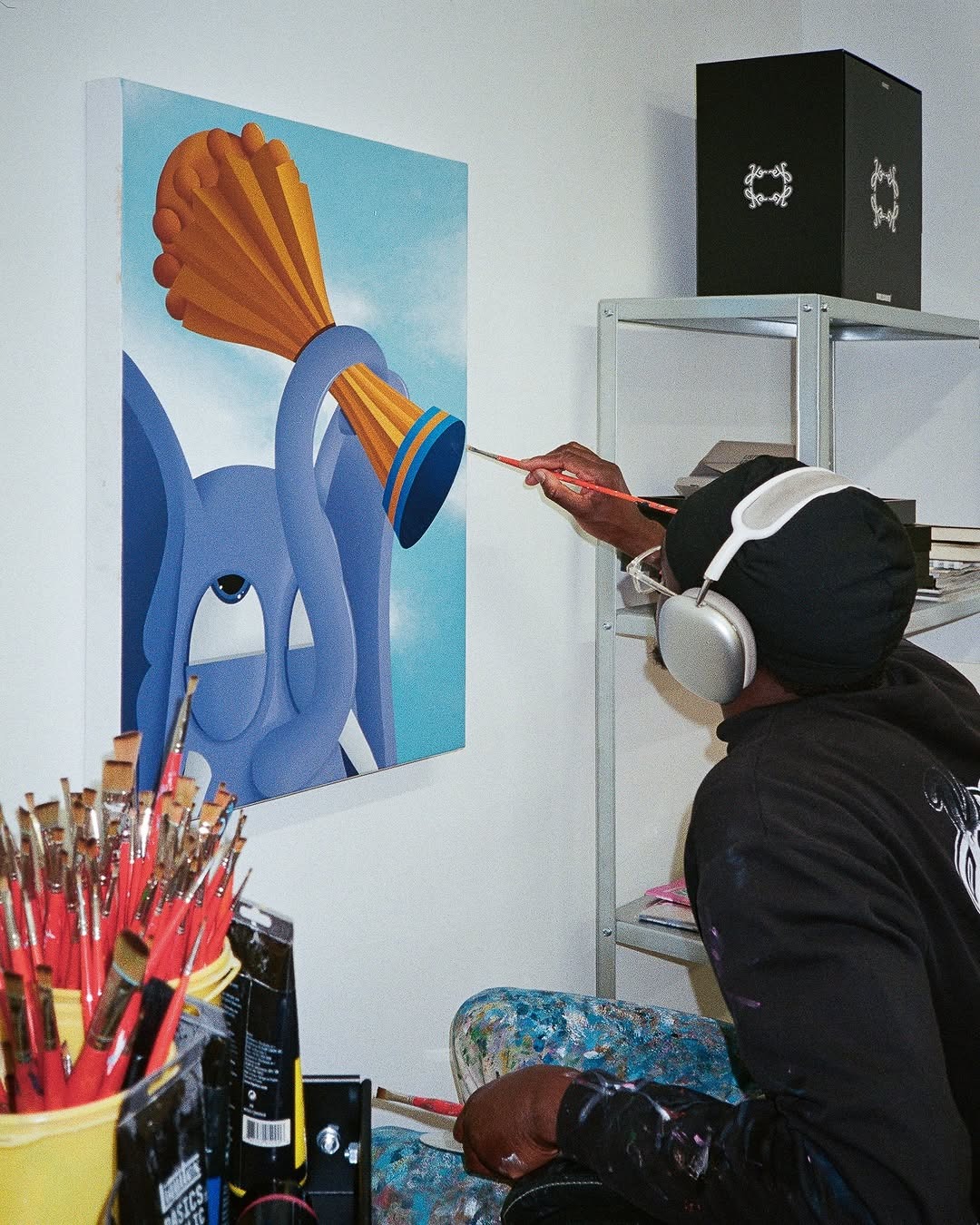
Karl N’da Adopo is a 27-year-old Ivorian-French multidisciplinary artist based in Toulouse, France. Learning to draw before he could even speak, one could almost assume that this creative field was destined for him. However, it did not come without any hardships. Rejected by every art institution he applied to, Karl is entirely self-taught. Coming from an African background, where children are often asked to pursue “guaranteed careers,” such as becoming a doctor or a lawyer, artistry was not something Karl’s relatives may have outright encouraged. It is only in his recent success, including an exposition he had in Paris this June 2026, that his family grew to better understand the dream he was chasing.
Sama, which is the name of Karl’s character, is not just a mere object he draws for pleasure. In his own words, the mainly blue elephant is his alter ego. One could also define it as an escape, so to speak, to make sense of the world around him, and to interpret his social commentaries. The word Sama means elephant in Dioula, a trade language belonging to the Mande family tree rooted in West Africa, mainly spoken in Burkina Faso, Ivory Coast, and Mali. It goes without saying that the elephant is also both the coat of arms and the national animal of the Ivory Coast, Karl’s African heritage. It is supposed to symbolize strength and endurance, a direct tie to the Ivory trade during French colonization between 1893 and 1960, and when the country got its name.
In the span of just a couple of years, Karl has presented his work in art galleries, school campuses and even at the well-respected Le Musée imaginaire d’Oli, both in his hometown of Toulouse and in the capital city of Paris. Through the use of vibrant colours and strong imagery, first drawn in crayons and collages, before pivoting to painting, Karl sought to display different humours. Not restricted to, but fairly common, the red elephant often pictures an individual in anger, while the blue elephant creates an air of substance. Moreover, the green elephant could embody an individual’s wittiness and pride. Otherwise, the pink elephant could come across as a sucker for love, an individual in its most vulnerable state.
Perhaps one of his most striking paintings is Sama and the Eiffel Tower as his own shadow. In this particular instance, Sama looks back at the iconic Parisian monument almost unamused, slightly saddened, but visibly unable to disengage from its tower. The painting is simple yet holds so much depth. Sama’s shadow could be understood as the inescapable past and shortcomings, possibly symbolizing the dreams that were never realised, such as studying art at one of Paris’ prestigious schools. Although Karl has explained multiple times that Sama could represent anyone, maybe on this occasion Sama was drawn on a personal level, commenting on individuals the city has turned its back on.
It is no secret that although France has a long history of colonization and migration, the Caribbean & African communities are still heavily discriminated against. From racial profiling, employment & housing biases, and lack of representation, systemic racism is very much prevalent and can not be tracked and collected through data due to Article 1 of the Constitution of the French Republic that declares, “France shall be an indivisible, secular, democratic and social Republic. It shall ensure the equality of all citizens before the law, without distinction of origin, race or religion.” In other words, in principle, everyone is recognized as an individual citizen. In practise, acts of racial inequality persist and may be lawfully ignored.
Furthermore, in an industry where black artists are neglected for following through abstract art, for example, however, are seemingly rewarded for black portraits, excuse my French, it takes some balls to make one's muse a darn elephant. It is not that contemporary artists, aside from painting black subjects, do not exist; there is an evident market trend and institutional demand that favour black portraiture. Between 2008 and the mid-2020s, art by Black americans artists, for example, represented only 2% of auction spend. Not to mention that only one artist dominates, leaving very little space for Black artists in every medium and genre to sustain themselves. To this day, the most expensive painting by a Black artist is the untitled 1982, a black skull on a turquoise blue background, by the late Haitian-American artist Jean-Michel Basquiat. Thus, it makes it extremely difficult for Black artists, especially without an academic background, to prevail with their distinct creative expression.
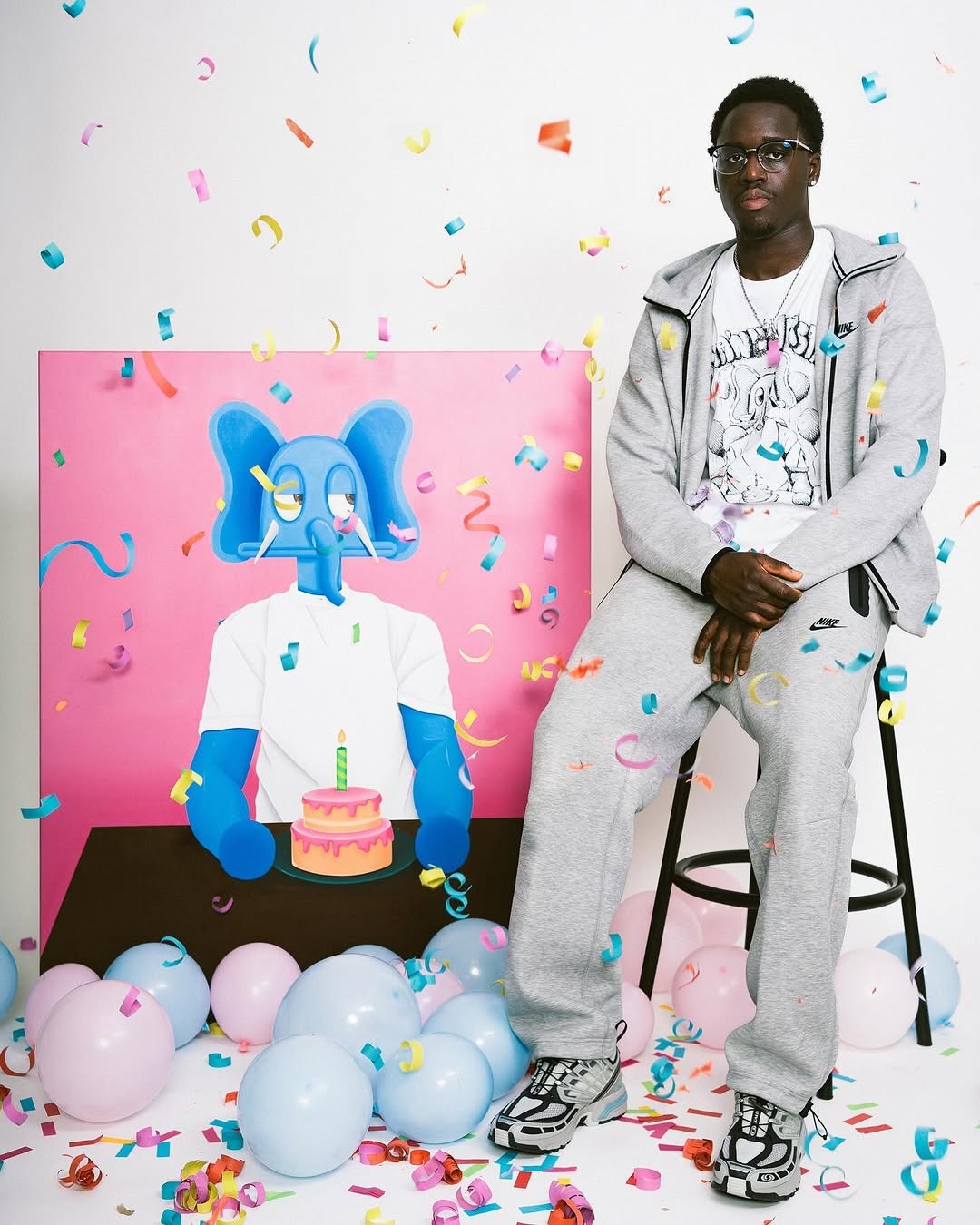
While examining Karl’s story and his own path toward success, it is clear that he had to make use of great endurance to reach the level of recognition he has earned today. In a world under the dominance of Western ideologies, where race can determine one's access to visibility, and cultural backgrounds depict the value of one's pursuit, it is of utmost importance not only to highlight moments where an artist can win against all odds but also to celebrate their victory lap. Karl N’da Adopo may not be a world-renowned icon like KAWS, not yet, but his cartoon-like artistry and rapid career growth are a phenomenon to watch develop closely in the coming years.
Cover image (Credit: Achille Grnd)


.png)

