.svg)


For nearly two decades, Flavour has served as one of the most enduring custodians of African musical heritage—an artist whose work expands the vocabulary of contemporary sound while remaining anchored in indigenous identity. Afroculture, his eighth studio album, is a carefully curated archive of sonic memory, cultural continuity, and artistic ambition. Across 13 tracks and seven diverse collaborators, Flavour constructs an expansive, cross-continental conversation on what African music has been and what it still dares to become.
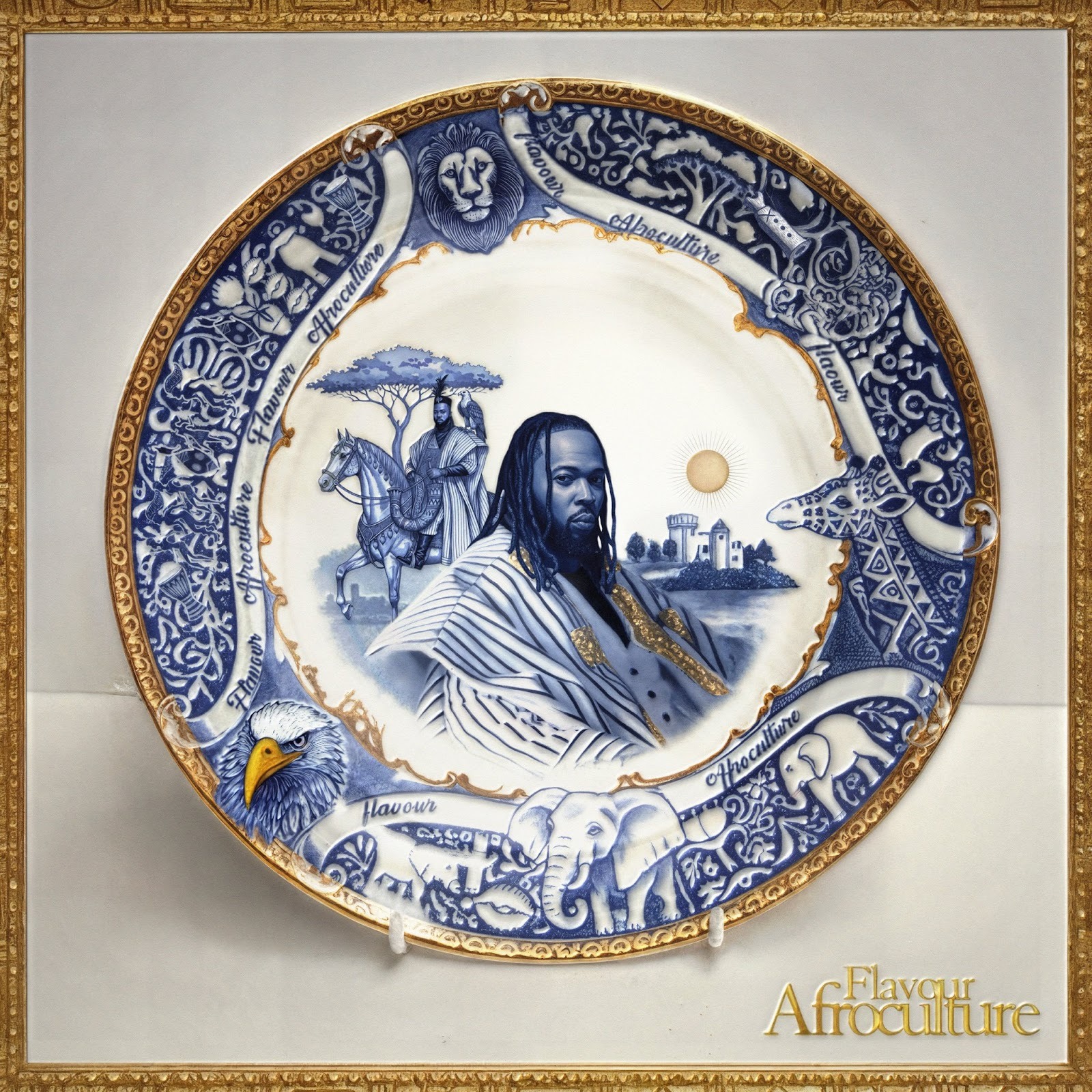
The project opens with an elemental force. The Baaba Maal-assisted title track, “Afroculture,” immerses the listener in a torrent of ancestral energy—Senegalese chants, rapid-fire drums, Oja flutes, triumphant brass, and a choral backdrop that feels like the swell of an ancient ceremony. Flavour blend into this world and becomes its vessel, shaping an immersive overture that announces the album’s cultural thesis with absolute clarity.
“Bambam” slows the pulse without diminishing intensity. Pheelz’s presence enriches the track’s emotional fabric—his harmonies and verse dovetailing seamlessly with Flavour’s impassioned delivery. The percussion remains the axis: bouncy, warm, unmistakably Afrobeats. Then arrives “The Eagle Has Landed,” a jubilant return to highlife’s electric guitar and piano-rooted nucleus. Here, Flavour performs with the swagger of a genre’s reigning custodian, reveling in his authority with a heroic sheen.
The momentum carries into “I’m On Fire,” where highlife’s cadence meets the pulse of Amapiano. Heavy kicks, shakers, and dance-infused progressions give Flavour room to glide with renewed vigor—an apt metaphor for an artist continually proving his vitality. “Pansa Pansa” with Kizz Daniel offers an inspired intersection of highlife and contemporary Afropop, illustrating how tradition can evolve without shedding its essence. Both artists create a spirited, unbothered groove that reinforces highlife’s potential to thrive within the modern Afrobeats structure. “Ada Bekee,” featuring Waga G, is one of the album’s strongest experiments as it serves as an exuberant fusion of Congolese Soukous and Igbo highlife. The brisk guitar work and kinetic percussion become a symbol of pan-African musical cross-pollination executed with remarkable fluidity.
The album’s emotional center emerges with “Orente,” where Qing Madi’s velvet-soft presence transforms an R&B reimagining of Nelly and Kelly Rowland’s “Dilemma” into a tender exchange of vocal chemistry. It serves as a deliberate breather and a soulful descent from the project’s high-tempo peaks, mirrored again in the spiritually textured “Big Masquerade (Okukuse),” a drum-laden, gospel-tinged meditation that highlights Flavour’s gift for sonic atmosphere. Then comes the wildcard: “War Ready” featuring Odumeje. The track is an electrifying mosaic of hip-hop bounce and blaring trumpets, punctuated by Pentecostal chants and unapologetic bravado. It is divisive by design, an artistic gamble that underscores Flavour’s refusal to create within safe margins. “Isabella” welcomes Brazilian hip-hop act Azzy for a bright, fast-paced, cross-continental love declaration. The synergy between both artists is refreshing, offering a glimpse into the expanding global grammar of African-rooted music.
“Jidenna” reinstates the gospel fervor, merging choir arrangements with Amapiano undertones. Flavour crafts a motivational anthem, rounded out by a radiant trumpet outro that elevates an already inspiring performance. “Big Moves Only” returns to the ritualistic depth of his heritage—Oja, traditional drums, Igbo rhythms, and Ijele resonance coalesce into one of the album’s densest cultural statements. Here, Flavour technically says, No dilution. No compromise. The final cadence, “Ife Di Mma,” is highlife in full bloom—percussive, dance-forward, deeply communal. It closes the project with the warmth of a homecoming.

In its entirety, Afroculture is a triumph of cultural stewardship. It reaffirms Flavour’s authority as a performer and also as a guardian of indigenous sound, one who understands the necessity of evolution yet refuses to abandon the spiritual and cultural DNA that defines highlife. The album’s seamless interweaving of Afropop, Soukous, R&B, Gospel, Amapiano, and traditional Igbo textures demonstrates that the future of African music is strongest when its past is not erased but expanded. In an era where commercial pressures often nudge artists toward homogenized global sounds, Afroculture stands as a counter-narrative—proof that evolution does not require dilution. It shows how indigenous genres, often sidelined in the contemporary mainstream, can sit at the centre of modern expression without feeling antiquated or ornamental. Flavour doesn’t sample culture for aesthetics—he embodies it, curates it, and actively carries it forward.


.png)

