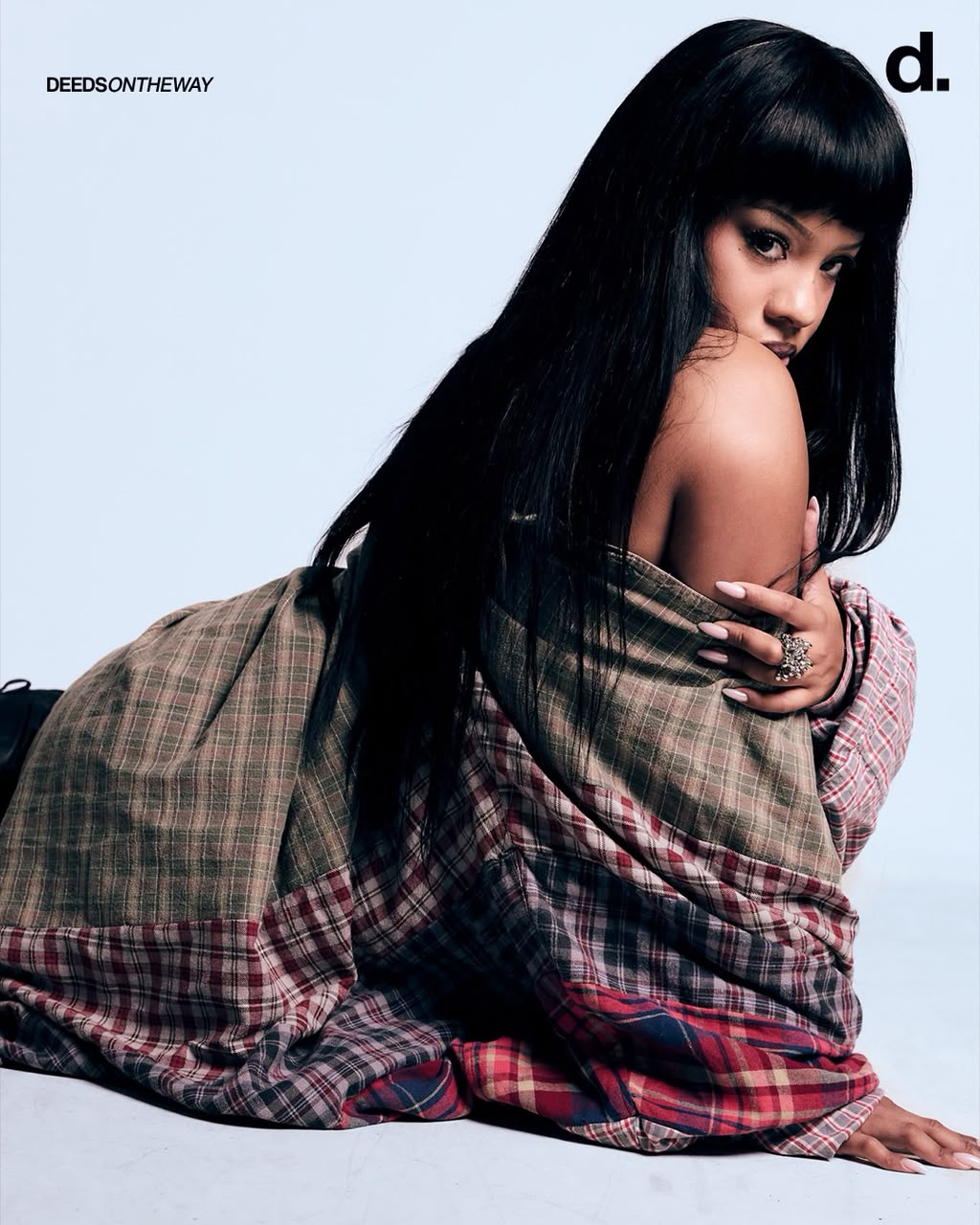
Blossom Oyeyipo on her solo Exhibition “Hypnagogia” with Wunika Mukan Gallery – Interview.

Authored by

There are moments we rarely pay attention to, the seconds just before sleep, when thoughts loosen their grip, and the mind just wanders without direction. It is in these quiet spaces without boundaries that memories and imaginations start to overlap. They are referred to as hallucinations and can appear in the form of sight,  sounds, or even feelings of movement. 

This moment is sometimes diagnosed as a medical condition. But Blossom Oyeyipo builds her work from this space, bringing viewers into an introspective state. Inviting them to ask the questions that matter and also exploring their depths, which is the gateway to becoming. At the opening of “Hypnagogia,” her solo exhibition at Wunika Mukan Gallery on April 4, 2026, Oyeyipo invites viewers into a meditative state through her paintings, drawing them into her reality. “Art is an awakening,” literary scholar Domnica Radulescu once said in an interview with Works (of Fiction) in Progress (WIP). And what Oyeyipo is doing with her body of work is the real awakening.

Blossom Oyeyipo, born in 1998 in Lagos, Nigeria, is a Lagos-based visual artist. Her work explores the liminal space between wakefulness and dreams, where intuition, memory, and the subconscious begin to surface. Through her paintings, she navigates the journey of becoming, shaped by the inner world and shifting landscapes.  Her practice also engages deeply with culture, weaving elements of identity, heritage, and lived experience into her visual language. She has participated in several group exhibitions, including “The Noire Art Exhibition” (2020), Art at Ouidah (2022), Kleinformate (2025), and the Irudika Illustration Festival (2023), among others, both in Nigeria and the diaspora.
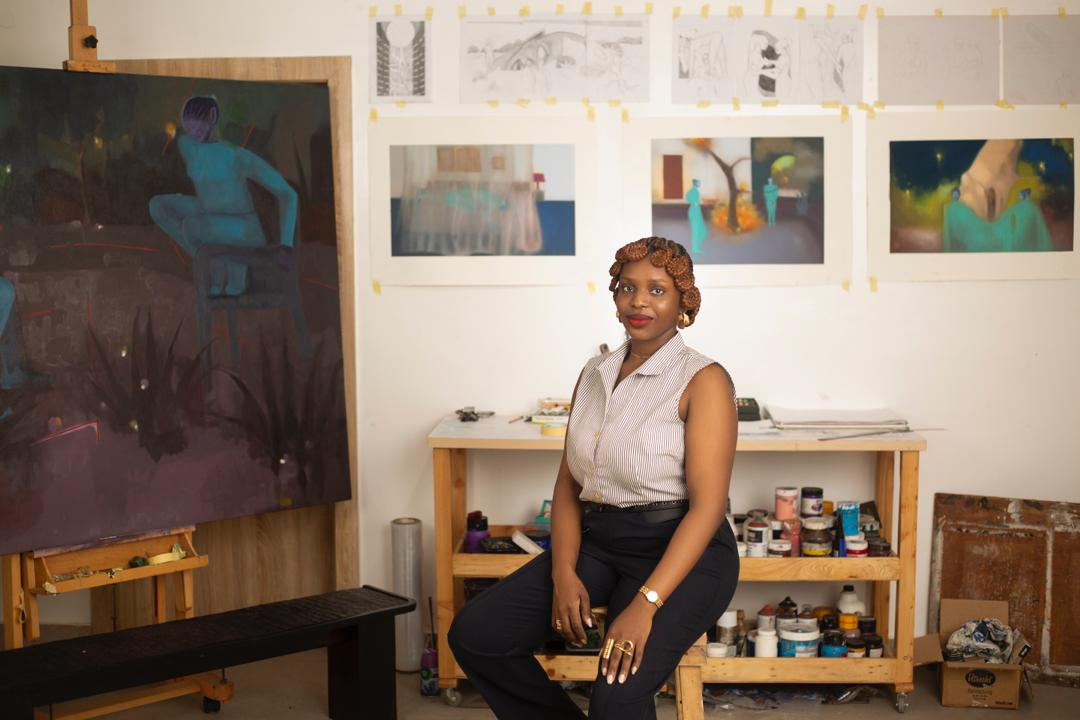
Image: Blossom Oyeyipo - Wunika Mukan Gallery

Oyeyipo’s mind is a space to wander—an invitation to witness the beauty of her process through her lens. Her exhibition with the Wunika Mukan Gallery is her first solo show. The exhibition space itself mirrors this quiet introspection. Soft tones, layered textures, and recurring figures create an atmosphere that feels both intimate and deep. Each piece makes viewers take a pause, inviting them to linger, reflect, and confront their inner world.

Stepping into Wunika Mukan Gallery, one cannot help but see it beyond being an exhibition. It’s an immersive experience that captures the viewer's attention before it is even fully understood. For many viewers, the impact is immediate. Alabi Boluwatife, an art enthusiast who attended the exhibition, said, “It was a new experience and so encouraging. It’s my first time seeing such a body of work, and those pieces are gorgeous”. 
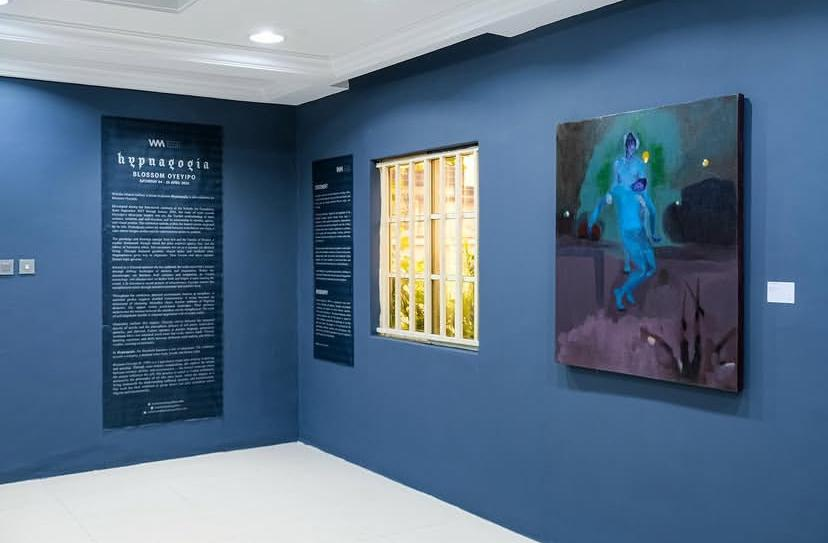
Image: Hypnagogia - Wunika Mukan Gallery

It is this first emotional drag, followed by a subtle unfolding of meaning, that defines Hypnagogia. From the blend of colors and the strokes, the works have a dreamy atmosphere. The figures also appear in pairs and suspended as though in a quiet conversation, blurring the boundary between the physical and non-physical. There is a sense of movement, yet stillness. This liminal quality is central to Oyeyipo’s practice. Drawing from Yoruba philosophy, particularly the concept of Ori as an inner guide, the works become the link between self and spirit, memory and becoming. In our interview with her, here is what she has to say.

Can you tell us about your background and what influenced your style of art and the themes you work with?

I wrote a narrative. It follows a protagonist named Irin through a conversation with her Ori, her inner head, that takes place entirely within her subconscious. That story is the spine of everything in this exhibition. My work is rooted in Yoruba philosophy and how it intersects with dream logic and magical realism, specifically this idea of a living, dynamic relationship between the corporeal self and the incorporeal self. I'm drawn to what I think of as mythical consciousness: the belief that this relationship can be made visible, that you can walk someone through it. My practice leans toward the surreal because myth doesn't operate by the rules of waking reality. It operates by feeling, by symbol, by the logic of dreams. Literarily, I was looking at Ben Okri's The Famished Road for the way the seen and unseen leak into each other, Amos Tutuola's The Palm-Wine Drinkard for his non-linear dream logic and the sheer originality of his interior world, and Alice in Wonderland as perhaps the oldest blueprint for the subconscious journey and the necessary return from it. These weren't references so much as permissions.

You spent four months in residency with Nchedo Art Residency before your first solo exhibition with Wunika Mukan Gallery. What was the most intriguing thing you discovered about yourself while working on this body of work?

Nchedo was a defining moment in my practice. What it gave me most was real, substantive conversation, about how to shape my visual language and draw clear lines through the layered thought processes that go into world-building and myth-making. My mentors were incredibly generous with suggestions and critiques at every stage, and I was encouraged to do deep research that fed directly into the work. Nchedo was founded by the artist Chidinma Nnoli and opened its doors in August 2025. I was the first resident, working through to January 2026, and I was surrounded by visiting artists genuinely invested in what I was building. The residency is dedicated to radical care for the artist, and I felt that in everything. What I discovered most intriguingly about myself was how much my environment dictates the pace of my internal world. Nchedo gave the work room to breathe, and in doing so, gave me room to fully inhabit it.
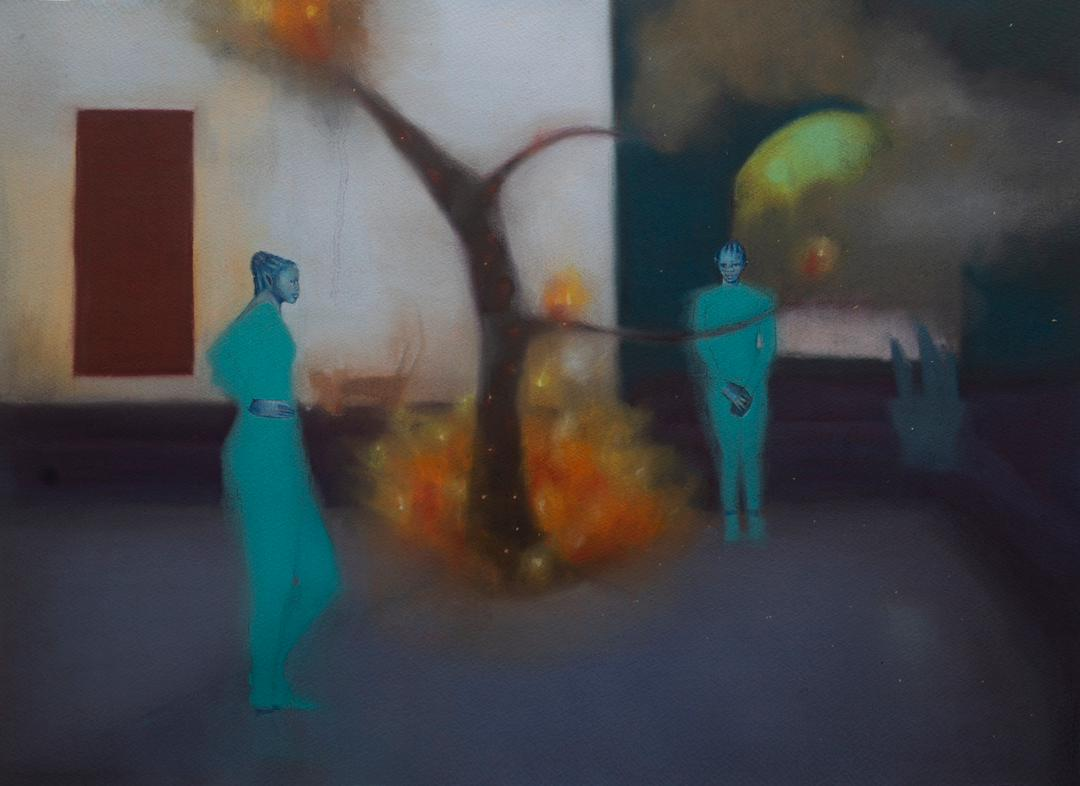
Image: Burning Bush in the Courtyard: A Vision of the Dreamer (2025) – Blossom Oyeyipo

You use the idea of "Ori" as a guide in your art. How does this spiritual belief actually show up in your work, in the colors you pick, the way you layer your paint, the textures you choose?

I think of my core practice as drawing, because that is where the work's essential quality lives. My pastel works are fully realized in their own right, rich with a dusty, dreamy quality that sits somewhere between atmosphere and memory, and that sensibility is what informs everything else, including the paintings. Ori manifests in the work in several ways simultaneously. As a character, a mirror being, the incorporeal self made present. As a place, the liminal space that exists between the material and the non-material is the territory the entire body of work inhabits. And as a material logic. The choice of pastels is deliberate; the medium itself is porous, dusty, never fully fixed, which mirrors the threshold state I am trying to evoke. The process of constant layering enacts the same idea: each layer is a conversation, something added, something partially obscured, meaning accumulated through repetition. Even the semi-abstracted forms in the painting backgrounds operate this way, reminding us that we are not quite in waking reality.

You often paint figures that look like reflections of each other. What is the thought process behind that?

The figures are in constant conversation, sharing space, sometimes holding one another, other times simply watching. There is often a grieving quality to the compositions, a tenderness that coexists with the weight of transition. In Held(2025), the painting directly references the Pietà: the corporeal self, Irin, is caught by her Ori in the aftermath of a fall. It isn't a literal reflection so much as a relationship, two versions of a self in negotiation, neither fully resolved, both necessary. The narrative gave these figures their emotional logic. They are not symbols of duality in the abstract; they are characters with a shared history, moving through a subconscious landscape together. The space between them is where the work really lives.

How do you feel this body of work speaks to young persons navigating their own "liminal" identities today?

We are living in an age of constant, frantic transition, where technology and the relentless speed of the world are in a permanent battle for our attention. This has led to what Joseph Campbell described as a crisis: the erosion of threshold points. Historically, indigenous cultures acknowledged life's great transitions through milestone rites, the passage from girlhood to womanhood, for instance, that signaled a necessary pause before entering a new stage of life. Today, those thresholds are being actively eroded, leaving many in a state of perpetual, ungrounded motion. My work serves as a reminder to sit with the discomfort of the in-between, to appreciate a multi-layered existence that doesn't require immediate resolution. I hope it validates the liminal state as a vital, creative space to be inhabited and not merely a corridor to rush through on the way to somewhere else.
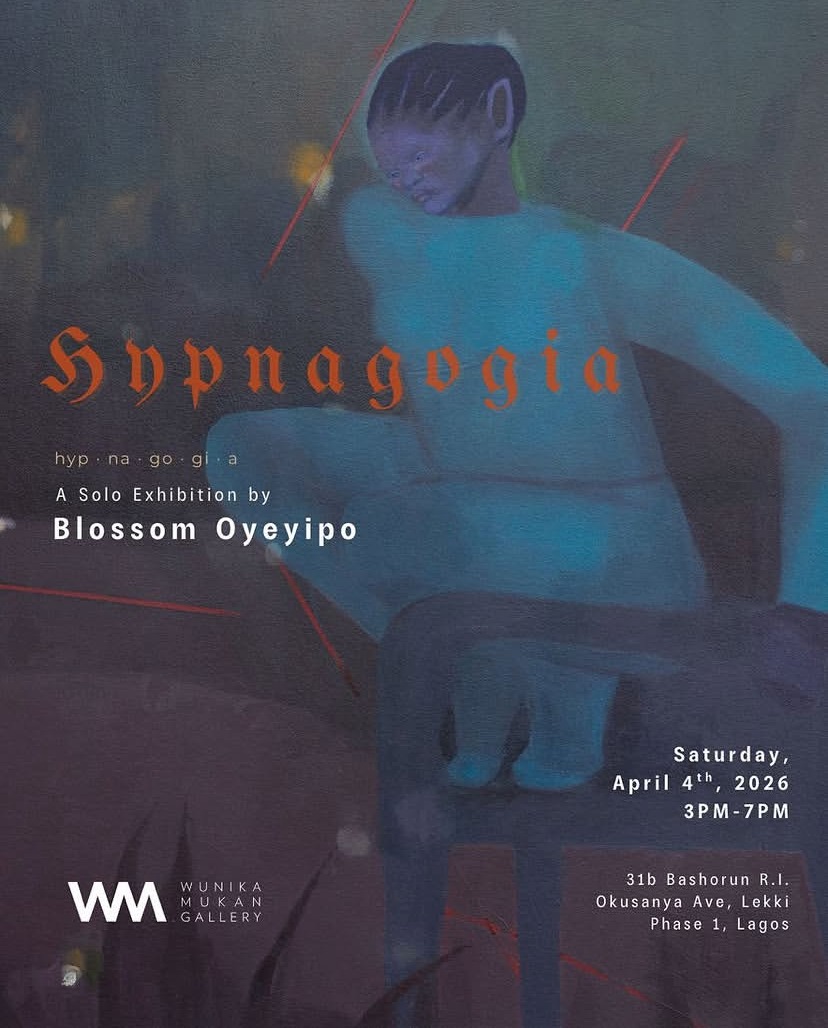
Image: Wunika Mukan Gallery

Your first solo exhibition— “Hypnagogia”—with Wunika Mukan Gallery explores the state between wakefulness and sleep. What specifically about this "in-between" state fascinates you?

For me,the hypnagogic state is less an abstraction than a feeling, one that can be triggered by very specific things: sheer fabric, corridors, verandas, spaces that signal temporary occupancy within a larger whole. I am drawn to places that don't fully belong to any one moment. The hypnagogic state is the same: it is where the logic of the waking world dissolves, and the surrealism of sleep takes over, where biomorphic forms surface and deep atmospheric tones feel most at home. It doesn't require permission from reality. My palette of dark blues, greens and occasional reds exists to put you there, in that specific quality of light that feels familiar and untraceable at once.

If someone leaves your exhibition with only one feeling or one thought, what do you want that to be?

Dream work, in its oldest sense, is not passive. You enter, you wrestle, and you return changed. I want the viewer to feel that. To walk out not just moved but subtly different, asking questions of themselves they weren't asking before. I want them to feel as though they have just stepped out of a dream they weren't quite ready to leave, held in quiet immersion but sitting with a slight discomfort. That discomfort is an invitation. If they leave, turning their gaze inward, toward their own inner world and whatever messages may be waiting there, then I have succeeded in sharing my world with them.

@adedoyinadeoye
Image: Wunika Mukan Gallery.
Blossom Oyeyipo on her solo Exhibition “Hypnagogia” with Wunika Mukan Gallery – Interview.

Authored by
This is some text inside of a div block.

There are moments we rarely pay attention to, the seconds just before sleep, when thoughts loosen their grip, and the mind just wanders without direction. It is in these quiet spaces without boundaries that memories and imaginations start to overlap. They are referred to as hallucinations and can appear in the form of sight,  sounds, or even feelings of movement. 

This moment is sometimes diagnosed as a medical condition. But Blossom Oyeyipo builds her work from this space, bringing viewers into an introspective state. Inviting them to ask the questions that matter and also exploring their depths, which is the gateway to becoming. At the opening of “Hypnagogia,” her solo exhibition at Wunika Mukan Gallery on April 4, 2026, Oyeyipo invites viewers into a meditative state through her paintings, drawing them into her reality. “Art is an awakening,” literary scholar Domnica Radulescu once said in an interview with Works (of Fiction) in Progress (WIP). And what Oyeyipo is doing with her body of work is the real awakening.

Blossom Oyeyipo, born in 1998 in Lagos, Nigeria, is a Lagos-based visual artist. Her work explores the liminal space between wakefulness and dreams, where intuition, memory, and the subconscious begin to surface. Through her paintings, she navigates the journey of becoming, shaped by the inner world and shifting landscapes.  Her practice also engages deeply with culture, weaving elements of identity, heritage, and lived experience into her visual language. She has participated in several group exhibitions, including “The Noire Art Exhibition” (2020), Art at Ouidah (2022), Kleinformate (2025), and the Irudika Illustration Festival (2023), among others, both in Nigeria and the diaspora.

Image: Blossom Oyeyipo - Wunika Mukan Gallery

Oyeyipo’s mind is a space to wander—an invitation to witness the beauty of her process through her lens. Her exhibition with the Wunika Mukan Gallery is her first solo show. The exhibition space itself mirrors this quiet introspection. Soft tones, layered textures, and recurring figures create an atmosphere that feels both intimate and deep. Each piece makes viewers take a pause, inviting them to linger, reflect, and confront their inner world.

Stepping into Wunika Mukan Gallery, one cannot help but see it beyond being an exhibition. It’s an immersive experience that captures the viewer's attention before it is even fully understood. For many viewers, the impact is immediate. Alabi Boluwatife, an art enthusiast who attended the exhibition, said, “It was a new experience and so encouraging. It’s my first time seeing such a body of work, and those pieces are gorgeous”. 

Image: Hypnagogia - Wunika Mukan Gallery

It is this first emotional drag, followed by a subtle unfolding of meaning, that defines Hypnagogia. From the blend of colors and the strokes, the works have a dreamy atmosphere. The figures also appear in pairs and suspended as though in a quiet conversation, blurring the boundary between the physical and non-physical. There is a sense of movement, yet stillness. This liminal quality is central to Oyeyipo’s practice. Drawing from Yoruba philosophy, particularly the concept of Ori as an inner guide, the works become the link between self and spirit, memory and becoming. In our interview with her, here is what she has to say.

Can you tell us about your background and what influenced your style of art and the themes you work with?

I wrote a narrative. It follows a protagonist named Irin through a conversation with her Ori, her inner head, that takes place entirely within her subconscious. That story is the spine of everything in this exhibition. My work is rooted in Yoruba philosophy and how it intersects with dream logic and magical realism, specifically this idea of a living, dynamic relationship between the corporeal self and the incorporeal self. I'm drawn to what I think of as mythical consciousness: the belief that this relationship can be made visible, that you can walk someone through it. My practice leans toward the surreal because myth doesn't operate by the rules of waking reality. It operates by feeling, by symbol, by the logic of dreams. Literarily, I was looking at Ben Okri's The Famished Road for the way the seen and unseen leak into each other, Amos Tutuola's The Palm-Wine Drinkard for his non-linear dream logic and the sheer originality of his interior world, and Alice in Wonderland as perhaps the oldest blueprint for the subconscious journey and the necessary return from it. These weren't references so much as permissions.

You spent four months in residency with Nchedo Art Residency before your first solo exhibition with Wunika Mukan Gallery. What was the most intriguing thing you discovered about yourself while working on this body of work?

Nchedo was a defining moment in my practice. What it gave me most was real, substantive conversation, about how to shape my visual language and draw clear lines through the layered thought processes that go into world-building and myth-making. My mentors were incredibly generous with suggestions and critiques at every stage, and I was encouraged to do deep research that fed directly into the work. Nchedo was founded by the artist Chidinma Nnoli and opened its doors in August 2025. I was the first resident, working through to January 2026, and I was surrounded by visiting artists genuinely invested in what I was building. The residency is dedicated to radical care for the artist, and I felt that in everything. What I discovered most intriguingly about myself was how much my environment dictates the pace of my internal world. Nchedo gave the work room to breathe, and in doing so, gave me room to fully inhabit it.

Image: Burning Bush in the Courtyard: A Vision of the Dreamer (2025) – Blossom Oyeyipo

You use the idea of "Ori" as a guide in your art. How does this spiritual belief actually show up in your work, in the colors you pick, the way you layer your paint, the textures you choose?

I think of my core practice as drawing, because that is where the work's essential quality lives. My pastel works are fully realized in their own right, rich with a dusty, dreamy quality that sits somewhere between atmosphere and memory, and that sensibility is what informs everything else, including the paintings. Ori manifests in the work in several ways simultaneously. As a character, a mirror being, the incorporeal self made present. As a place, the liminal space that exists between the material and the non-material is the territory the entire body of work inhabits. And as a material logic. The choice of pastels is deliberate; the medium itself is porous, dusty, never fully fixed, which mirrors the threshold state I am trying to evoke. The process of constant layering enacts the same idea: each layer is a conversation, something added, something partially obscured, meaning accumulated through repetition. Even the semi-abstracted forms in the painting backgrounds operate this way, reminding us that we are not quite in waking reality.

You often paint figures that look like reflections of each other. What is the thought process behind that?

The figures are in constant conversation, sharing space, sometimes holding one another, other times simply watching. There is often a grieving quality to the compositions, a tenderness that coexists with the weight of transition. In Held(2025), the painting directly references the Pietà: the corporeal self, Irin, is caught by her Ori in the aftermath of a fall. It isn't a literal reflection so much as a relationship, two versions of a self in negotiation, neither fully resolved, both necessary. The narrative gave these figures their emotional logic. They are not symbols of duality in the abstract; they are characters with a shared history, moving through a subconscious landscape together. The space between them is where the work really lives.

How do you feel this body of work speaks to young persons navigating their own "liminal" identities today?

We are living in an age of constant, frantic transition, where technology and the relentless speed of the world are in a permanent battle for our attention. This has led to what Joseph Campbell described as a crisis: the erosion of threshold points. Historically, indigenous cultures acknowledged life's great transitions through milestone rites, the passage from girlhood to womanhood, for instance, that signaled a necessary pause before entering a new stage of life. Today, those thresholds are being actively eroded, leaving many in a state of perpetual, ungrounded motion. My work serves as a reminder to sit with the discomfort of the in-between, to appreciate a multi-layered existence that doesn't require immediate resolution. I hope it validates the liminal state as a vital, creative space to be inhabited and not merely a corridor to rush through on the way to somewhere else.

Image: Wunika Mukan Gallery

Your first solo exhibition— “Hypnagogia”—with Wunika Mukan Gallery explores the state between wakefulness and sleep. What specifically about this "in-between" state fascinates you?

For me,the hypnagogic state is less an abstraction than a feeling, one that can be triggered by very specific things: sheer fabric, corridors, verandas, spaces that signal temporary occupancy within a larger whole. I am drawn to places that don't fully belong to any one moment. The hypnagogic state is the same: it is where the logic of the waking world dissolves, and the surrealism of sleep takes over, where biomorphic forms surface and deep atmospheric tones feel most at home. It doesn't require permission from reality. My palette of dark blues, greens and occasional reds exists to put you there, in that specific quality of light that feels familiar and untraceable at once.

If someone leaves your exhibition with only one feeling or one thought, what do you want that to be?

Dream work, in its oldest sense, is not passive. You enter, you wrestle, and you return changed. I want the viewer to feel that. To walk out not just moved but subtly different, asking questions of themselves they weren't asking before. I want them to feel as though they have just stepped out of a dream they weren't quite ready to leave, held in quiet immersion but sitting with a slight discomfort. That discomfort is an invitation. If they leave, turning their gaze inward, toward their own inner world and whatever messages may be waiting there, then I have succeeded in sharing my world with them.

@adedoyinadeoye
Image: Wunika Mukan Gallery.

This is some text inside of a div block.

Blossom Oyeyipo on her solo Exhibition “Hypnagogia” with Wunika Mukan Gallery – Interview.

Authored by

There are moments we rarely pay attention to, the seconds just before sleep, when thoughts loosen their grip, and the mind just wanders without direction. It is in these quiet spaces without boundaries that memories and imaginations start to overlap. They are referred to as hallucinations and can appear in the form of sight,  sounds, or even feelings of movement. 

This moment is sometimes diagnosed as a medical condition. But Blossom Oyeyipo builds her work from this space, bringing viewers into an introspective state. Inviting them to ask the questions that matter and also exploring their depths, which is the gateway to becoming. At the opening of “Hypnagogia,” her solo exhibition at Wunika Mukan Gallery on April 4, 2026, Oyeyipo invites viewers into a meditative state through her paintings, drawing them into her reality. “Art is an awakening,” literary scholar Domnica Radulescu once said in an interview with Works (of Fiction) in Progress (WIP). And what Oyeyipo is doing with her body of work is the real awakening.

Blossom Oyeyipo, born in 1998 in Lagos, Nigeria, is a Lagos-based visual artist. Her work explores the liminal space between wakefulness and dreams, where intuition, memory, and the subconscious begin to surface. Through her paintings, she navigates the journey of becoming, shaped by the inner world and shifting landscapes.  Her practice also engages deeply with culture, weaving elements of identity, heritage, and lived experience into her visual language. She has participated in several group exhibitions, including “The Noire Art Exhibition” (2020), Art at Ouidah (2022), Kleinformate (2025), and the Irudika Illustration Festival (2023), among others, both in Nigeria and the diaspora.

Image: Blossom Oyeyipo - Wunika Mukan Gallery

Oyeyipo’s mind is a space to wander—an invitation to witness the beauty of her process through her lens. Her exhibition with the Wunika Mukan Gallery is her first solo show. The exhibition space itself mirrors this quiet introspection. Soft tones, layered textures, and recurring figures create an atmosphere that feels both intimate and deep. Each piece makes viewers take a pause, inviting them to linger, reflect, and confront their inner world.

Stepping into Wunika Mukan Gallery, one cannot help but see it beyond being an exhibition. It’s an immersive experience that captures the viewer's attention before it is even fully understood. For many viewers, the impact is immediate. Alabi Boluwatife, an art enthusiast who attended the exhibition, said, “It was a new experience and so encouraging. It’s my first time seeing such a body of work, and those pieces are gorgeous”. 

Image: Hypnagogia - Wunika Mukan Gallery

It is this first emotional drag, followed by a subtle unfolding of meaning, that defines Hypnagogia. From the blend of colors and the strokes, the works have a dreamy atmosphere. The figures also appear in pairs and suspended as though in a quiet conversation, blurring the boundary between the physical and non-physical. There is a sense of movement, yet stillness. This liminal quality is central to Oyeyipo’s practice. Drawing from Yoruba philosophy, particularly the concept of Ori as an inner guide, the works become the link between self and spirit, memory and becoming. In our interview with her, here is what she has to say.

Can you tell us about your background and what influenced your style of art and the themes you work with?

I wrote a narrative. It follows a protagonist named Irin through a conversation with her Ori, her inner head, that takes place entirely within her subconscious. That story is the spine of everything in this exhibition. My work is rooted in Yoruba philosophy and how it intersects with dream logic and magical realism, specifically this idea of a living, dynamic relationship between the corporeal self and the incorporeal self. I'm drawn to what I think of as mythical consciousness: the belief that this relationship can be made visible, that you can walk someone through it. My practice leans toward the surreal because myth doesn't operate by the rules of waking reality. It operates by feeling, by symbol, by the logic of dreams. Literarily, I was looking at Ben Okri's The Famished Road for the way the seen and unseen leak into each other, Amos Tutuola's The Palm-Wine Drinkard for his non-linear dream logic and the sheer originality of his interior world, and Alice in Wonderland as perhaps the oldest blueprint for the subconscious journey and the necessary return from it. These weren't references so much as permissions.

You spent four months in residency with Nchedo Art Residency before your first solo exhibition with Wunika Mukan Gallery. What was the most intriguing thing you discovered about yourself while working on this body of work?

Nchedo was a defining moment in my practice. What it gave me most was real, substantive conversation, about how to shape my visual language and draw clear lines through the layered thought processes that go into world-building and myth-making. My mentors were incredibly generous with suggestions and critiques at every stage, and I was encouraged to do deep research that fed directly into the work. Nchedo was founded by the artist Chidinma Nnoli and opened its doors in August 2025. I was the first resident, working through to January 2026, and I was surrounded by visiting artists genuinely invested in what I was building. The residency is dedicated to radical care for the artist, and I felt that in everything. What I discovered most intriguingly about myself was how much my environment dictates the pace of my internal world. Nchedo gave the work room to breathe, and in doing so, gave me room to fully inhabit it.

Image: Burning Bush in the Courtyard: A Vision of the Dreamer (2025) – Blossom Oyeyipo

You use the idea of "Ori" as a guide in your art. How does this spiritual belief actually show up in your work, in the colors you pick, the way you layer your paint, the textures you choose?

I think of my core practice as drawing, because that is where the work's essential quality lives. My pastel works are fully realized in their own right, rich with a dusty, dreamy quality that sits somewhere between atmosphere and memory, and that sensibility is what informs everything else, including the paintings. Ori manifests in the work in several ways simultaneously. As a character, a mirror being, the incorporeal self made present. As a place, the liminal space that exists between the material and the non-material is the territory the entire body of work inhabits. And as a material logic. The choice of pastels is deliberate; the medium itself is porous, dusty, never fully fixed, which mirrors the threshold state I am trying to evoke. The process of constant layering enacts the same idea: each layer is a conversation, something added, something partially obscured, meaning accumulated through repetition. Even the semi-abstracted forms in the painting backgrounds operate this way, reminding us that we are not quite in waking reality.

You often paint figures that look like reflections of each other. What is the thought process behind that?

The figures are in constant conversation, sharing space, sometimes holding one another, other times simply watching. There is often a grieving quality to the compositions, a tenderness that coexists with the weight of transition. In Held(2025), the painting directly references the Pietà: the corporeal self, Irin, is caught by her Ori in the aftermath of a fall. It isn't a literal reflection so much as a relationship, two versions of a self in negotiation, neither fully resolved, both necessary. The narrative gave these figures their emotional logic. They are not symbols of duality in the abstract; they are characters with a shared history, moving through a subconscious landscape together. The space between them is where the work really lives.

How do you feel this body of work speaks to young persons navigating their own "liminal" identities today?

We are living in an age of constant, frantic transition, where technology and the relentless speed of the world are in a permanent battle for our attention. This has led to what Joseph Campbell described as a crisis: the erosion of threshold points. Historically, indigenous cultures acknowledged life's great transitions through milestone rites, the passage from girlhood to womanhood, for instance, that signaled a necessary pause before entering a new stage of life. Today, those thresholds are being actively eroded, leaving many in a state of perpetual, ungrounded motion. My work serves as a reminder to sit with the discomfort of the in-between, to appreciate a multi-layered existence that doesn't require immediate resolution. I hope it validates the liminal state as a vital, creative space to be inhabited and not merely a corridor to rush through on the way to somewhere else.

Image: Wunika Mukan Gallery

Your first solo exhibition— “Hypnagogia”—with Wunika Mukan Gallery explores the state between wakefulness and sleep. What specifically about this "in-between" state fascinates you?

For me,the hypnagogic state is less an abstraction than a feeling, one that can be triggered by very specific things: sheer fabric, corridors, verandas, spaces that signal temporary occupancy within a larger whole. I am drawn to places that don't fully belong to any one moment. The hypnagogic state is the same: it is where the logic of the waking world dissolves, and the surrealism of sleep takes over, where biomorphic forms surface and deep atmospheric tones feel most at home. It doesn't require permission from reality. My palette of dark blues, greens and occasional reds exists to put you there, in that specific quality of light that feels familiar and untraceable at once.

If someone leaves your exhibition with only one feeling or one thought, what do you want that to be?

Dream work, in its oldest sense, is not passive. You enter, you wrestle, and you return changed. I want the viewer to feel that. To walk out not just moved but subtly different, asking questions of themselves they weren't asking before. I want them to feel as though they have just stepped out of a dream they weren't quite ready to leave, held in quiet immersion but sitting with a slight discomfort. That discomfort is an invitation. If they leave, turning their gaze inward, toward their own inner world and whatever messages may be waiting there, then I have succeeded in sharing my world with them.

@adedoyinadeoye
Image: Wunika Mukan Gallery.
Other Stories
London
London
Lagos
London
Newyork
London
Shop
Join the community.
You are now subscribed to receive updates.
Oops! Something went wrong while submitting the form.