Is This Still Couture? Paris SS26 Reignites Fashion’s Oldest Argument

Authored by

Haute Couture Spring/Summer 2026 in Paris seemed to press its ear to the ground. Across the runways, there was a collective turning toward the earth — not necessarily as a literal landscape, but as a source of texture, direction and meaning. Dior, Chanel, and Schiaparelli each arrived at this impulse differently, but together they traced a shared desire to root fantasy in something organic: the floral, the whimsical, the otherworldly. Couture, which is often imagined as untouchable, felt distinctly alive and unearthed.

At Dior, the earth bloomed. Jonathan Anderson’s couture debut framed the natural world as a question of form, volume and internal logic. Drawing from the ceramic work of Kenyan-born British potter Magdalene Odundo, the collection approached couture through sculpture rather than garment-first thinking. Lightness was a technical challenge instead of a visual effect. Rounded silhouettes and projecting forms were developed through extensive prototyping, with the atelier working alongside specialists from architectural disciplines to engineer internal frameworks capable of holding shape without weight. Materials such as piano wire and densely gathered tulle formed unseen architectures beneath the surface.

Then came the flowers. 

Floral elements appeared insistently and everywhere, not as embellishment but as connective thread through the entire collection. They surfaced as earrings, bloomed across dresses, emerged on shoes, and threaded the collection together in full saturation. Embroidery and flower-making operated structurally, binding the looks into a single ecosystem rather than isolated statements. Anderson did not reference nature sparingly; it was cultivated until the collection felt entirely in bloom.

The collection was presented alongside an exhibition at the Musée Rodin that placed Anderson’s designs in dialogue with Dior’s archive and Odundo’s ceramics, and the collection positioned couture as a fine practice of material inquiry.
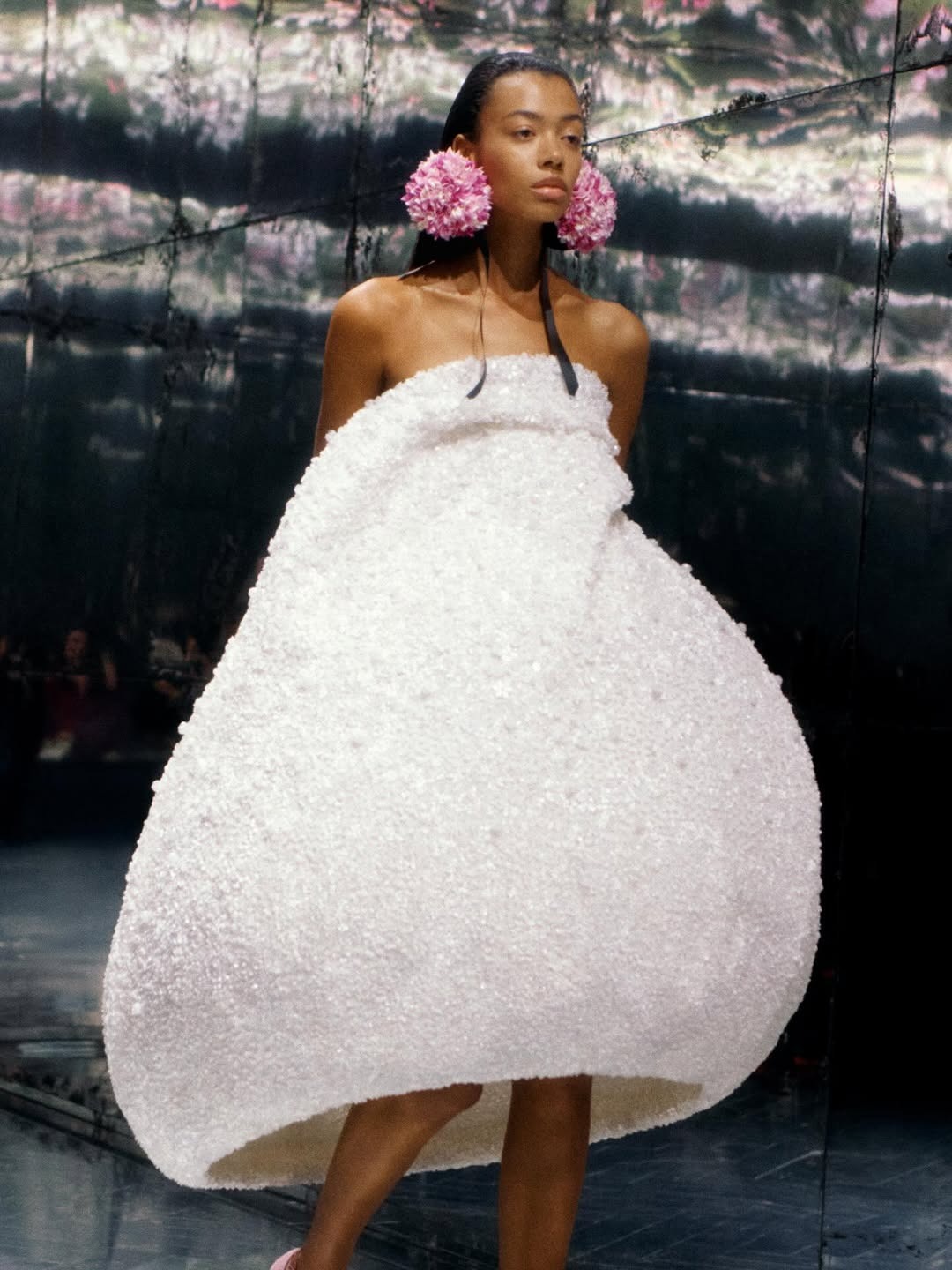
Christian Dior Spring/Summer 2026 Haute Couture

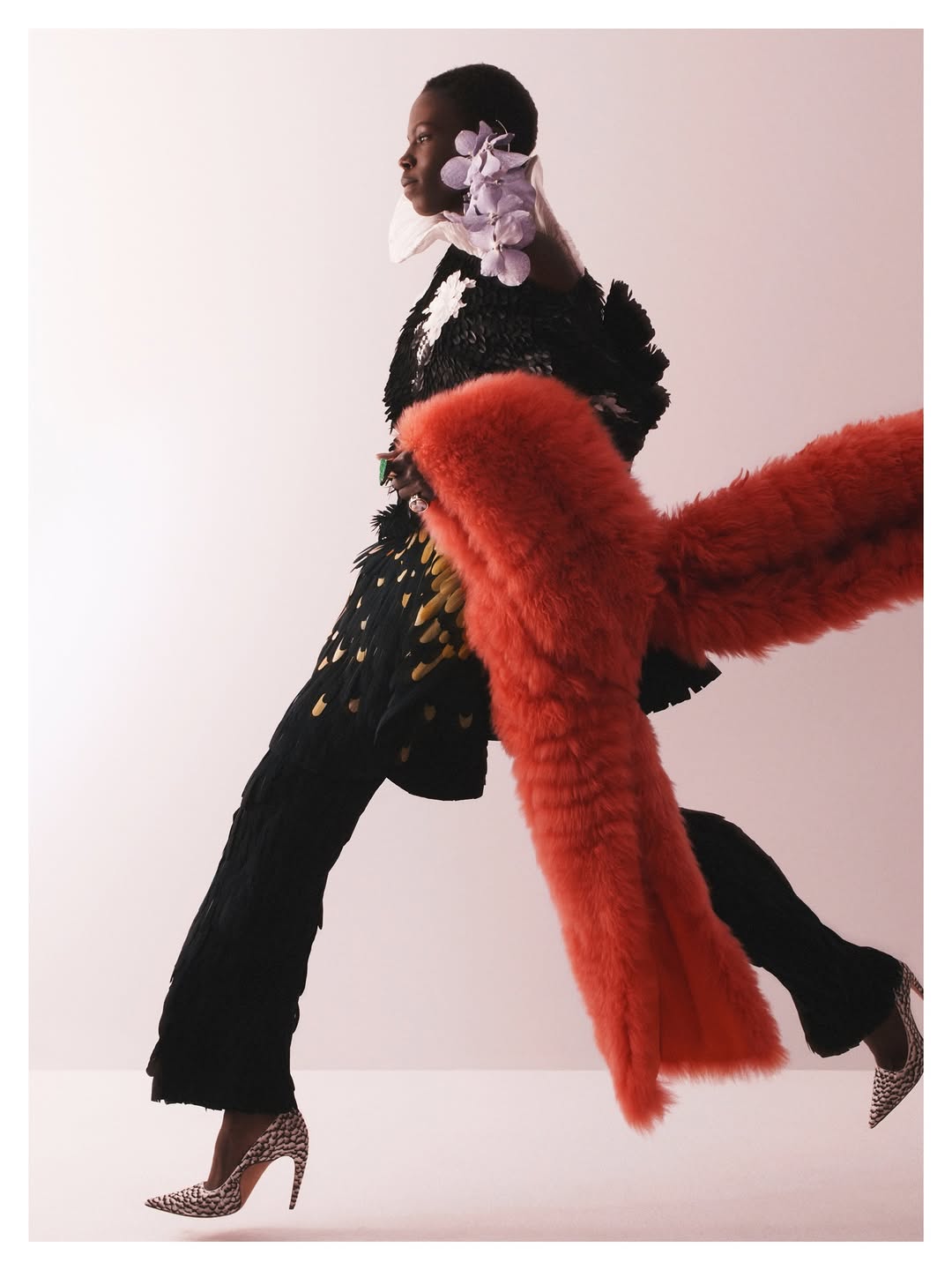
Chanel’s Haute Couture presentation was lighter, more mischievous in comparison to Dior. Under Matthieu Blazy, whimsy operated as a form of logic, guiding how the clothes moved, hovered and dissolved on the body. Feathers suggested motion, proportions gently disrupted expectation, and surfaces carried the impression of air even at rest. Tweeds, which is long central to the house, were subtly dyed to echo owl feathers, while a cocoon dress with rounded brown sleeves and a ring of red at the neckline recalled the markings of a woodpecker. Elsewhere, peacock prints, beetle-like volumes, and their repeated motifs resembling hand-drawn feathers or scales reinforced the collection’s natural references.

This lightness was carefully constructed. Feather effects were achieved through cut-thread embroidery and layered applications instead of leaning into literal volume. Painted organza and meticulously dyed tweeds required precise control to maintain softness and still hold its structure. Bead embroidery was used sparingly, catching light without anchoring the garments visually. The mood was dreamlike but grounded, and shaped by simplicity and precision. Couture at Chanel narrowed its focus, stripping back to essentials and allowing craftsmanship to speak through restraint.The garments themselves appeared effortless. However, that ease risks being misread as the opposite of couture, so it depends on exacting control. Blazy’s Chanel proposed a form of couture rooted in observation and material intelligence, and the fantasy was able to emerge through this refinement.

Chanel Spring/Summer 2026 Haute Couture

Schiaparelli, as expected, left the ground entirely (but remained tethered to it in spirit). In his show notes, Daniel Roseberry traced the origin of the season to a visit to the renowned Sistine Chapel in Vatican City, where, in contrast to narrative painting that instructs, Michelangelo’s ceiling suspends meaning and privileges feeling. What mattered, Roseberry notes, was not representation but response. The collection took shape around that shift, asking not what couture should look like, but how it should feel.

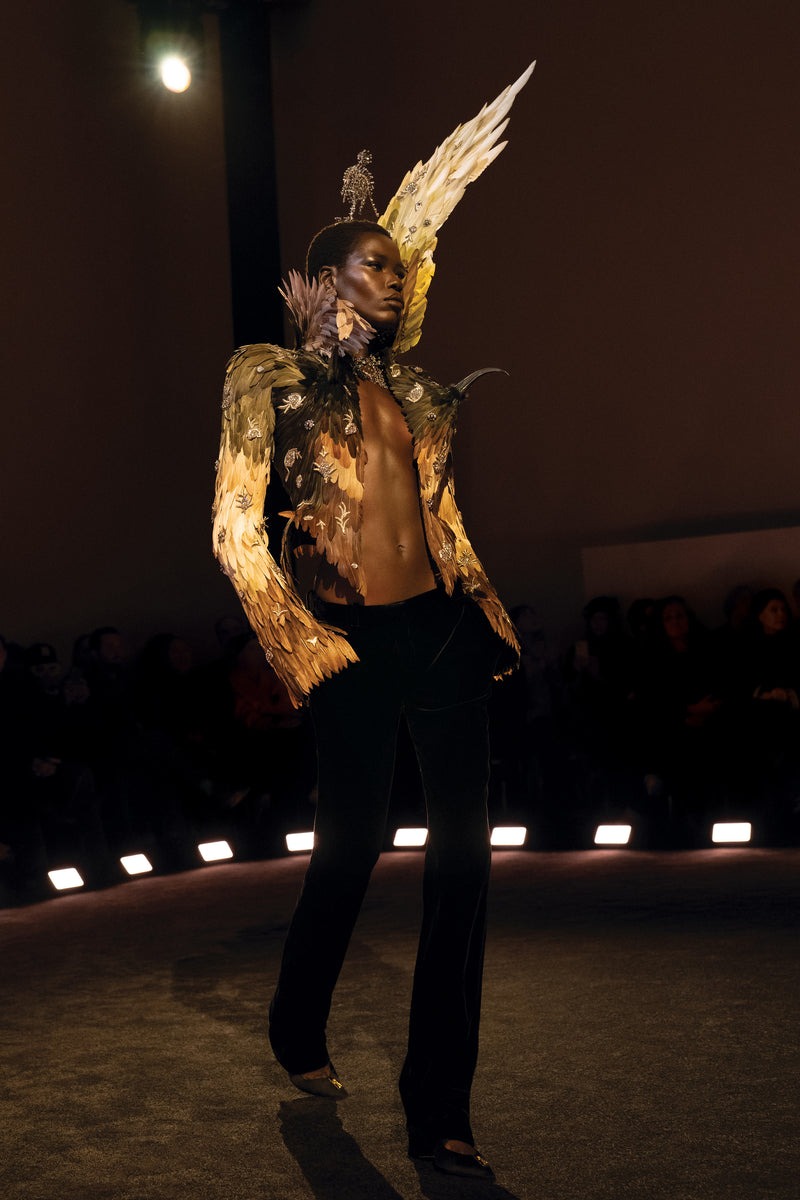
That recalibration translated into silhouettes built around tension and excess. Roseberry described the central figures of the collection as “infantas terribles,” creatures drawn from scorpions, snakes, and birds, with their aggression woven directly into form. Sharp strokes became stingers, squiggles hardened into tails and teeth. These looks pushed upward and outward, treating couture as something that defies gravity and not clothing that necessarily conforms to the body. 

The technical execution justified the scale of the fantasy. Lace was hand-cut and sculpted into bas-relief to create depth and shadow. Feathers appeared both real and simulated, painted, airbrushed, dipped in resin or crystallized. Neon tulle was layered beneath lace to produce a softened, atmospheric effect. Each look was built around a named identity, from “Isabella Blowfish” to jackets saturated in the colors of birds of paradise. Accessories extended the mythology, with artificial bird heads rendered in silk, resin, and pearl, nodding to Elsa Schiaparelli’s longstanding fascination with animal life.

Schiaparelli’s contribution to the season embraced nature as something volatile and theatrical. Roseberry leaned into excess, sensation, and transformation. The collection argued for couture as an emotional instrument, one that uses extreme craft to grant permission to feel rather than just explain.
Sch
Schiaparelli Spring/Summer 2026 Haute Couture

Together, these collections were literally and figuratively grounded but somehow offered escape. Not escapism detached from reality, but a re-enchantment of it. The sources were clear: imagined gardens and creatures, distant lands, and unfettered creativity. What anchors these visions collectively was not fantasy alone, but the labor of it all. Each look is a record of thousands of hours spent in the ateliers, shaped by the hands of artisans whose expertise turns ideas into the pieces displayed. In couture, imagination only becomes real through devotion.

This season reignites one of fashion’s oldest debates: where does the fantasy of haute couture truly reside? Is it in theatrical gestures, dramatic silhouettes and spectacle? Or does it live in something more restrained — an invisible excellence, a technical precision so refined it borders on the impossible? Chanel’s subtler showing this season, in particular, invites this question. Can restraint itself be fantastical when the craftsmanship is flawless?

“So many people ask me what the point is of couture. It’s certainly not to create clothing for daily life. But for me, couture allows me to connect with the hopeful adolescent I once was, the one who decided to not go into medicine or finance or law, but to chase that singular fantasy that fashion can still provide,” said Daniel Roseberry in his notes for Schiaperreli’s The Agony and the Ecstasy.

This discourse matters because couture is so often misunderstood. Its value is not determined by trend cycles or runway theatrics, but by method and imagination stretched far and wide. Haute couture is defined by process, by artisanal construction, inherited techniques, and a standard of execution that cannot be replicated at scale. These garments are built, not assembled. Their language is hidden in seams, linings and structures the eye may never even fully see. Chanel’s SS26 collection makes this distinction especially clear. Here, labor is deliberately concealed rather than staged. Techniques like calibrated dyeing, cut-thread embroidery, feather work and material layering operate beneath the surface. The absence of overt drama does not signal ease, but discipline, and reflects a couture tradition where mastery can be measured by control and restraint.

Couture has never been about realism or utility. It exists as a space of projection, where imagination, obsession and labor are taken to their furthest edge. What justifies couture is not its wearability, but its insistence on doing things at a scale that resists efficiency. In an industry increasingly driven by speed, replication and disposability, couture remains one of the last places where time itself is treated as a material.

And so, as SS26 couture drew from flowers, fauna, and imagined worlds, its foundation remained largely unchanged. Haute couture continues to operate at the intersection of fantasy, discipline, vision and technique. It preserves ways of making that would otherwise disappear. Couture sets a benchmark for what craft can be when it is not optimized into trend or productivity. Its value lies in refusal: a refusal to rush, a refusal to flatten ideas and a refusal to allow skill to become obsolete. It’s rooted in craft and shaped by human hands, and continues to reach beyond the possible, holding space for imagination to become something timeless.

Is This Still Couture? Paris SS26 Reignites Fashion’s Oldest Argument

Authored by
This is some text inside of a div block.

Haute Couture Spring/Summer 2026 in Paris seemed to press its ear to the ground. Across the runways, there was a collective turning toward the earth — not necessarily as a literal landscape, but as a source of texture, direction and meaning. Dior, Chanel, and Schiaparelli each arrived at this impulse differently, but together they traced a shared desire to root fantasy in something organic: the floral, the whimsical, the otherworldly. Couture, which is often imagined as untouchable, felt distinctly alive and unearthed.

At Dior, the earth bloomed. Jonathan Anderson’s couture debut framed the natural world as a question of form, volume and internal logic. Drawing from the ceramic work of Kenyan-born British potter Magdalene Odundo, the collection approached couture through sculpture rather than garment-first thinking. Lightness was a technical challenge instead of a visual effect. Rounded silhouettes and projecting forms were developed through extensive prototyping, with the atelier working alongside specialists from architectural disciplines to engineer internal frameworks capable of holding shape without weight. Materials such as piano wire and densely gathered tulle formed unseen architectures beneath the surface.

Then came the flowers. 

Floral elements appeared insistently and everywhere, not as embellishment but as connective thread through the entire collection. They surfaced as earrings, bloomed across dresses, emerged on shoes, and threaded the collection together in full saturation. Embroidery and flower-making operated structurally, binding the looks into a single ecosystem rather than isolated statements. Anderson did not reference nature sparingly; it was cultivated until the collection felt entirely in bloom.

The collection was presented alongside an exhibition at the Musée Rodin that placed Anderson’s designs in dialogue with Dior’s archive and Odundo’s ceramics, and the collection positioned couture as a fine practice of material inquiry.

Christian Dior Spring/Summer 2026 Haute Couture

Chanel’s Haute Couture presentation was lighter, more mischievous in comparison to Dior. Under Matthieu Blazy, whimsy operated as a form of logic, guiding how the clothes moved, hovered and dissolved on the body. Feathers suggested motion, proportions gently disrupted expectation, and surfaces carried the impression of air even at rest. Tweeds, which is long central to the house, were subtly dyed to echo owl feathers, while a cocoon dress with rounded brown sleeves and a ring of red at the neckline recalled the markings of a woodpecker. Elsewhere, peacock prints, beetle-like volumes, and their repeated motifs resembling hand-drawn feathers or scales reinforced the collection’s natural references.

This lightness was carefully constructed. Feather effects were achieved through cut-thread embroidery and layered applications instead of leaning into literal volume. Painted organza and meticulously dyed tweeds required precise control to maintain softness and still hold its structure. Bead embroidery was used sparingly, catching light without anchoring the garments visually. The mood was dreamlike but grounded, and shaped by simplicity and precision. Couture at Chanel narrowed its focus, stripping back to essentials and allowing craftsmanship to speak through restraint.The garments themselves appeared effortless. However, that ease risks being misread as the opposite of couture, so it depends on exacting control. Blazy’s Chanel proposed a form of couture rooted in observation and material intelligence, and the fantasy was able to emerge through this refinement.

Chanel Spring/Summer 2026 Haute Couture

Schiaparelli, as expected, left the ground entirely (but remained tethered to it in spirit). In his show notes, Daniel Roseberry traced the origin of the season to a visit to the renowned Sistine Chapel in Vatican City, where, in contrast to narrative painting that instructs, Michelangelo’s ceiling suspends meaning and privileges feeling. What mattered, Roseberry notes, was not representation but response. The collection took shape around that shift, asking not what couture should look like, but how it should feel.

That recalibration translated into silhouettes built around tension and excess. Roseberry described the central figures of the collection as “infantas terribles,” creatures drawn from scorpions, snakes, and birds, with their aggression woven directly into form. Sharp strokes became stingers, squiggles hardened into tails and teeth. These looks pushed upward and outward, treating couture as something that defies gravity and not clothing that necessarily conforms to the body. 

The technical execution justified the scale of the fantasy. Lace was hand-cut and sculpted into bas-relief to create depth and shadow. Feathers appeared both real and simulated, painted, airbrushed, dipped in resin or crystallized. Neon tulle was layered beneath lace to produce a softened, atmospheric effect. Each look was built around a named identity, from “Isabella Blowfish” to jackets saturated in the colors of birds of paradise. Accessories extended the mythology, with artificial bird heads rendered in silk, resin, and pearl, nodding to Elsa Schiaparelli’s longstanding fascination with animal life.

Schiaparelli’s contribution to the season embraced nature as something volatile and theatrical. Roseberry leaned into excess, sensation, and transformation. The collection argued for couture as an emotional instrument, one that uses extreme craft to grant permission to feel rather than just explain.

Sch
Schiaparelli Spring/Summer 2026 Haute Couture

Together, these collections were literally and figuratively grounded but somehow offered escape. Not escapism detached from reality, but a re-enchantment of it. The sources were clear: imagined gardens and creatures, distant lands, and unfettered creativity. What anchors these visions collectively was not fantasy alone, but the labor of it all. Each look is a record of thousands of hours spent in the ateliers, shaped by the hands of artisans whose expertise turns ideas into the pieces displayed. In couture, imagination only becomes real through devotion.

This season reignites one of fashion’s oldest debates: where does the fantasy of haute couture truly reside? Is it in theatrical gestures, dramatic silhouettes and spectacle? Or does it live in something more restrained — an invisible excellence, a technical precision so refined it borders on the impossible? Chanel’s subtler showing this season, in particular, invites this question. Can restraint itself be fantastical when the craftsmanship is flawless?

“So many people ask me what the point is of couture. It’s certainly not to create clothing for daily life. But for me, couture allows me to connect with the hopeful adolescent I once was, the one who decided to not go into medicine or finance or law, but to chase that singular fantasy that fashion can still provide,” said Daniel Roseberry in his notes for Schiaperreli’s The Agony and the Ecstasy.

This discourse matters because couture is so often misunderstood. Its value is not determined by trend cycles or runway theatrics, but by method and imagination stretched far and wide. Haute couture is defined by process, by artisanal construction, inherited techniques, and a standard of execution that cannot be replicated at scale. These garments are built, not assembled. Their language is hidden in seams, linings and structures the eye may never even fully see. Chanel’s SS26 collection makes this distinction especially clear. Here, labor is deliberately concealed rather than staged. Techniques like calibrated dyeing, cut-thread embroidery, feather work and material layering operate beneath the surface. The absence of overt drama does not signal ease, but discipline, and reflects a couture tradition where mastery can be measured by control and restraint.

Couture has never been about realism or utility. It exists as a space of projection, where imagination, obsession and labor are taken to their furthest edge. What justifies couture is not its wearability, but its insistence on doing things at a scale that resists efficiency. In an industry increasingly driven by speed, replication and disposability, couture remains one of the last places where time itself is treated as a material.

And so, as SS26 couture drew from flowers, fauna, and imagined worlds, its foundation remained largely unchanged. Haute couture continues to operate at the intersection of fantasy, discipline, vision and technique. It preserves ways of making that would otherwise disappear. Couture sets a benchmark for what craft can be when it is not optimized into trend or productivity. Its value lies in refusal: a refusal to rush, a refusal to flatten ideas and a refusal to allow skill to become obsolete. It’s rooted in craft and shaped by human hands, and continues to reach beyond the possible, holding space for imagination to become something timeless.
This is some text inside of a div block.

Is This Still Couture? Paris SS26 Reignites Fashion’s Oldest Argument

Authored by

Haute Couture Spring/Summer 2026 in Paris seemed to press its ear to the ground. Across the runways, there was a collective turning toward the earth — not necessarily as a literal landscape, but as a source of texture, direction and meaning. Dior, Chanel, and Schiaparelli each arrived at this impulse differently, but together they traced a shared desire to root fantasy in something organic: the floral, the whimsical, the otherworldly. Couture, which is often imagined as untouchable, felt distinctly alive and unearthed.

At Dior, the earth bloomed. Jonathan Anderson’s couture debut framed the natural world as a question of form, volume and internal logic. Drawing from the ceramic work of Kenyan-born British potter Magdalene Odundo, the collection approached couture through sculpture rather than garment-first thinking. Lightness was a technical challenge instead of a visual effect. Rounded silhouettes and projecting forms were developed through extensive prototyping, with the atelier working alongside specialists from architectural disciplines to engineer internal frameworks capable of holding shape without weight. Materials such as piano wire and densely gathered tulle formed unseen architectures beneath the surface.

Then came the flowers. 

Floral elements appeared insistently and everywhere, not as embellishment but as connective thread through the entire collection. They surfaced as earrings, bloomed across dresses, emerged on shoes, and threaded the collection together in full saturation. Embroidery and flower-making operated structurally, binding the looks into a single ecosystem rather than isolated statements. Anderson did not reference nature sparingly; it was cultivated until the collection felt entirely in bloom.

The collection was presented alongside an exhibition at the Musée Rodin that placed Anderson’s designs in dialogue with Dior’s archive and Odundo’s ceramics, and the collection positioned couture as a fine practice of material inquiry.

Christian Dior Spring/Summer 2026 Haute Couture

Chanel’s Haute Couture presentation was lighter, more mischievous in comparison to Dior. Under Matthieu Blazy, whimsy operated as a form of logic, guiding how the clothes moved, hovered and dissolved on the body. Feathers suggested motion, proportions gently disrupted expectation, and surfaces carried the impression of air even at rest. Tweeds, which is long central to the house, were subtly dyed to echo owl feathers, while a cocoon dress with rounded brown sleeves and a ring of red at the neckline recalled the markings of a woodpecker. Elsewhere, peacock prints, beetle-like volumes, and their repeated motifs resembling hand-drawn feathers or scales reinforced the collection’s natural references.

This lightness was carefully constructed. Feather effects were achieved through cut-thread embroidery and layered applications instead of leaning into literal volume. Painted organza and meticulously dyed tweeds required precise control to maintain softness and still hold its structure. Bead embroidery was used sparingly, catching light without anchoring the garments visually. The mood was dreamlike but grounded, and shaped by simplicity and precision. Couture at Chanel narrowed its focus, stripping back to essentials and allowing craftsmanship to speak through restraint.The garments themselves appeared effortless. However, that ease risks being misread as the opposite of couture, so it depends on exacting control. Blazy’s Chanel proposed a form of couture rooted in observation and material intelligence, and the fantasy was able to emerge through this refinement.

Chanel Spring/Summer 2026 Haute Couture

Schiaparelli, as expected, left the ground entirely (but remained tethered to it in spirit). In his show notes, Daniel Roseberry traced the origin of the season to a visit to the renowned Sistine Chapel in Vatican City, where, in contrast to narrative painting that instructs, Michelangelo’s ceiling suspends meaning and privileges feeling. What mattered, Roseberry notes, was not representation but response. The collection took shape around that shift, asking not what couture should look like, but how it should feel.

That recalibration translated into silhouettes built around tension and excess. Roseberry described the central figures of the collection as “infantas terribles,” creatures drawn from scorpions, snakes, and birds, with their aggression woven directly into form. Sharp strokes became stingers, squiggles hardened into tails and teeth. These looks pushed upward and outward, treating couture as something that defies gravity and not clothing that necessarily conforms to the body. 

The technical execution justified the scale of the fantasy. Lace was hand-cut and sculpted into bas-relief to create depth and shadow. Feathers appeared both real and simulated, painted, airbrushed, dipped in resin or crystallized. Neon tulle was layered beneath lace to produce a softened, atmospheric effect. Each look was built around a named identity, from “Isabella Blowfish” to jackets saturated in the colors of birds of paradise. Accessories extended the mythology, with artificial bird heads rendered in silk, resin, and pearl, nodding to Elsa Schiaparelli’s longstanding fascination with animal life.

Schiaparelli’s contribution to the season embraced nature as something volatile and theatrical. Roseberry leaned into excess, sensation, and transformation. The collection argued for couture as an emotional instrument, one that uses extreme craft to grant permission to feel rather than just explain.

Sch
Schiaparelli Spring/Summer 2026 Haute Couture

Together, these collections were literally and figuratively grounded but somehow offered escape. Not escapism detached from reality, but a re-enchantment of it. The sources were clear: imagined gardens and creatures, distant lands, and unfettered creativity. What anchors these visions collectively was not fantasy alone, but the labor of it all. Each look is a record of thousands of hours spent in the ateliers, shaped by the hands of artisans whose expertise turns ideas into the pieces displayed. In couture, imagination only becomes real through devotion.

This season reignites one of fashion’s oldest debates: where does the fantasy of haute couture truly reside? Is it in theatrical gestures, dramatic silhouettes and spectacle? Or does it live in something more restrained — an invisible excellence, a technical precision so refined it borders on the impossible? Chanel’s subtler showing this season, in particular, invites this question. Can restraint itself be fantastical when the craftsmanship is flawless?

“So many people ask me what the point is of couture. It’s certainly not to create clothing for daily life. But for me, couture allows me to connect with the hopeful adolescent I once was, the one who decided to not go into medicine or finance or law, but to chase that singular fantasy that fashion can still provide,” said Daniel Roseberry in his notes for Schiaperreli’s The Agony and the Ecstasy.

This discourse matters because couture is so often misunderstood. Its value is not determined by trend cycles or runway theatrics, but by method and imagination stretched far and wide. Haute couture is defined by process, by artisanal construction, inherited techniques, and a standard of execution that cannot be replicated at scale. These garments are built, not assembled. Their language is hidden in seams, linings and structures the eye may never even fully see. Chanel’s SS26 collection makes this distinction especially clear. Here, labor is deliberately concealed rather than staged. Techniques like calibrated dyeing, cut-thread embroidery, feather work and material layering operate beneath the surface. The absence of overt drama does not signal ease, but discipline, and reflects a couture tradition where mastery can be measured by control and restraint.

Couture has never been about realism or utility. It exists as a space of projection, where imagination, obsession and labor are taken to their furthest edge. What justifies couture is not its wearability, but its insistence on doing things at a scale that resists efficiency. In an industry increasingly driven by speed, replication and disposability, couture remains one of the last places where time itself is treated as a material.

And so, as SS26 couture drew from flowers, fauna, and imagined worlds, its foundation remained largely unchanged. Haute couture continues to operate at the intersection of fantasy, discipline, vision and technique. It preserves ways of making that would otherwise disappear. Couture sets a benchmark for what craft can be when it is not optimized into trend or productivity. Its value lies in refusal: a refusal to rush, a refusal to flatten ideas and a refusal to allow skill to become obsolete. It’s rooted in craft and shaped by human hands, and continues to reach beyond the possible, holding space for imagination to become something timeless.

Other Stories
London
London
Lagos
London
Newyork
London
Shop
Join the community.
You are now subscribed to receive updates.
Oops! Something went wrong while submitting the form.