.svg)

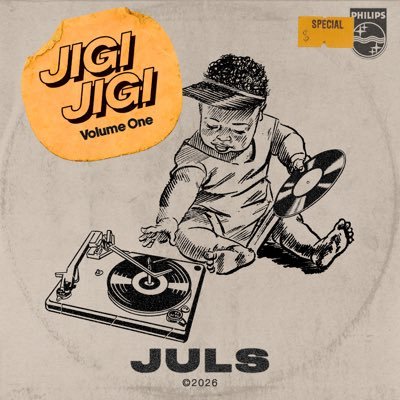
In the rhythmic lexicon of West Africa, "Jigi Jigi" is more than just a phrase; it is an imperative. Translating directly to "move" or "dance," it serves as the heartbeat of Juls’ latest project. It is an onomatopoeic nudge, a rhythmic command that bypasses the cerebral and heads straight for the hips. By naming the EP Jigi Jigi Vol 1, the British-Ghanaian producer sets a clear intention: this is music designed to break the stillness, urging a physical and spiritual response to a global sound that refuses to stay in one place. For the better part of a decade, Juls has been the silent architect of the "Afrobeats" explosion. But as the genre became a global commodity often polished and flattened for Western pop sensibilities, the British-Ghanaian producer began a slow, deliberate retreat into the archives. On his latest EP, Jigi Jigi Vol. 1, Juls stops looking for the "next" sound and starts looking for the only sound, the one that existed before borders. This EP is an intricate, percussion-led tapestry that argues for the shared DNA of the Black Atlantic, stitching together Latin grooves, Caribbean swing, and African soul into a singular, breathable fabric. By removing the reliance on superstar vocalists and letting the instrumentation lead, Juls forces the listener to engage with the history of the sound. He is teaching us that the evolution of music isn't about finding something "new," but about remembering where the pieces originally fit together.
Jazz In The Air opens the project with a literal "sense of release." Juls fills the silence with a sophisticated dialogue between improvised Jazz and traditional Afro-drum. The piano chords aren't just background noise; they provide a melodic ceiling that allows the sharp, rhythmic kicks to drive the energy forward. It is incredibly calming, yet it possesses an underlying kineticism that feels like a sunset dance on a rooftop in Accra. If the EP has a spiritual headquarters, it is Roots. It begins with a sobering manifesto: a call for African unity, an end to the hyper-competition birthed by colonial structures, and a return to collaboration. Once the message settles, the music erupts into a vibrant display of Ghanaian heritage. The interplay of Ga drums and the Atenteben (bamboo flute) creates a texture rarely heard in modern commercial music. The Highlife melodies act as a tether to the 1960s, while the upbeat kicks remind us that the heart of this sound is still very much beating in the present.
Kokrobite Blues, interestingly named after the legendary Ghanaian surfing and drumming village lives up to the heritage. It synthesizes the Blues, the music of the diaspora’s struggle. The trumpets here are the standout, wailing with a soulful clarity that bridges the gap between a New Orleans funeral march and a West African celebration. On Mi Morena, Juls leans heavily into his Latin-Caribbean curiosities here. This is Salsa re-imagined through an Afrobeats lens. The syncopation is tighter, the percussion is crisp, and the "swing" feels distinctly Afro-Latino.
Capoeira Riddim featuring Ezra Skys, shifts the energy toward Brazil. Inspired by the Afro-Brazilian martial art, this track is a percussive masterclass. It utilizes the raw, physical energy of House music but strips away the synthetic gloss, replacing it with the organic rattle and thrum of street-level percussion. It is a rhythmic workout that fuses House energy with the raw power of Brazilian street culture.The journey concludes on 3AM In Kaapstad featuring Xivo. This is a "nocturnal" track, blending the sophisticated textures of Cape Jazz with the deep, atmospheric Amapiano. It feels like a liminal space, the quiet hour before dawn where all these different sounds finally settle into a singular, unified hum. It's very much introspective and unresolved in the best way. It’s the sound of disparate histories finally settling into a shared frequency.
Jigi Jigi Vol. 1 operates as a study in musical lineage. Juls approaches rhythm as inherited knowledge, something carried, reshaped, and reintroduced rather than endlessly reinvented. By centering percussion, melody, and spatial arrangement over vocal dominance, he creates room for the listener to hear the architecture of the music itself: the echoes of Highlife, Jazz, Blues, Afro-Latin and Afro-Brazilian traditions speaking across time and geography. The project demands physical response, but it also invites historical awareness, asking the listener to recognize how these sounds converse with one another beneath the surface. In doing so, Juls quietly asserts a broader vision of global Black music, one rooted in movement, memory, and continuity, positioning Jigi Jigi Vol. 1 not as a final statement, but as a living framework for what comes next.




.png)

