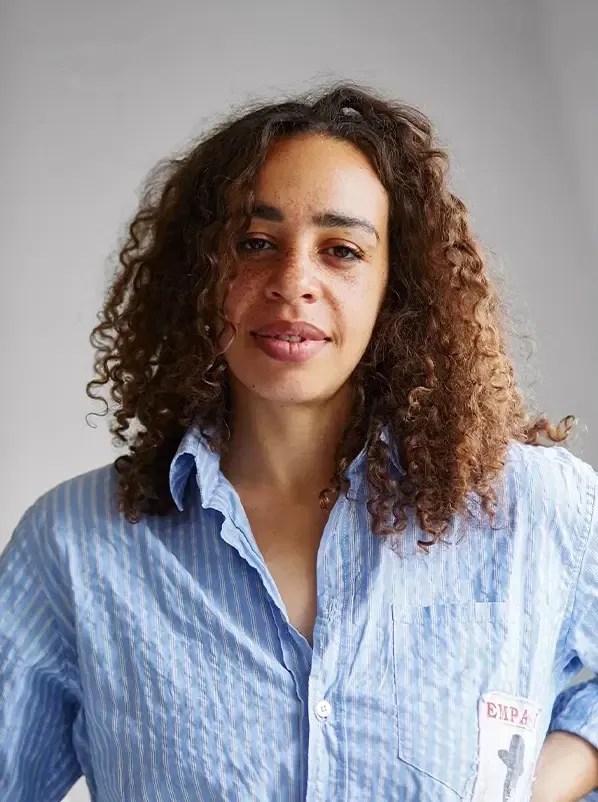
Puck reported this week that Martine Rose has signed a deal to succeed Pierpaolo Piccioli as creative director of Balenciaga, who is reportedly leaving after less than two years.
A Kering representative declined to comment to Puck, Rose did not respond to its request, and no official announcement has followed. The appointment therefore remains unconfirmed. Other outlets describe Rose as a candidate under consideration, a more cautious account than Puck’s, which reports that a contract has already been signed.
Two strands of the reaction stand out. One argues that Rose should continue developing her own label before taking on a house with Balenciaga’s commercial obligations. The other celebrates the prospect of a British-Jamaican woman leading a house whose creative leadership has historically been male, treating the potential appointment as a milestone for representation. Both arguments raise valid questions, but neither, on its own, amounts to an assessment of Rose’s work or her suitability for the role.
Martine Rose was born in Croydon and graduated from Middlesex University in 2002 with a degree in fashion design. Her first label folded in 2005. Two years later, she founded her eponymous menswear label, financed in part by a £1,500 pounds loan from the Prince’s Trust, according to The Business of Fashion. Her approach to fashion has drawn on the raves, reggae sound systems and punk scenes of the London she grew up in, influences reflected in the unconventional settings she has chosen for her shows, from a street market to a community climbing gym and a Camden cul-de-sac.
As Avola magazine describes it, her method involves taking familiar garments, such as office shirts and football jerseys, and pushing their proportions until they become unfamiliar. Her work has since extended into collaborations with Nike and Napapijri, a guest creative director role at Clarks, and the 2023 Fashion Award for British Menswear Designer of the Year. She is not new to Balenciaga, either. In 2015, Demna hired her as a menswear consultant, a role she held for about three years.
The argument that Rose should focus on building her own label before moving to Balenciaga assumes a degree of independence that her business history complicates. In October 2021, Tomorrow, a London-based brand accelerator, acquired a 60 percent stake in the label through a share swap that gave Rose an undisclosed stake in Tomorrow, according to The Business of Fashion.
In March, Rose cancelled production of her Fall 2026 collection, saying she was “forced to make the unprecedented decision to cancel the season’s production orders.” Her statement gave no reason for the decision, while nss magazine reported that orders had been placed by about 200 retailers.
The Business of Fashion later reported that Tomorrow's relationships with its labels had deteriorated amid allegations that the company had fallen behind on payments to designers. Industry sources also told the publication that Rose had attempted to buy back control of her business but had been refused. Tomorrow was subsequently sold to Progetto 11, the parent company of The Level Group.
Readiness is not easily measured by a single standard. Financial stability offers one public data point: figures from Companies House filings for her UK studio, compiled by the aggregator Pomanda, show turnover of about £1.2 million pounds. That figure does not establish the financial health of the wider label, particularly given Tomorrow's role as its global licensing partner.
On creative identity, the evidence is more substantial. AnOther described Rose as having arguably shifted the aesthetic of menswear over the past decade. Building a label that can function without its founder presents a different challenge, and one that few designer-led businesses meet, including those whose founders go on to lead larger houses.
The commercial stakes are considerable. Balenciaga reportedly generated €1.189 billion euros in revenue in 2021, although Kering no longer discloses the house’s individual financial performance. Its wider Other Houses division generated €2.9 billion euros in 2025. For Rose, the appointment would offer access to greater manufacturing capacity, distribution and global visibility, alongside the commercial expectations of a billion-euro fashion house. The demands of the role could also affect the development of her own label, and Puck’s report offers no clarity on what would become of her business if the appointment proceeds.
Historically, Rose would be breaking new ground. Since Balenciaga’s 1987 relaunch, its creative directors have been Michel Goma, Josephus Thimister, Nicolas Ghesquière, Alexander Wang, Demna and Pierpaolo Piccioli, all men. Rose would become the house’s first female creative director and, given her British-Jamaican heritage, its first Black woman in the role. The milestone reflects a wider industry imbalance. In February 2025, 1Granary reported that women represented approximately 74 percent of students across selected fashion programmes but occupied just 12 percent of creative director positions at leading luxury houses.
Puck and Avola approach the potential appointment differently. Puck highlights Kering CEO Luca de Meo’s ambition to position Balenciaga as Gen Z’s entry point into the luxury group, while Avola emphasises the significance of Rose’s identity. Both perspectives are relevant, although her design credentials deserve equal attention. Rose previously worked in Balenciaga’s menswear division and has built an influential label recognised for exaggerated proportions, subcultural references and unconventional tailoring. Her collaborations with Nike, Napapijri and Clarks further demonstrate her versatility.
However, questions remain about her readiness to oversee the entire house. While her influence on Balenciaga’s menswear under Demna is documented, her approach to womenswear, couture craftsmanship, commercial strategy and executive leadership remains less established. Her potential ability to reconcile the house’s sculptural heritage with her contemporary design language is another consideration. Neither Puck nor subsequent reporting has clarified the contractual terms or creative autonomy she would enjoy.
Ultimately, Rose’s appointment would represent a significant moment for fashion representation, supported by an established record of creative influence. Yet her success would depend on the work she produces, the commercial expectations placed upon her and the institutional support available. The historical milestone may generate the headlines, but her creative direction would determine the legacy.
Cover Credit: Martine Rose