Never Die, Denim: Inside The Upcycling Reign of Azach

Authored by

AZACH launched Reconstruction Into Refinement a fortnight ago as a denim collection built around the differences between old and deadstock fabric. 

Lagos-based AZACH describes itself as a circular fashion label, creating contemporary garments through reconstruction, rework and considered design. Its approach uses existing and deadstock materials to make pieces intended to have more than one life. In the text accompanying Reconstruction Into Refinement, the brand frames the joining of old and deadstock denim as a way of turning their differences into subtle, everyday garments. 

The idea also extends beyond clothing. AZACH compares reconstruction to rebuilding a life, carrying memories, lessons, relationships and resources into what comes next. Its method rests on three principles: seeing possibility in a material, using what already exists and refining it.

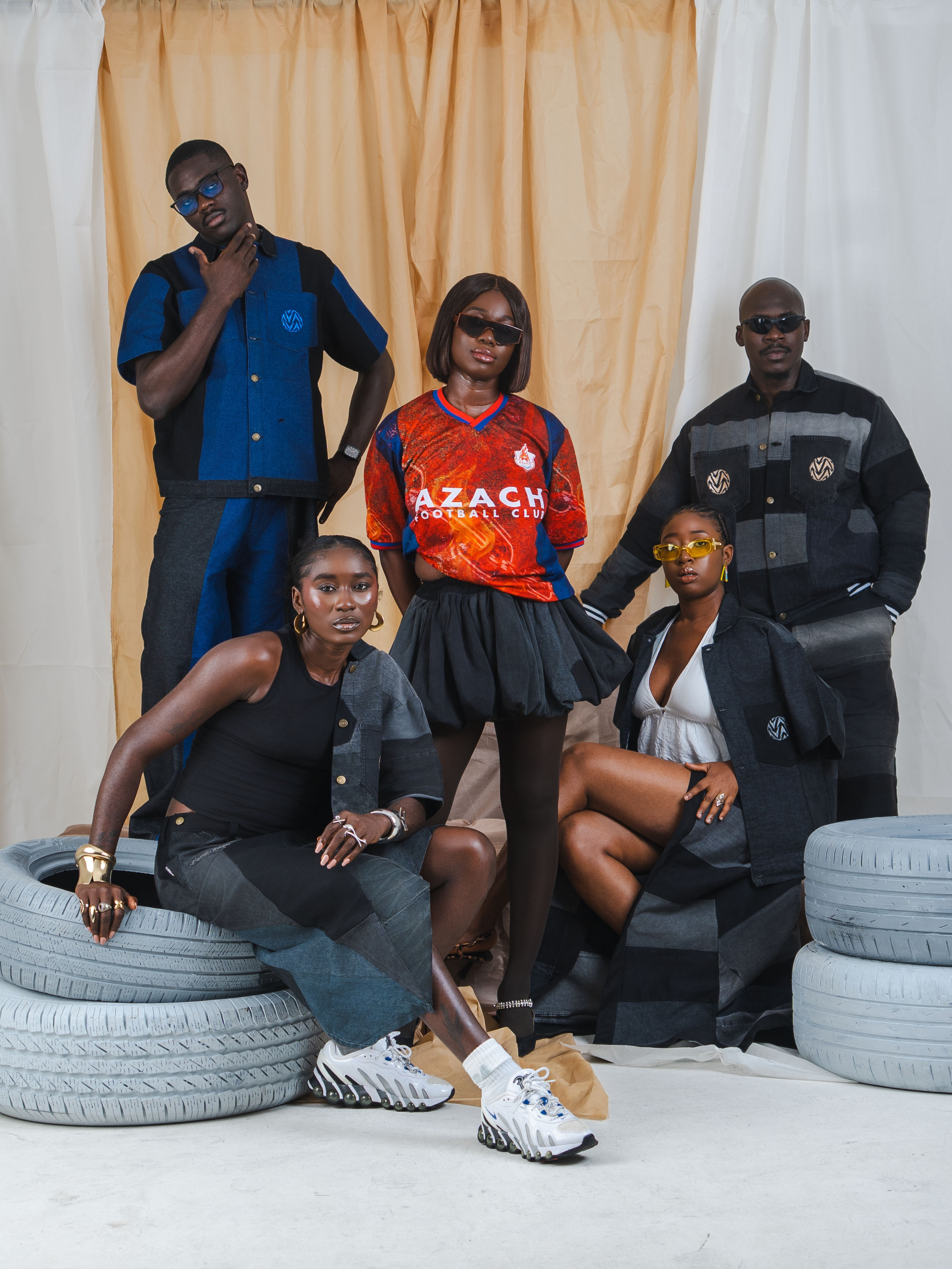
Reconstruction joins unlike pieces of denim, while refinement comes through the tailoring that makes those joins feel deliberate. The palette stays within a single range, from near-black through washed mid-blue to pale blue, with a red and navy football shirt in one look providing the only break. The restrained colours leave the construction to carry the visual interest, drawing attention to the points where one denim meets another.
Credit: AZACH

Skirts anchor the womenswear, with the floor-length Split Skirt appearing in blue denim patchwork and a black-and-grey version with a high split. The shorter Pleat and Bubble Skirts feature pleated and rounded hems, respectively, while the boxy Crop Frame Jacket is styled over both the Drift and Bubble Skirts. Other looks pair the Pleat Skirt with a white tee and denim headwrap, and the Bubble Skirt with a red-and-navy AZACH Football Club shirt, whose design is uncredited.

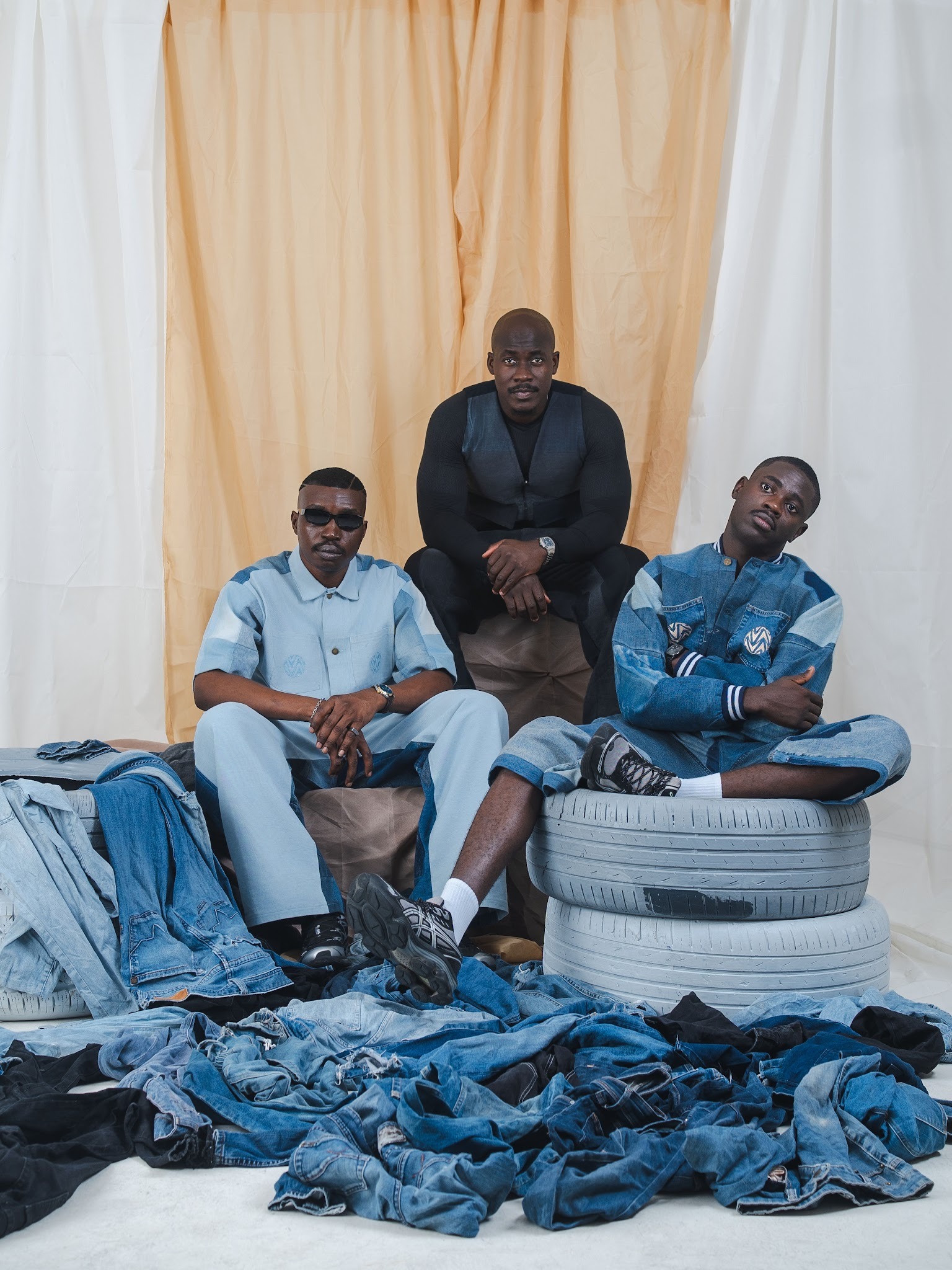
The menswear extends the patchwork into jackets, coordinated sets and vests, including a two-tone Varsity Jacket paired with symmetry jorts. The Dual Block, Compost and Devide Sets explore varying denim shades, while the Duality Vest and sleeveless Notch Top introduce darker and lighter variations. A denim head tie accompanies the Devide Set, while a circular monogram recurs across several jackets and tops.

The menswear titles reinforce its emphasis on combining and dividing materials. Dual Block, Duality and Symmetry suggest relationships between separate parts, while Compost evokes the transformation of old material into something new. In the lookbook, the denim is photographed against tan drapes, with stacked tyres and grey cloth forming part of the set. Sneakers, loafers, sandals and knee-high boots complete the looks, placing the garments within a range of styling choices that reflects the brand’s stated intention to make everyday wear.

Uche Aladimma founded AZACH in February 2022 to upcycle second-hand clothing imported into Nigeria in bales, some of which can end up in landfill if unsold. He’s joined by David Olayeni as AZACH’s co-founder as they both transform unsold stock and donated denim into new garments while providing work for local artisans. 

AZACH also appears in VC4A’s Orange Corners alumni community. The programme is backed by the Dutch government and run in Nigeria by the FATE Foundation.

Credit: AZACH

Its current lookbook leads with a different emphasis: “Modern fashion, made from what already exists,” followed by a reference to circularity. The sequence places the design proposition first, presenting the clothes through their aesthetic and construction before introducing the environmental thinking behind them. Circularity remains part of the brand’s identity, but the lookbook makes it a supporting principle of the design, not its opening pitch.

Denim carries particular significance in Nigeria’s second-hand clothing market. A 2022 project by the University of the Arts London’s Fashion, Textiles and Technology Institute and Fashion Revolution Nigeria brought tailors, menders and upcyclers into discussions about circular denim practices. The project noted that overproduction in the global north had helped create a large international trade in used denim. Nigerian designers have developed different ways of working with this material. 

NKWO, founded by Nkwo Onwuka, won the Bicester Collection Award for Emerging Designers at the 2022 CNMI Sustainable Fashion Awards. Its Dakala fabric is made from denim scraps sourced from markets and donations. Where NKWO transforms scraps into a new textile, AZACH joins existing denim panels directly into garments. The visible seams in Reconstruction Into Refinement make that difference in construction apparent.

Reconstruction Into Refinement rests on the idea that the past can be used rather than discarded. Its real test will come when the clothes leave the lookbook, away from the tan drapes and stacked tyres, and become part of an ordinary weekday. The patchwork must work beyond the photograph, as clothing people want to wear.

Cover Credit: AZACH

Never Die, Denim: Inside The Upcycling Reign of Azach

Authored by
This is some text inside of a div block.

AZACH launched Reconstruction Into Refinement a fortnight ago as a denim collection built around the differences between old and deadstock fabric. 

Lagos-based AZACH describes itself as a circular fashion label, creating contemporary garments through reconstruction, rework and considered design. Its approach uses existing and deadstock materials to make pieces intended to have more than one life. In the text accompanying Reconstruction Into Refinement, the brand frames the joining of old and deadstock denim as a way of turning their differences into subtle, everyday garments. 

The idea also extends beyond clothing. AZACH compares reconstruction to rebuilding a life, carrying memories, lessons, relationships and resources into what comes next. Its method rests on three principles: seeing possibility in a material, using what already exists and refining it.

Reconstruction joins unlike pieces of denim, while refinement comes through the tailoring that makes those joins feel deliberate. The palette stays within a single range, from near-black through washed mid-blue to pale blue, with a red and navy football shirt in one look providing the only break. The restrained colours leave the construction to carry the visual interest, drawing attention to the points where one denim meets another.

Credit: AZACH

Skirts anchor the womenswear, with the floor-length Split Skirt appearing in blue denim patchwork and a black-and-grey version with a high split. The shorter Pleat and Bubble Skirts feature pleated and rounded hems, respectively, while the boxy Crop Frame Jacket is styled over both the Drift and Bubble Skirts. Other looks pair the Pleat Skirt with a white tee and denim headwrap, and the Bubble Skirt with a red-and-navy AZACH Football Club shirt, whose design is uncredited.

The menswear extends the patchwork into jackets, coordinated sets and vests, including a two-tone Varsity Jacket paired with symmetry jorts. The Dual Block, Compost and Devide Sets explore varying denim shades, while the Duality Vest and sleeveless Notch Top introduce darker and lighter variations. A denim head tie accompanies the Devide Set, while a circular monogram recurs across several jackets and tops.

The menswear titles reinforce its emphasis on combining and dividing materials. Dual Block, Duality and Symmetry suggest relationships between separate parts, while Compost evokes the transformation of old material into something new. In the lookbook, the denim is photographed against tan drapes, with stacked tyres and grey cloth forming part of the set. Sneakers, loafers, sandals and knee-high boots complete the looks, placing the garments within a range of styling choices that reflects the brand’s stated intention to make everyday wear.

Uche Aladimma founded AZACH in February 2022 to upcycle second-hand clothing imported into Nigeria in bales, some of which can end up in landfill if unsold. He’s joined by David Olayeni as AZACH’s co-founder as they both transform unsold stock and donated denim into new garments while providing work for local artisans. 

AZACH also appears in VC4A’s Orange Corners alumni community. The programme is backed by the Dutch government and run in Nigeria by the FATE Foundation.

Credit: AZACH

Its current lookbook leads with a different emphasis: “Modern fashion, made from what already exists,” followed by a reference to circularity. The sequence places the design proposition first, presenting the clothes through their aesthetic and construction before introducing the environmental thinking behind them. Circularity remains part of the brand’s identity, but the lookbook makes it a supporting principle of the design, not its opening pitch.

Denim carries particular significance in Nigeria’s second-hand clothing market. A 2022 project by the University of the Arts London’s Fashion, Textiles and Technology Institute and Fashion Revolution Nigeria brought tailors, menders and upcyclers into discussions about circular denim practices. The project noted that overproduction in the global north had helped create a large international trade in used denim. Nigerian designers have developed different ways of working with this material. 

NKWO, founded by Nkwo Onwuka, won the Bicester Collection Award for Emerging Designers at the 2022 CNMI Sustainable Fashion Awards. Its Dakala fabric is made from denim scraps sourced from markets and donations. Where NKWO transforms scraps into a new textile, AZACH joins existing denim panels directly into garments. The visible seams in Reconstruction Into Refinement make that difference in construction apparent.

Reconstruction Into Refinement rests on the idea that the past can be used rather than discarded. Its real test will come when the clothes leave the lookbook, away from the tan drapes and stacked tyres, and become part of an ordinary weekday. The patchwork must work beyond the photograph, as clothing people want to wear.

Cover Credit: AZACH

This is some text inside of a div block.

Never Die, Denim: Inside The Upcycling Reign of Azach

Authored by

AZACH launched Reconstruction Into Refinement a fortnight ago as a denim collection built around the differences between old and deadstock fabric. 

Lagos-based AZACH describes itself as a circular fashion label, creating contemporary garments through reconstruction, rework and considered design. Its approach uses existing and deadstock materials to make pieces intended to have more than one life. In the text accompanying Reconstruction Into Refinement, the brand frames the joining of old and deadstock denim as a way of turning their differences into subtle, everyday garments. 

The idea also extends beyond clothing. AZACH compares reconstruction to rebuilding a life, carrying memories, lessons, relationships and resources into what comes next. Its method rests on three principles: seeing possibility in a material, using what already exists and refining it.

Reconstruction joins unlike pieces of denim, while refinement comes through the tailoring that makes those joins feel deliberate. The palette stays within a single range, from near-black through washed mid-blue to pale blue, with a red and navy football shirt in one look providing the only break. The restrained colours leave the construction to carry the visual interest, drawing attention to the points where one denim meets another.

Credit: AZACH

Skirts anchor the womenswear, with the floor-length Split Skirt appearing in blue denim patchwork and a black-and-grey version with a high split. The shorter Pleat and Bubble Skirts feature pleated and rounded hems, respectively, while the boxy Crop Frame Jacket is styled over both the Drift and Bubble Skirts. Other looks pair the Pleat Skirt with a white tee and denim headwrap, and the Bubble Skirt with a red-and-navy AZACH Football Club shirt, whose design is uncredited.

The menswear extends the patchwork into jackets, coordinated sets and vests, including a two-tone Varsity Jacket paired with symmetry jorts. The Dual Block, Compost and Devide Sets explore varying denim shades, while the Duality Vest and sleeveless Notch Top introduce darker and lighter variations. A denim head tie accompanies the Devide Set, while a circular monogram recurs across several jackets and tops.

The menswear titles reinforce its emphasis on combining and dividing materials. Dual Block, Duality and Symmetry suggest relationships between separate parts, while Compost evokes the transformation of old material into something new. In the lookbook, the denim is photographed against tan drapes, with stacked tyres and grey cloth forming part of the set. Sneakers, loafers, sandals and knee-high boots complete the looks, placing the garments within a range of styling choices that reflects the brand’s stated intention to make everyday wear.

Uche Aladimma founded AZACH in February 2022 to upcycle second-hand clothing imported into Nigeria in bales, some of which can end up in landfill if unsold. He’s joined by David Olayeni as AZACH’s co-founder as they both transform unsold stock and donated denim into new garments while providing work for local artisans. 

AZACH also appears in VC4A’s Orange Corners alumni community. The programme is backed by the Dutch government and run in Nigeria by the FATE Foundation.

Credit: AZACH

Its current lookbook leads with a different emphasis: “Modern fashion, made from what already exists,” followed by a reference to circularity. The sequence places the design proposition first, presenting the clothes through their aesthetic and construction before introducing the environmental thinking behind them. Circularity remains part of the brand’s identity, but the lookbook makes it a supporting principle of the design, not its opening pitch.

Denim carries particular significance in Nigeria’s second-hand clothing market. A 2022 project by the University of the Arts London’s Fashion, Textiles and Technology Institute and Fashion Revolution Nigeria brought tailors, menders and upcyclers into discussions about circular denim practices. The project noted that overproduction in the global north had helped create a large international trade in used denim. Nigerian designers have developed different ways of working with this material. 

NKWO, founded by Nkwo Onwuka, won the Bicester Collection Award for Emerging Designers at the 2022 CNMI Sustainable Fashion Awards. Its Dakala fabric is made from denim scraps sourced from markets and donations. Where NKWO transforms scraps into a new textile, AZACH joins existing denim panels directly into garments. The visible seams in Reconstruction Into Refinement make that difference in construction apparent.

Reconstruction Into Refinement rests on the idea that the past can be used rather than discarded. Its real test will come when the clothes leave the lookbook, away from the tan drapes and stacked tyres, and become part of an ordinary weekday. The patchwork must work beyond the photograph, as clothing people want to wear.

Cover Credit: AZACH

Other Stories
London
London
Lagos
London
Newyork
London
Shop
Join the community.
You are now subscribed to receive updates.
Oops! Something went wrong while submitting the form.
Subscribe