On the Runway: Tolu Coker’s Survivor’s Remorse and the Cost of Becoming British

Authored by

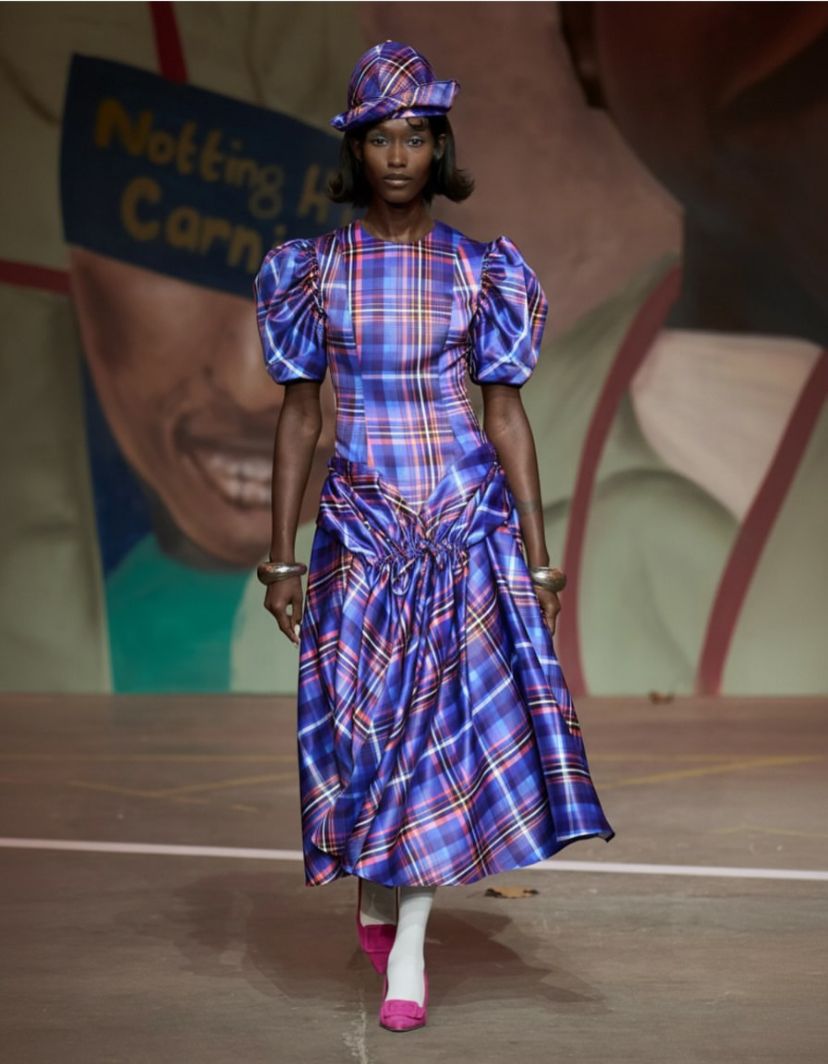
It started with concrete textures and stop signs. A mural stretched across the wall, sitting inside the strange familiarity of a West London street corner. The space felt nostalgic, almost tender, but the central mood of Survivor’s Remorse was something else entirely: bargaining.

Tolu Coker’s collection reads as a negotiation of identity; grief, loss, distance from cultural roots, and ultimately reclamation. Through structured silhouettes and geometric patterning, she builds a language that sits between worlds. What she presents is not just a collection, but a question: what does it cost to become British?

On February 19, 2026, she posted a short film, a prelude to the collection. At its core, it was a simple message: “Do not forget who you are.” For many Africans in the diaspora, that tension is constant. The pursuit of opportunity often comes with an unspoken exchange: proximity to success in return for distance from self.
Survivor’s Remorse sits inside that exchange. Drawing from her formative years in London, Coker constructs a world shaped by nostalgia. This is not memory as comfort. It is memory as something you have to actively hold onto. The cost of becoming is never simple. It begins with grief, not from entry to a better world, but from leaving the familiar and starting again. The excitement of a new world quickly meets the reality of unfamiliarity, and with it, the quiet pressure to become something else.

The set makes this clear before the clothes even arrive. A mural and nostalgic space that reminds you of unfamiliarity and the task of adapting, anchoring the room in memory. Coker is not just staging a show; she is staging absence. She reminds us that grief is not separate from creation; it is often what shapes it.

But grief does not sit alone. It shifts into aspiration.

The London Underground sign on set becomes more than scenery; it reads as a symbol of childhood longing. The city as a system, as a promise, as something you watch before you are fully inside it. Growing up on Mozart Street in Westminster means growing up close enough to power to recognise it, but far enough to understand that it is not yet yours. The presence of King Charles III in the room sharpens this tension. Power is no longer distant; it is watching. And in that moment, aspiration becomes something more complex. It is no longer just desire, but performance: learning how to speak, dress, and move in a way that allows entry.

And then comes assimilation.
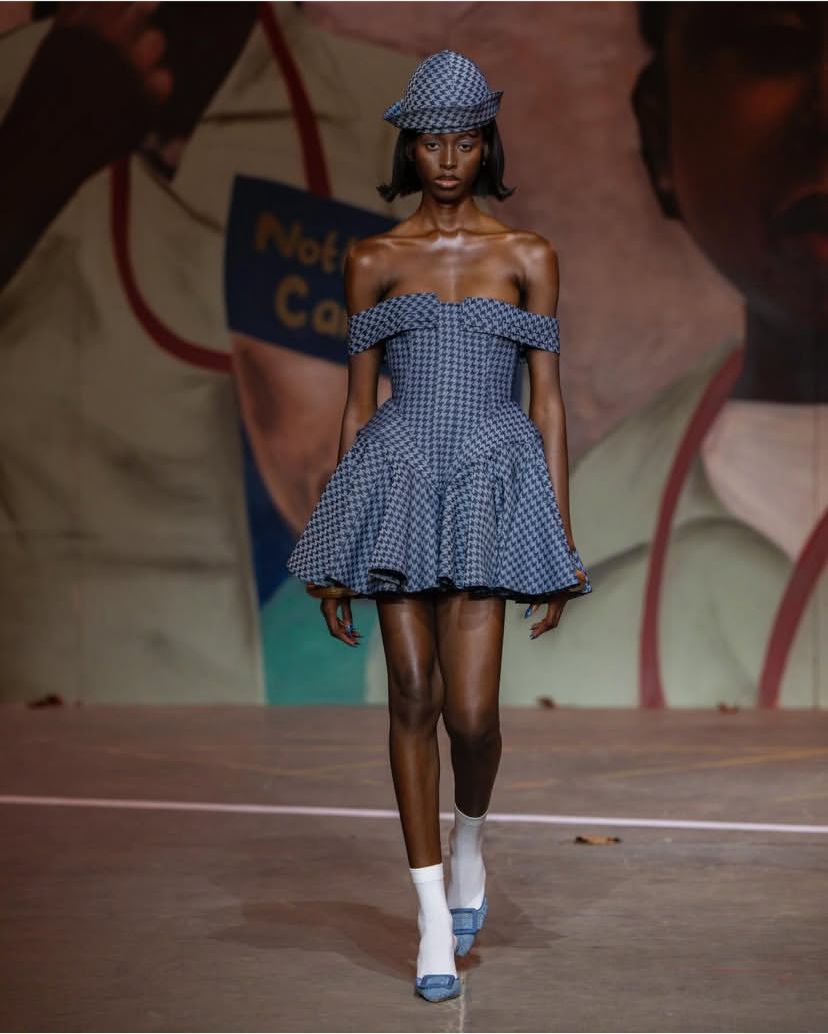
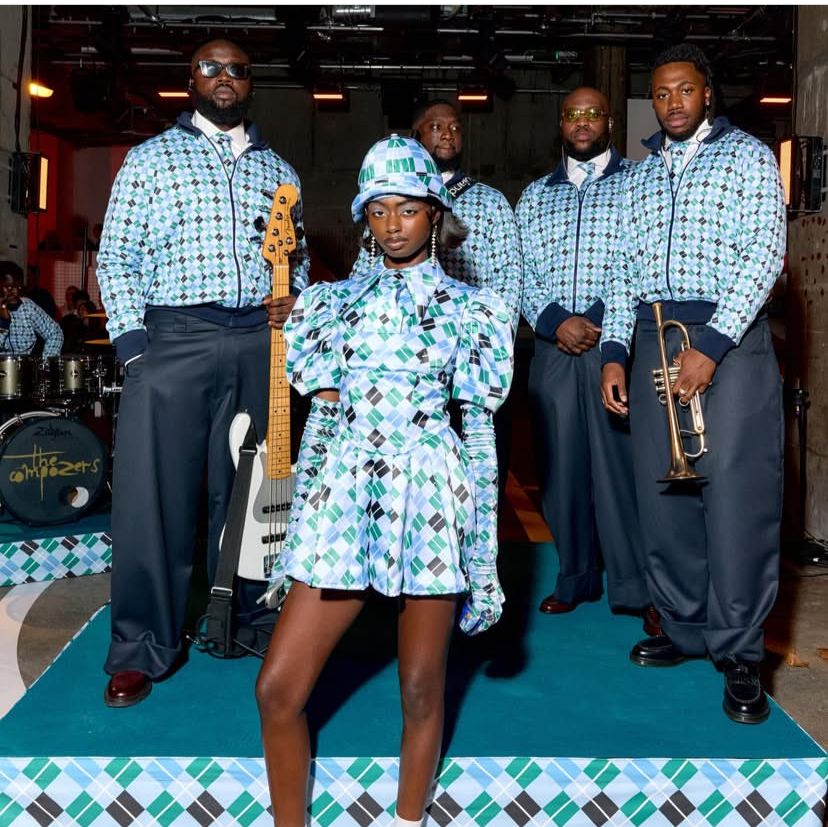
The clothes take centre stage here. Yoruba and British fashion codes collide deliberately. Structured tailoring meets cultural patterning, creating something that feels distinctly Afro-modern.  “Reclaimed satins merge the vibrancy of Yoruba textiles with the tradition of British tartans. The palette, juxtaposed against the sharpness of the silhouettes, narrates a tale of migrating cultures and the contributions of the African and Black Diaspora to the makeup of Britain”- Tolu Coker. 

Each garment carries its own tension, whether it is British wool, denim or reclaimed satins. The clothes had a story that followed them. The designs are almost architectural, with the knitted jumpers and jerseys highlighting a sense of evolution. Each colour, fragment, shape and textile are designed to match what it means to assimilate into a new culture. School uniform silhouettes remain the common structure - pleated skirts, crisp shirting, tightly knotted ties - trace the early stages of this transformation. But assimilation never fully completes itself. It fractures.

This is seen in the details; the way British forms are interrupted by something older and culturally rooted. The collection does not resolve these tensions; it holds them. And within that, the real weight of survivor’s remorse emerges. Not guilt for leaving, but awareness of what had to be adjusted, softened, or set aside in order to stay.

And finally, within it all, Tolu chooses to remain herself. The colour shifts, and tomato reds, lime yellows, saturated tones take centre. The colours reflect her heritage as a presence. She is not merging identities into something more palatable but allowing them to exist fully, without compromise.

“I think the key is being honest and being yourself ” - Simz on Tolu Coker’s Instagram, Feb 2026.

Survivor’s Remorse offers coexistence rather than fusion. The cost of becoming British does not have to be fusion, but adaptation. Yoruba and British identities do not negotiate; they sit side by side. To become British is never just a moment of arrival. It is a process of exchange. Of adaptation. Of translation. Of holding parts of yourself closer while letting others slip just enough to be understood. What Tolu Coker does with Survivor’s Remorse is make that process visible. She turns it into fabric, into structure, into movement. She refuses to let it sit quietly beneath the surface. And in doing so, she expands what fashion can hold: not just clothes, not just aesthetics, but memory, tension, and inheritance. The full, complicated weight of becoming, and the quiet power of choosing, finally, what you get to keep.

On the Runway: Tolu Coker’s Survivor’s Remorse and the Cost of Becoming British

Authored by
This is some text inside of a div block.

It started with concrete textures and stop signs. A mural stretched across the wall, sitting inside the strange familiarity of a West London street corner. The space felt nostalgic, almost tender, but the central mood of Survivor’s Remorse was something else entirely: bargaining.

Tolu Coker’s collection reads as a negotiation of identity; grief, loss, distance from cultural roots, and ultimately reclamation. Through structured silhouettes and geometric patterning, she builds a language that sits between worlds. What she presents is not just a collection, but a question: what does it cost to become British?

On February 19, 2026, she posted a short film, a prelude to the collection. At its core, it was a simple message: “Do not forget who you are.” For many Africans in the diaspora, that tension is constant. The pursuit of opportunity often comes with an unspoken exchange: proximity to success in return for distance from self.

Survivor’s Remorse sits inside that exchange. Drawing from her formative years in London, Coker constructs a world shaped by nostalgia. This is not memory as comfort. It is memory as something you have to actively hold onto. The cost of becoming is never simple. It begins with grief, not from entry to a better world, but from leaving the familiar and starting again. The excitement of a new world quickly meets the reality of unfamiliarity, and with it, the quiet pressure to become something else.

The set makes this clear before the clothes even arrive. A mural and nostalgic space that reminds you of unfamiliarity and the task of adapting, anchoring the room in memory. Coker is not just staging a show; she is staging absence. She reminds us that grief is not separate from creation; it is often what shapes it.

But grief does not sit alone. It shifts into aspiration.

The London Underground sign on set becomes more than scenery; it reads as a symbol of childhood longing. The city as a system, as a promise, as something you watch before you are fully inside it. Growing up on Mozart Street in Westminster means growing up close enough to power to recognise it, but far enough to understand that it is not yet yours. The presence of King Charles III in the room sharpens this tension. Power is no longer distant; it is watching. And in that moment, aspiration becomes something more complex. It is no longer just desire, but performance: learning how to speak, dress, and move in a way that allows entry.

And then comes assimilation.

The clothes take centre stage here. Yoruba and British fashion codes collide deliberately. Structured tailoring meets cultural patterning, creating something that feels distinctly Afro-modern.  “Reclaimed satins merge the vibrancy of Yoruba textiles with the tradition of British tartans. The palette, juxtaposed against the sharpness of the silhouettes, narrates a tale of migrating cultures and the contributions of the African and Black Diaspora to the makeup of Britain”- Tolu Coker. 

Each garment carries its own tension, whether it is British wool, denim or reclaimed satins. The clothes had a story that followed them. The designs are almost architectural, with the knitted jumpers and jerseys highlighting a sense of evolution. Each colour, fragment, shape and textile are designed to match what it means to assimilate into a new culture. School uniform silhouettes remain the common structure - pleated skirts, crisp shirting, tightly knotted ties - trace the early stages of this transformation. But assimilation never fully completes itself. It fractures.

This is seen in the details; the way British forms are interrupted by something older and culturally rooted. The collection does not resolve these tensions; it holds them. And within that, the real weight of survivor’s remorse emerges. Not guilt for leaving, but awareness of what had to be adjusted, softened, or set aside in order to stay.

And finally, within it all, Tolu chooses to remain herself. The colour shifts, and tomato reds, lime yellows, saturated tones take centre. The colours reflect her heritage as a presence. She is not merging identities into something more palatable but allowing them to exist fully, without compromise.

“I think the key is being honest and being yourself ” - Simz on Tolu Coker’s Instagram, Feb 2026.

Survivor’s Remorse offers coexistence rather than fusion. The cost of becoming British does not have to be fusion, but adaptation. Yoruba and British identities do not negotiate; they sit side by side. To become British is never just a moment of arrival. It is a process of exchange. Of adaptation. Of translation. Of holding parts of yourself closer while letting others slip just enough to be understood. What Tolu Coker does with Survivor’s Remorse is make that process visible. She turns it into fabric, into structure, into movement. She refuses to let it sit quietly beneath the surface. And in doing so, she expands what fashion can hold: not just clothes, not just aesthetics, but memory, tension, and inheritance. The full, complicated weight of becoming, and the quiet power of choosing, finally, what you get to keep.
This is some text inside of a div block.

On the Runway: Tolu Coker’s Survivor’s Remorse and the Cost of Becoming British

Authored by

It started with concrete textures and stop signs. A mural stretched across the wall, sitting inside the strange familiarity of a West London street corner. The space felt nostalgic, almost tender, but the central mood of Survivor’s Remorse was something else entirely: bargaining.

Tolu Coker’s collection reads as a negotiation of identity; grief, loss, distance from cultural roots, and ultimately reclamation. Through structured silhouettes and geometric patterning, she builds a language that sits between worlds. What she presents is not just a collection, but a question: what does it cost to become British?

On February 19, 2026, she posted a short film, a prelude to the collection. At its core, it was a simple message: “Do not forget who you are.” For many Africans in the diaspora, that tension is constant. The pursuit of opportunity often comes with an unspoken exchange: proximity to success in return for distance from self.

Survivor’s Remorse sits inside that exchange. Drawing from her formative years in London, Coker constructs a world shaped by nostalgia. This is not memory as comfort. It is memory as something you have to actively hold onto. The cost of becoming is never simple. It begins with grief, not from entry to a better world, but from leaving the familiar and starting again. The excitement of a new world quickly meets the reality of unfamiliarity, and with it, the quiet pressure to become something else.

The set makes this clear before the clothes even arrive. A mural and nostalgic space that reminds you of unfamiliarity and the task of adapting, anchoring the room in memory. Coker is not just staging a show; she is staging absence. She reminds us that grief is not separate from creation; it is often what shapes it.

But grief does not sit alone. It shifts into aspiration.

The London Underground sign on set becomes more than scenery; it reads as a symbol of childhood longing. The city as a system, as a promise, as something you watch before you are fully inside it. Growing up on Mozart Street in Westminster means growing up close enough to power to recognise it, but far enough to understand that it is not yet yours. The presence of King Charles III in the room sharpens this tension. Power is no longer distant; it is watching. And in that moment, aspiration becomes something more complex. It is no longer just desire, but performance: learning how to speak, dress, and move in a way that allows entry.

And then comes assimilation.

The clothes take centre stage here. Yoruba and British fashion codes collide deliberately. Structured tailoring meets cultural patterning, creating something that feels distinctly Afro-modern.  “Reclaimed satins merge the vibrancy of Yoruba textiles with the tradition of British tartans. The palette, juxtaposed against the sharpness of the silhouettes, narrates a tale of migrating cultures and the contributions of the African and Black Diaspora to the makeup of Britain”- Tolu Coker. 

Each garment carries its own tension, whether it is British wool, denim or reclaimed satins. The clothes had a story that followed them. The designs are almost architectural, with the knitted jumpers and jerseys highlighting a sense of evolution. Each colour, fragment, shape and textile are designed to match what it means to assimilate into a new culture. School uniform silhouettes remain the common structure - pleated skirts, crisp shirting, tightly knotted ties - trace the early stages of this transformation. But assimilation never fully completes itself. It fractures.

This is seen in the details; the way British forms are interrupted by something older and culturally rooted. The collection does not resolve these tensions; it holds them. And within that, the real weight of survivor’s remorse emerges. Not guilt for leaving, but awareness of what had to be adjusted, softened, or set aside in order to stay.

And finally, within it all, Tolu chooses to remain herself. The colour shifts, and tomato reds, lime yellows, saturated tones take centre. The colours reflect her heritage as a presence. She is not merging identities into something more palatable but allowing them to exist fully, without compromise.

“I think the key is being honest and being yourself ” - Simz on Tolu Coker’s Instagram, Feb 2026.

Survivor’s Remorse offers coexistence rather than fusion. The cost of becoming British does not have to be fusion, but adaptation. Yoruba and British identities do not negotiate; they sit side by side. To become British is never just a moment of arrival. It is a process of exchange. Of adaptation. Of translation. Of holding parts of yourself closer while letting others slip just enough to be understood. What Tolu Coker does with Survivor’s Remorse is make that process visible. She turns it into fabric, into structure, into movement. She refuses to let it sit quietly beneath the surface. And in doing so, she expands what fashion can hold: not just clothes, not just aesthetics, but memory, tension, and inheritance. The full, complicated weight of becoming, and the quiet power of choosing, finally, what you get to keep.

Other Stories
London
London
Lagos
London
Newyork
London
Shop
Join the community.
You are now subscribed to receive updates.
Oops! Something went wrong while submitting the form.