.svg)

.jpg)
Pharrell Williams has not produced a disappointing season since taking over as Louis Vuitton’s menswear creative director in 2023, and that consistency is precisely what makes his tenure worth examining closely. Every collection has been wearable, considered, and recognisably elegant, built around silhouettes that rarely stray far from what came before them. The choirs, the rivers, the architecture, and the game boards have, however, been among the most ambitious theatre contemporary fashion has produced, and the distance between the two is the most revealing thing happening at the house right now.
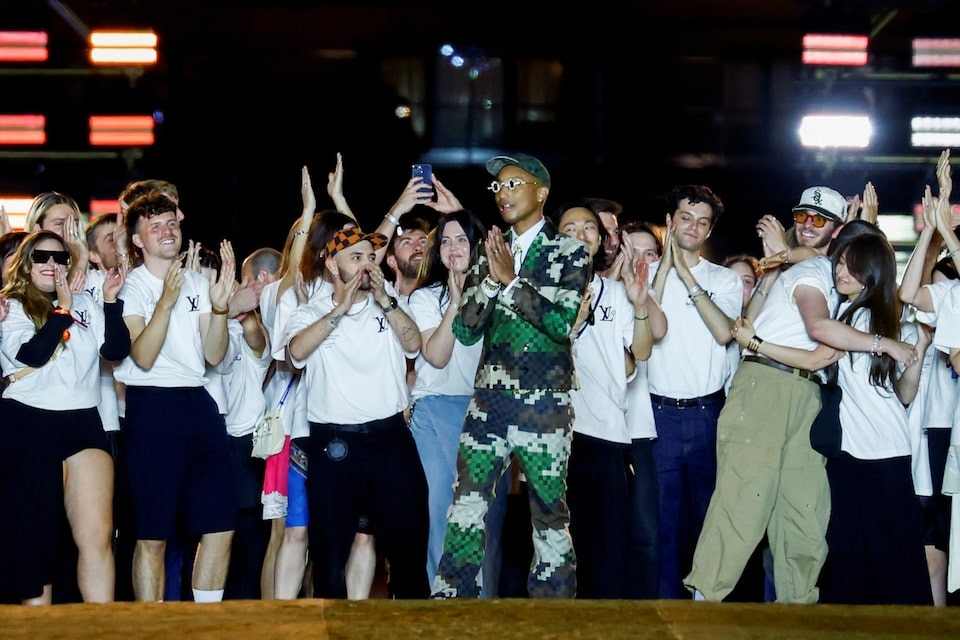
His debut established the formula in full. For Spring/Summer 2024, Williams shut down Paris’s Pont Neuf, one of the city’s oldest bridges, with guests arriving by boat to watch gospel choir Voices of Fire perform an original composition he produced himself, accompanied by pianist Lang Lang and a live orchestra. Jay-Z performed after the show closed. Beyoncé, Rihanna, Zendaya, A$AP Rocky, and LeBron James sat front row, lending the evening the texture of a cultural event rather than a seasonal presentation. The clothes themselves, by contrast, drew immediate comparisons to Williams’s own earlier Nigo and Human Made collaborations with the house, built on slim-fit tailoring, a pixelated “Damoflage” reinterpretation of the brand’s Damier print, and a reworked Speedy bag. Critics described the collection as disappointingly safe even as nobody described the staging surrounding it as anything less than spectacular.
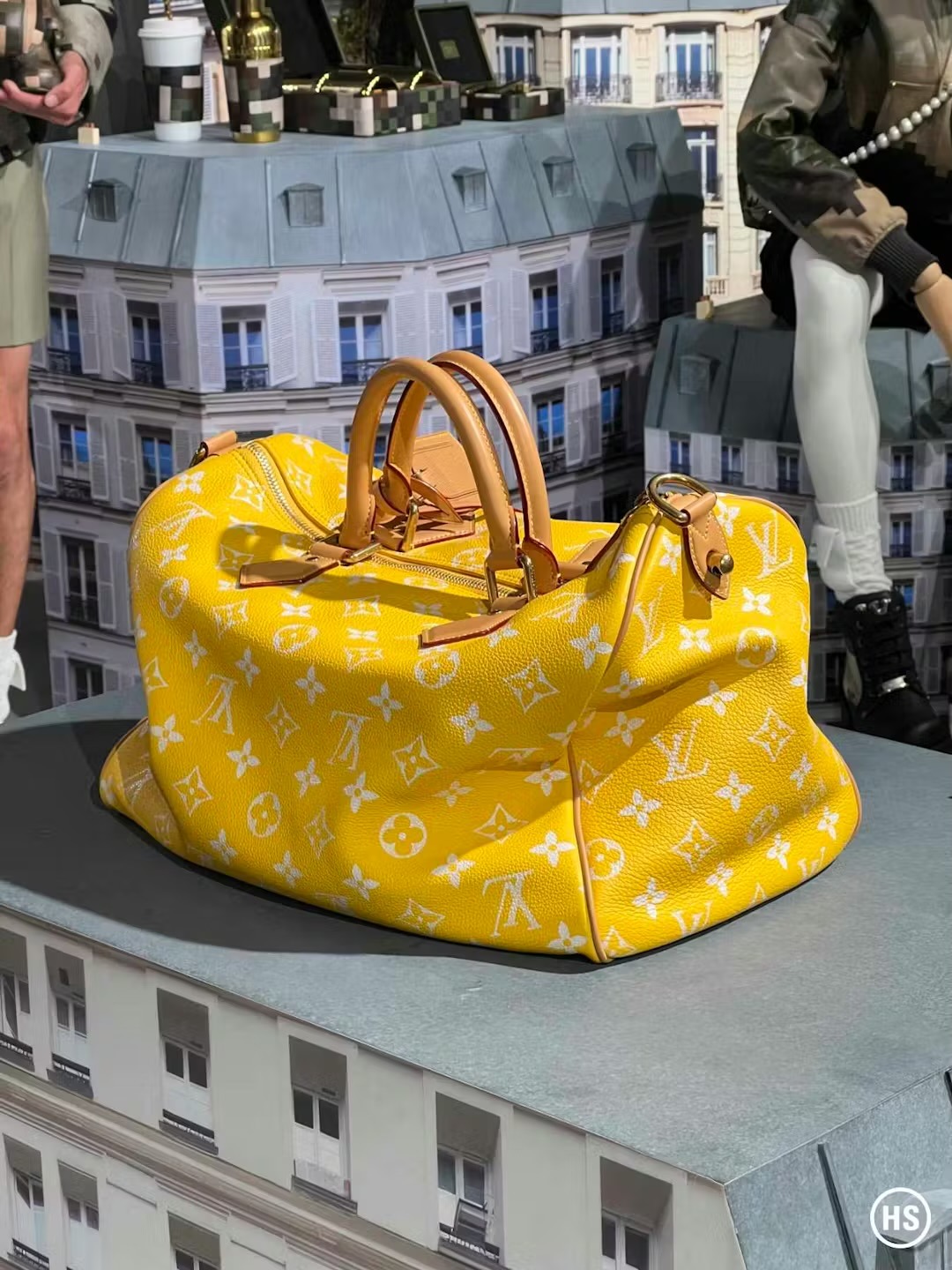
The bags told the same story in miniature. Williams’s debut also introduced the Millionaire Speedy, a reworking of Louis Vuitton’s nearly century-old Speedy silhouette in crocodile leather with gold hardware and diamond-encrusted closures, priced at $1 million and available only by invitation. The bag itself altered nothing structural about a shape the house has sold since the 1930s. What changed was the material, the mythology, and the audience permitted to buy it. Williams described the design as channeling “the attitude and hustle mentality of Canal Street,” the Manhattan strip famous for counterfeit luxury goods, recreating the soft, slightly blurred monogram effect associated with knockoffs through a deliberate, controlled silkscreen process rather than disowning it. Rihanna and LeBron James appeared in the campaign. The bag became one of the most discussed luxury objects of the year without requiring a single new silhouette, the clearest possible miniature of the formula playing out across his entire tenure: change the story being told around the object, leave the object substantially alone.
That same pattern scaled further with each successive show. For Spring/Summer 2026, Williams transformed the forecourt of the Pompidou Centre into a 2,700 square foot Snakes and Ladders board, the product of months of collaboration with Studio Mumbai and architect Bijoy Jain. Beyoncé’s arrival was choreographed as a moment within the show itself, with guests becoming playing pieces on a structure built to monumental scale. The collection drew its inspiration from India as a source of creative energy rather than from specific silhouettes or garments, producing clothing that was handsome and wearable but conceptually thinner than the 2,700 square feet of set design surrounding it.
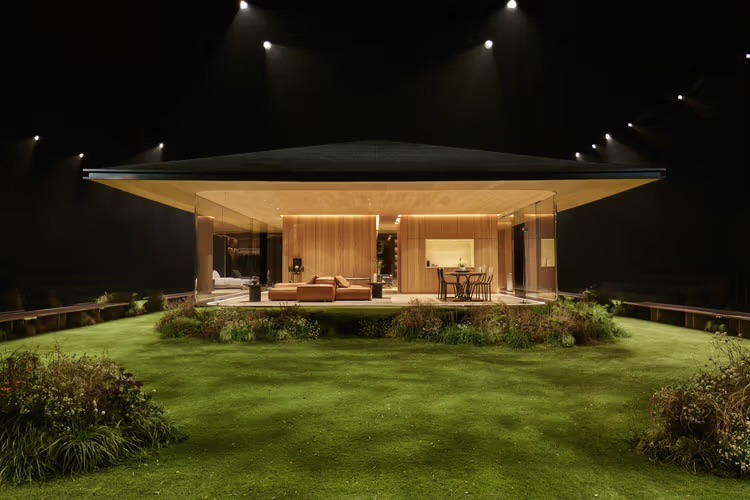
By Fall/Winter 2026, Williams had extended his ambition into architecture entirely, unveiling DROPHAUS, a “timeless future living concept” developed with Japanese studio Not A Hotel and installed inside a Zen garden at the Louis Vuitton Foundation. “Drophaus is my vision of the future,” he told Wallpaper Magazine. “I’m not an architect. I’m a solution builder.” Critics at Numéro described the collection itself as fairly classic, grounded in earthy, utilitarian tones, conceding that bolder stylistic statements might have been hoped for before acknowledging that bold statements were never really the point.
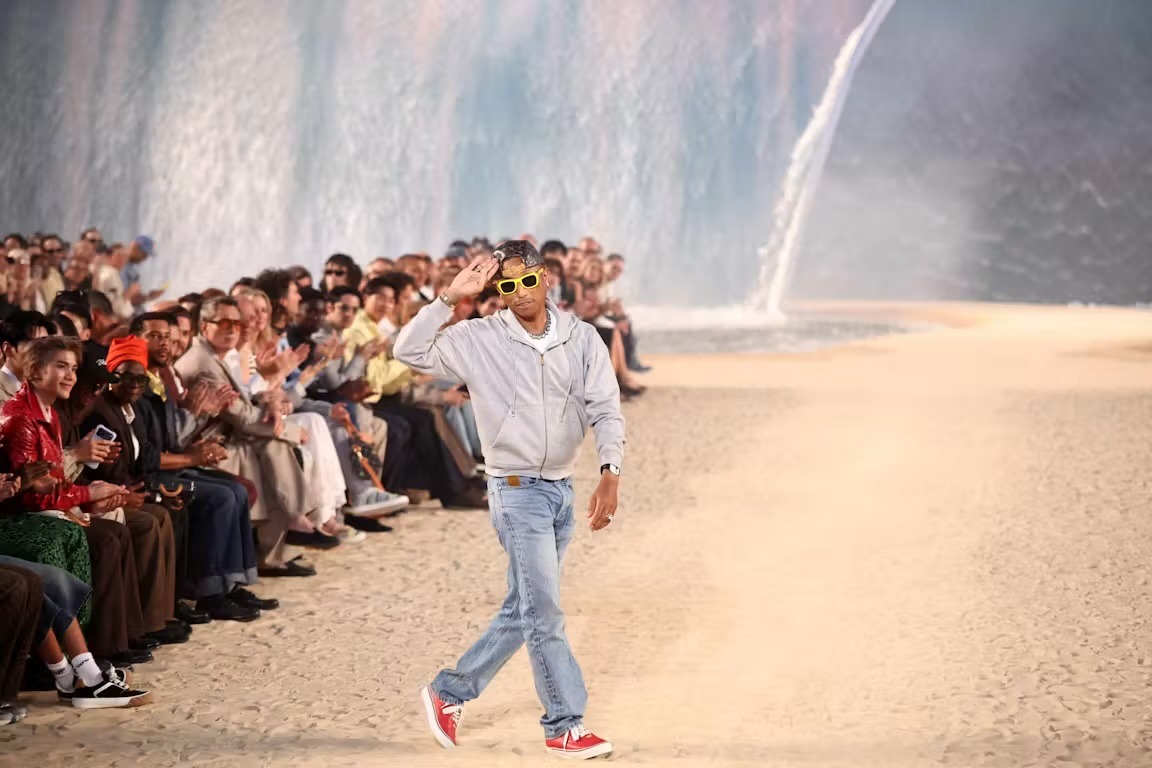
The Spring/Summer 2027 Pre-Collection, “Whatever the Weather,” continues the approach without deviation, offering travel-ready tailoring photographed beautifully and recognisable as yet another iteration of a formula Williams has maintained consistently since his first season.
None of this happened by accident, and Williams has never suggested otherwise. He inherited the role from Virgil Abloh, whose own tenure at Louis Vuitton was built on curation and cultural connection rather than pure technical innovation, a “curatorial, dot-connecting role” rather than a strictly design-driven one, as one fashion newsletter founder put it at the time of Williams’s appointment. Williams simply extended that inheritance, treating his own discography as narrative material the way another creative director might treat archival research. A gospel choir has appeared at nearly every major show of his tenure. He scores his own runways.
What critics calling the clothes boring tend to overlook is the part of the job that happens nowhere near a runway. Louis Vuitton’s parent company, LVMH, reported revenue of 80 billion euros the year Williams was appointed, and a house operating at that scale answers to a clientele, a set of sales projections, and a wardrobe strategy that exists independently of what fashion writers want to see on stage. Williams has been transparent about exactly this dynamic. “There are a lot of people entering the stores and asking for Pharrell’s products,” LVMH CEO Pietro Beccari confirmed shortly after his debut show. Williams himself has described designing with his own taste as the benchmark, preferring to “go narrow and go deep” rather than dilute ideas to satisfy everyone watching. He has been even more direct about the commercial logic underneath the cultural spectacle. “My culture has been a very significant contributor to the bottom line every quarter,” he said. “That’s not lost on the house. That’s not lost on the family. That’s not lost on me.”
That admission reframes the entire criticism. If Williams’s clothes changed tomorrow to satisfy the people calling him predictable, nothing guarantees Louis Vuitton’s actual customer, the one currently walking into stores asking for his exact products, would follow him there. The spectacle is not compensating for a shortage of design ambition. It may constitute the design strategy in full, keeping the product recognizable and wearable enough to sell at scale while allowing the show to carry whatever risk the garments were never going to take on themselves.
The criticism is not wrong so much as misdirected. Pharrell Williams is not failing to be a daring designer. He has built a version of the role in which daring lives somewhere other than the garment, inside the choir, the architecture, the 2,700 square feet of game board, the boat ride to a bridge that does not usually permit boats through. He is never bad. He is good, better, occasionally his best, and never anything less than that. Whether that range reflects a fashion industry too commodified to permit real risk at this scale, or a genuinely brilliant reading of what a luxury house with an 80 billion euro parent company can actually afford to gamble on, is the harder question underneath this entire conversation. Williams has already answered it for himself, on record, more than once. The clothes carry the business. The choir carries the culture. He built a tenure where neither one has to risk failing the other.
IG: @sophiannadozie


.png)

