.svg)

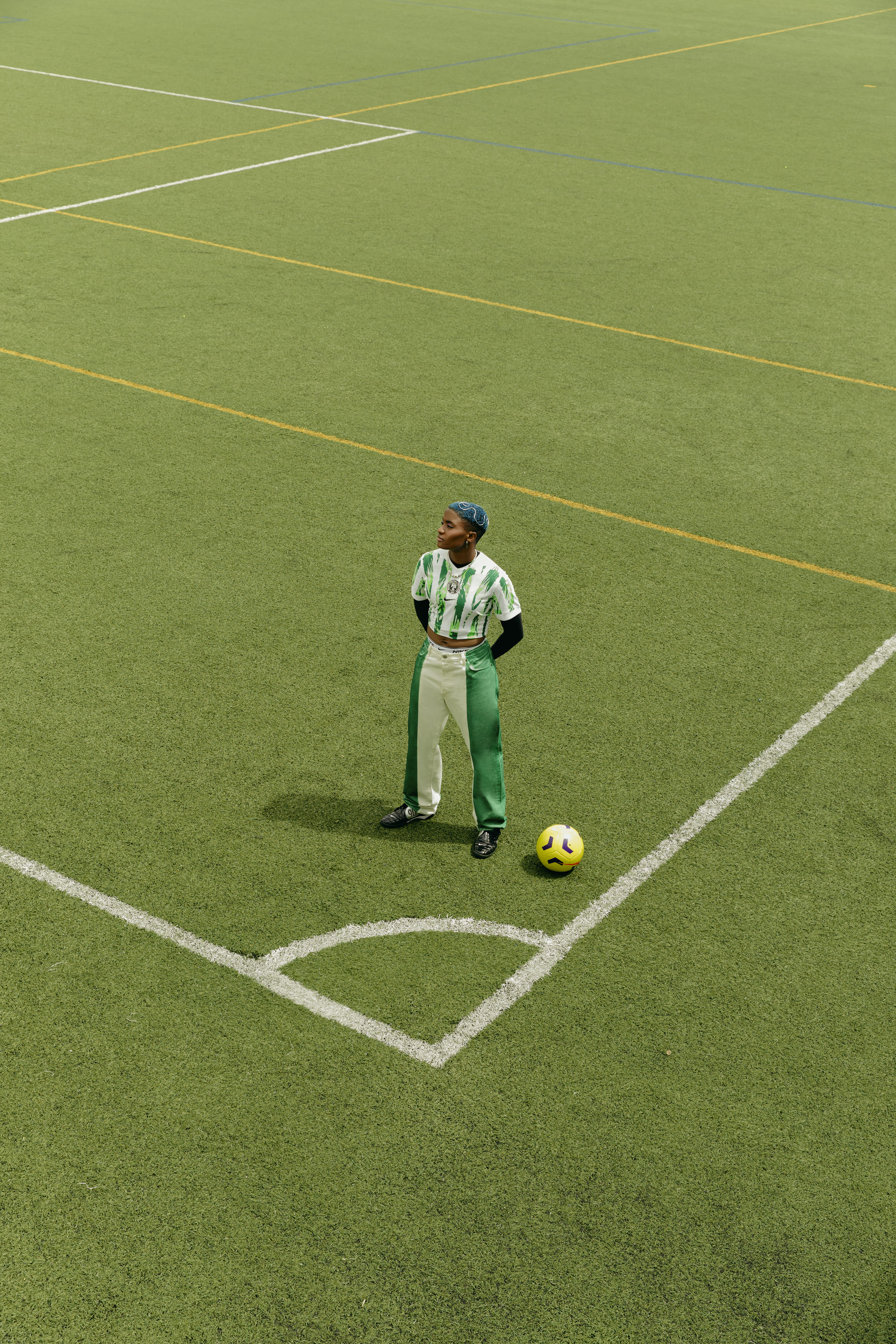
At the shrill sound of the final whistle of Nigeria's Round of 16 match against Germany at the 2019 Women's World Cup in France, the Super Falcons suffered a harrowing 3-0 defeat. Yet, Rasheedat Ajibade was left with one feeling. "I was happy," she says gleefully. "We lost but I was so proud of the fact that I was able to step up to the occasion with so much flair, composure, and confidence."
Unbeknownst to the then eager 19-year-old making her global debut on the senior team, these would be some of the character traits that'll mark her captaincy once inheriting the armband only a few years down the line. In that moment in France, however, it felt like a culmination of all the years of hard work.

Ajibade was born in Mushin, Lagos, to a large family of four sisters and a brother. Though financial hardship shaped most of her early life, football offered her a sense of purpose. "Coming from a low income background, I saw my mom do a lot just to ensure that she puts food on our table," she explains. "I just kept promising myself that one day, I'm going to help her out of that situation." In 2013, she joined FC Robo Queens in the Nigeria Women's Premier League, and by 2017 was already one of the country's most exciting young talents.
The years that followed took her from domestic standout to continental fixture — a move to Atlético Madrid (and eventually Paris Saint-Germain), a growing presence for the Super Falcons at successive WAFCON tournaments, and eventually, the armband itself. It was while wearing that armband that she led Nigeria to a 10th WAFCON title (the most of any team on the continent) last July and was named Player of the Tournament for her efforts.
.jpg)
As we speak over Zoom, she does so from Morocco, the host country where the Super Falcons hope to defend their title and extend their streak with an 11th tournament win at WAFCON 2026. It's the day following their 2-1 victory in the warm-up game against the Twiga Stars of Tanzania, and Ajibade's famed composure and confidence remain palpable. "There's no pressure honestly," she says calmly, with an air of certainty. "When you want to protect and defend something, it takes a lot of effort and intentionality so everyone is locked in and focused for the next couple of weeks. We're just going to take it one game at a time and be present in the moment."
By every measure, the Super Falcons are the most decorated and dominant national football team on the continent, with the Egyptian men's team trailing slightly behind. In the tournament's 13-year history, the only nations that have been able to break Nigeria’s stronghold are Equatorial Guinea (2008 and 2012) and South Africa (2022). It goes without saying that with the weight of such a feat comes with an equally immense amount of expectation especially as a WAFCON victory doubles a qualifier for FIFA’s Women’s World Cup in Brazil next year. Ajibade acknowledges this expectation, and almost welcomes it. "We're a team that everyone is looking forward to winning against. We know what our goal is, and that is to keep setting the standard.”

The plan for managing the expectations and heading down the road to the 11th win clear-eyed seems simple enough for Ajibade. The first thing is breaking free from external noise. “Sometimes that can come from the camp or even administrators of the games,” she says. “I just put everything in God’s hands. Prayer and the word of God keep me grounded. I also don’t use social media much.” The second is leaning on her teammates. “I confide in them. We’ve been here before so no stress,” she notes. When I ask about her individual goals at the tournament as captain and the last Player of The Tournament title holder she points back to the power of the collective vs that of the individual. “I carry the armband. But the team carries a trophy,” she notes. “Of course getting Player of the Tournament is nice. But for me, I always think about carrying the team first. Every time I step on that pitch, what’s on my mind is ‘how can I either support my teammates better? How can we all work together to be better.’ Even after every game, I'm thinking about what we can do to be better for the next game even if we win or not”.

That same collective mentality is what Ajibade believes will finally close the gap between continental dominance and global relevance. Nigeria's stronghold over Africa has never fully translated on the sport's biggest stage. The quarter-final finish back in 1999 remains the Super Falcons' best showing at the Women's World Cup. For Ajibade and this generation of Falcons, winning at WAFCON is far from the end goal. “Being the most decorated team in Africa gives us a sense of pride but we also want to set the global standard [in women’s football] Our biggest goal is to win the World and we know it’s doable,” she says with the same unwavering confidence. With Brazil 2027 already cutting close and their statistical position as favourites to win WAFCON 2026, that ambition might not be abstract for much longer. All that’s left is employing Ajibade’s philosophy of letting it all play out one game at a time.





.png)

