.svg)

.JPG)
At the Victoria and Albert Museum in London, Schiaparelli: Fashion Becomes Art stages a confrontation between fashion as adornment and fashion as disturbance, assembling over 400 objects into a retrospective that feels, at first glance, almost too coherent. The exhibition proposes Elsa Schiaparelli as the definitive bridge between couture and avant-garde practice. Moving through it, a more complicated question emerges: what does it mean to canonize a designer whose work was built on resisting coherence altogether?
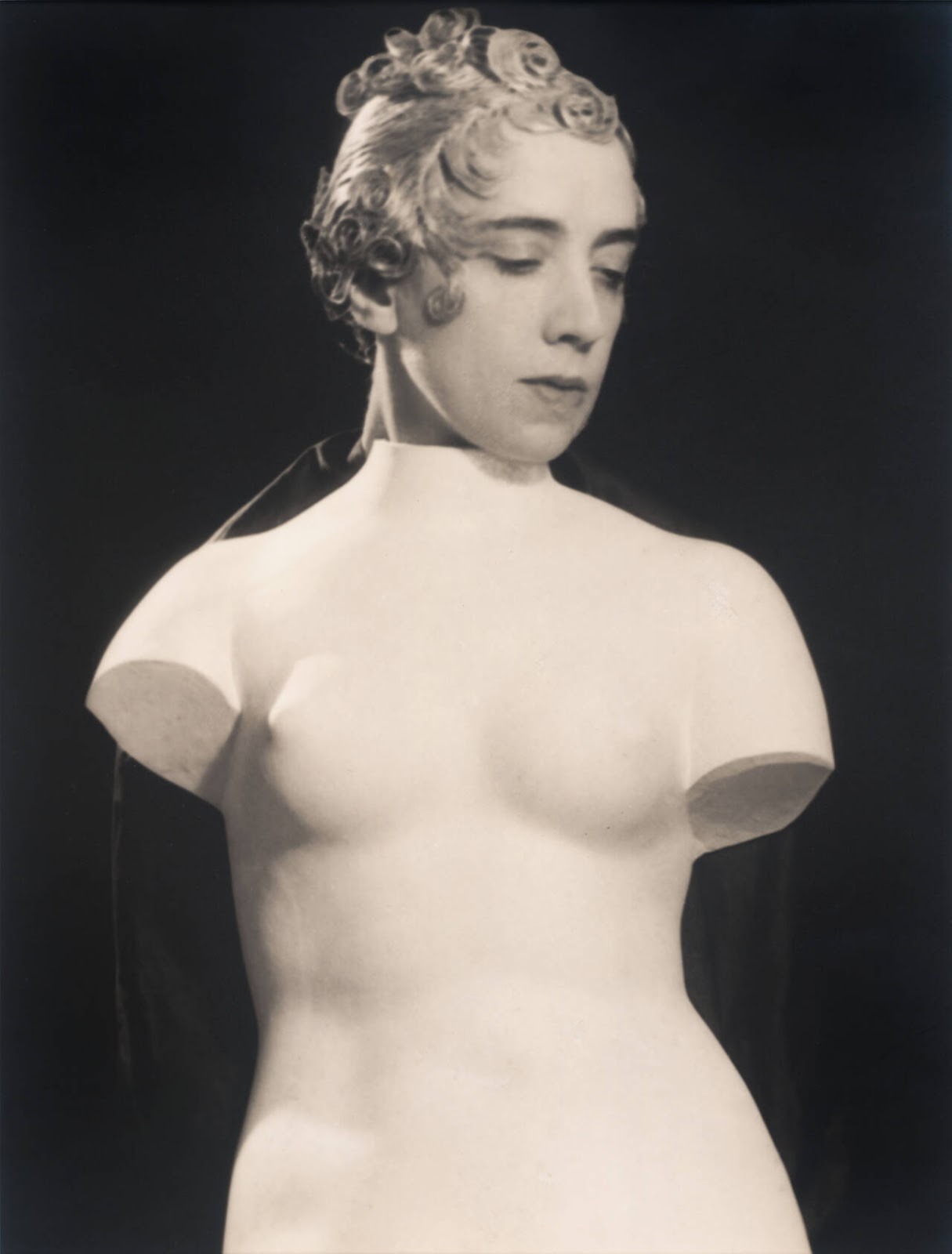
The galleries open with familiar anchors — the 1938 Skeleton Dress, its raised ribs pressing outward through black crepe with a grotesqueness; the Tears Dress, printed and slashed into illusionistic wounds; the Lobster Dress, developed with Salvador Dalí, placed in dialogue with his Lobster Telephone. These works are framed as surrealist artefacts, evidence of Schiaparelli’s proximity to the avant-garde. But reading them only through surrealism softens their impact. The skeleton dress does much more than reveal. It imposes, reorganizing the body into surface, flattening interiority into something visible, stylized and strangely controlled.
That tension between exposure and construction threads through the exhibition. Trompe l’oeil knitwear mimics bows and tailored details that don’t exist, embedding illusion into the everyday. The Shoe Hat collapses function into absurdity with unsettling precision. Even the smallest details, buttons shaped like insects, peanuts, and miniature objects, interrupt the visual continuity of garments, forcing attention onto elements typically designed to disappear.

As the exhibition expands, so does Schiaparelli’s world. Evening jackets sprout gilded sculptural forms; jewellery mimics body parts and symbolic relics; archival letters and sketches trace her exchanges with collaborators like Jean Cocteau. Artworks by Man Ray and the portrait of Nusch Éluard by Pablo Picasso position her firmly within a surrealist network, while also risking a certain stabilization.
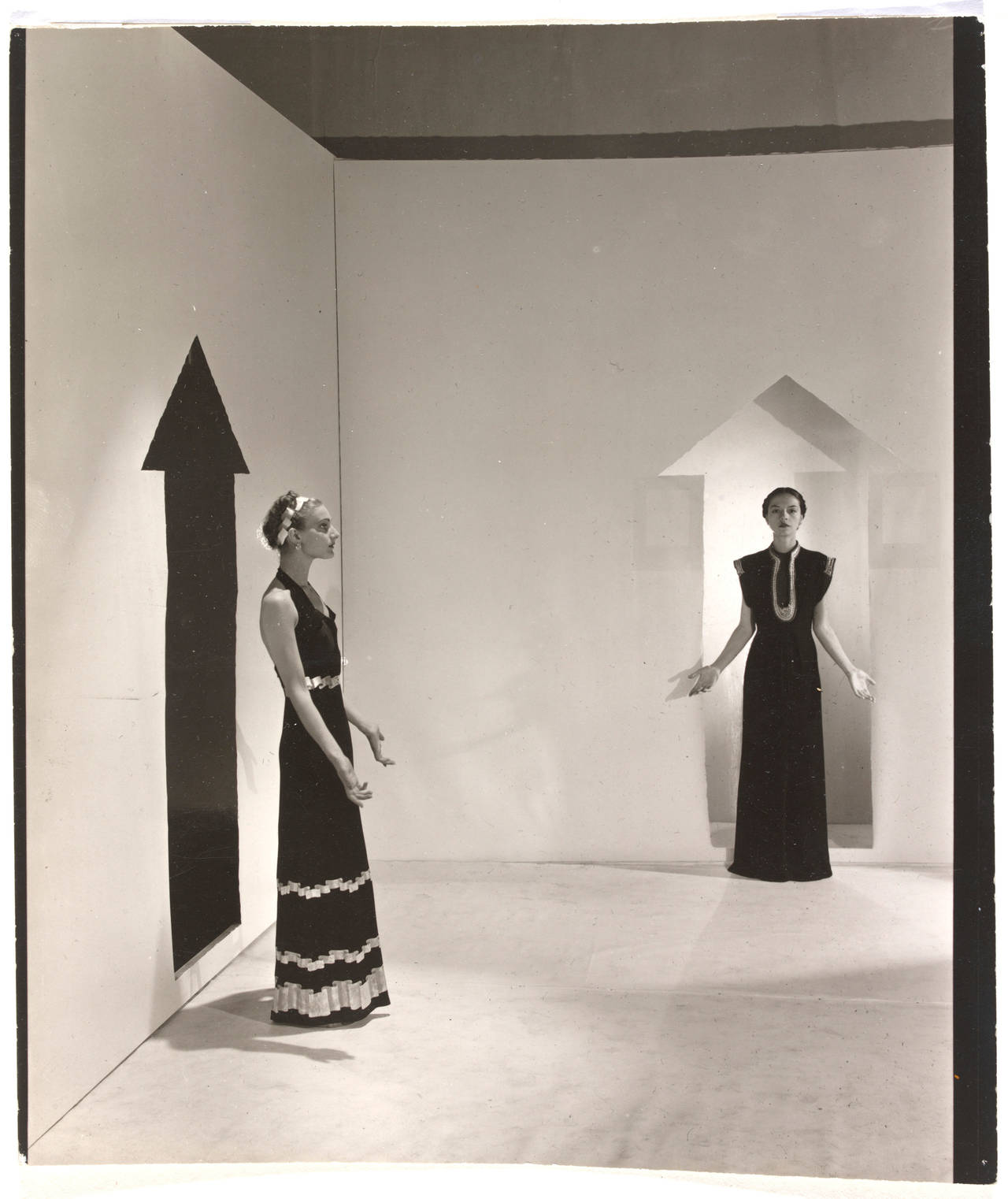
There is a subtle, more revealing narrative embedded in the exhibition’s margins. Garments produced for her London salon in the 1930s speak to a transnational practice spanning Paris, London, and New York. Photographs of her in the Place Vendôme studio construct a persona as deliberate as her designs. Costume work for performers like Marlene Dietrich and Mae West extends her reach into cinema, where clothing serves as a narrative device filled with character. Across these contexts, Schiaparelli emerges not just as a designer, but as a strategist of image and someone deeply attuned to visibility and circulation.
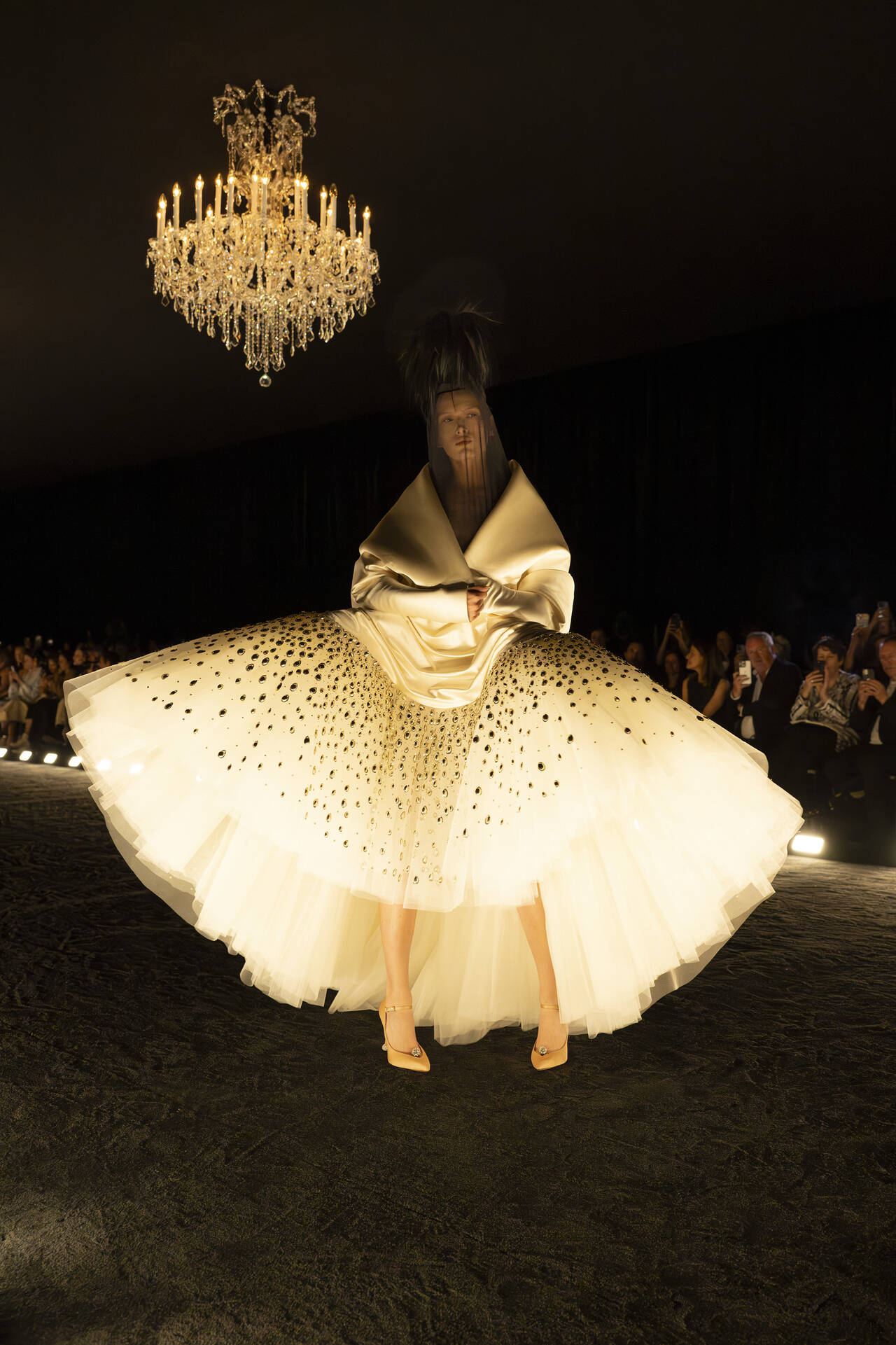
The exhibition occasionally leans toward coherence, smoothing over the contradictions that make her work most vital. The messiness of collaboration, the asymmetry of influence, the calculated construction of her own myth — these are present, but not interrogated as much. What gets lost is the sense of Schiaparelli as fundamentally unstable.
This instability feels especially charged in the final section, where the house’s present-day evolution under Daniel Roseberry is framed as a continuation. His couture, worn by figures like Dua Lipa and Ariana Grande, translates Schiaparelli’s surrealist vocabulary into sculptural, highly controlled forms. With gold lungs, anatomical corsetry, and face-shaped jewellery, each piece is engineered with precision, designed to register instantly and to circulate seamlessly within a contemporary image economy.
When placed in proximity to Schiaparelli’s original work, the differences are sharpened. Where her garments feel unruly and almost accidental in their strangeness, Roseberry’s appear exacting, almost fully aware of their reception.
This is the exhibition’s most compelling tension, and also where it pulls back. It gestures toward the question without fully inhabiting it: when surrealism becomes a house code, what happens to its capacity to unsettle? And when disruption is institutionalized, can it still function as critique?

Schiaparelli: Fashion Becomes Art ultimately positions the house as an ongoing project, a lineage that stretches cleanly from past to present. But the more interesting reading resists that smooth continuity. It lingers instead in the fractures, between object and body, art and fashion, disruption and spectacle.
Schiaparelli’s legacy was never just about merging fashion and art solely. It was about making that boundary unstable, difficult to locate and impossible to fix. Her garments don’t resolve into meaning. Instead they hover, unsettled and unresolved. That is precisely where the exhibition is most successful, in the moments where it falters and where coherence slips.



.png)

