.svg)

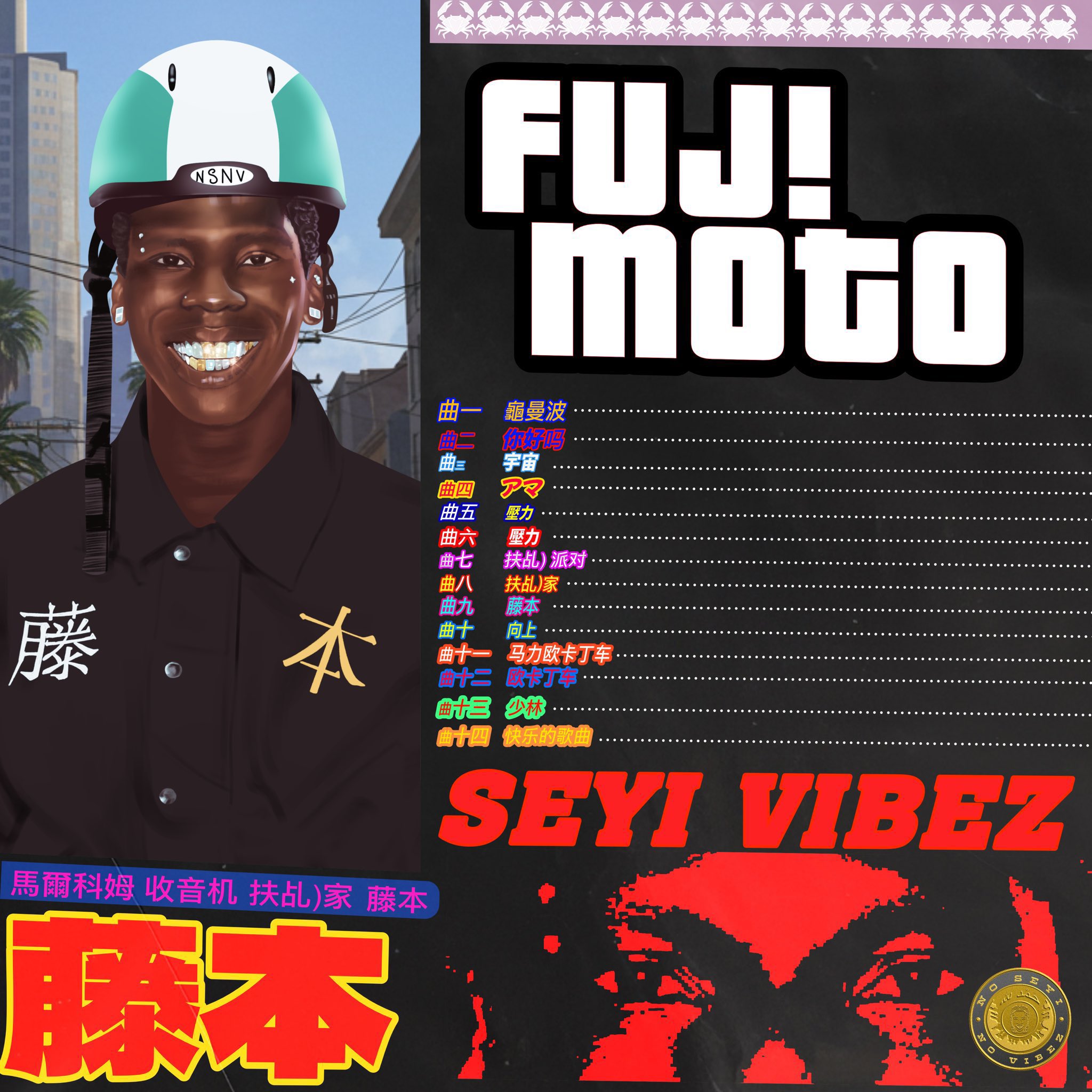
Seyi Vibez returns in relentless form with Fuji Moto, a project that expands, if not complicates his already towering catalogue. Now on his seventh release, the Street-pop luminary attempts a cross-cultural fusion: a 14-track collection adorned with Japanese imagery, a title referencing the “wisteria root,” and guest appearances ranging from Olamide to French Montana and Trippie Redd. The conceptual promise hints at a journey back to the origins of his craft, yet filtered through the metaphorical lens of Japanese aesthetics. Whether that symbolism translates sonically is another question entirely.
The album opens with Tortoise Mambo, where Seyi Vibez steps forward like a showman in a hall of mirrors, boasting the ability to shapeshift vocally into Saheed Osupa, Ed Sheeran, and Bob Marley. It’s a flamboyant overture and a proclamation of range, yet the irony isn’t lost that such global versatility stands in contrast to the album’s title, which suggests a grounded cultural core. On How Are You, one of the pre-released tracks, Seyi glides into the Afro-house wave with the ease of someone walking into a familiar room. The record’s heavy drums and escalating groove create a dance-floor invitation, but the songwriting leans on simplicity—“Baby how are you / I just want to say hello”—resulting in a track that moves more than it speaks. Universe brings the expected: crowd vocals, rolling log drums, and an amapiano backbone polished for nightlife. The hook, bright and insistent, does the heavy lifting, compensating for verses that feel more functional than inspired.
The tempo collapses into something tender on Ama, a grieving letter to his late mother. Here, Seyi Vibez sheds the performer’s armor entirely. The delivery is raw, almost fragile, as if every note trembles under memory’s weight, this is a standout moment where he finally allows vulnerability to lead. The emotional grip loosens with the Pressure remix featuring French Montana. Though the production maintains the reflective calm, Montana’s verse feels more like an email attachment than an extension of the song’s emotional world. The synergy never quite materialises, and the remix dilutes more than it adds.
Then the album bursts open like lights at a street carnival: Fuji Party featuring Olamide is a chaotic but intriguing blend, Japanese shakuhachi flutes flirting with talking drums, amapiano bounce, and heavy kicks. It’s frenetic, infectious even, but the title overpromises; there’s little Fuji texture within. Olamide, however, arrives with a nostalgic spark, tapping into his early-2010s cadence with ease. Fuji House leans into high-energy theatrics with synths, electric guitars, commanding drums yet the songwriting falters. Seyi Vibez spends the track hailing different acts in a way that nods to Fuji tradition, but the execution feels shallow, more a gesture than a deep dive. On the title track Fuji Moto, the presence of Waka-style chants creates a familiar Muslim spiritual undertone, and Seyi delivers with conviction. Still, despite its sonic richness, it skirts the very Fuji essence it claims to celebrate another disappointing instance where imagery outweighs intention. Up, featuring Trippie Redd, pulls the album back into moody introspection. It’s a trap-R&B hybrid that plays out like a late-night confession, and Trippie delivers one of the most fluid, complementary verses on the entire project. The track feels like a natural endpoint, a much needed cooling before the cohesion fractures entirely.
The remaining songs, Mario Kart, Macho featuring NLE Choppa, Shaolin, Happy Song, excoet Pressure are all previously released cuts from the Children of Africa EP. Their inclusion abruptly shifts the album from narrative to compilation, flattening any thematic build Seyi Vibez had begun to construct.
Fuji Moto places Seyi Vibez in a sharp tension between presentation and execution, a tug-of-war where the aesthetics win far more battles than the ideas behind them. The project leans heavily on Fuji-adjacent branding: Japanese motifs splashed across the rollout, Fuji-inspired titles, and metaphors that suggest a deep-rooted cultural excavation. Yet what you encounter sonically is a far more familiar terrain, sleek Afro-fusion tapestries, well-oiled amapiano frameworks, and contemporary street-pop formulas that, while impeccably produced, rarely engage with the Fuji tradition the album claims to orbit. The production across the album is undeniably stellar. The arrangements are layered with precision, the percussion sits with a polished weight, the sound design is immersive, and even the genre blends, though occasionally chaotic, are executed with technical finesse. Tracks like Fuji Party and Universe shimmer with world-building detail, demonstrating that he understands atmosphere, groove, and audio architecture at an elite level. But this excellence in production exposes the conceptual gap even more clearly: the soundscapes rise while the thematic direction struggles to keep up.
The album’s promised exploration of “roots”—hinted at through the Japanese “Moto” metaphor and Fuji references never materialises in the songwriting, structure, or vocal approach. Instead, Fuji becomes a decorative accessory rather than a core influence. What should have been a cultural deep-dive feels more like a visual motif stretched thin across an unrelated sonic palette. And with the inclusion of previously released songs from Children of Africa, the project’s conceptual thread snaps entirely. What began as an exploration of identity gradually morphs into a loosely arranged playlist, undermining any sense of narrative cohesion or artistic intent. In the end, Fuji Moto stands as a beautifully produced but thematically hollow experiment, a collection of strong songs waiting for the concept that was supposed to hold them together.





.png)

