.svg)

.JPG)
There’s been multiple moments over the past year when it’s impossible to look at a handbag without something hanging off it. Labubus clipped onto Birkins. Tiny books dangling from Miu Miu Arcadies. Beaded charms attached to bags already overloaded with keys, ribbons, headphones, and half a personality. Accessories stopped being singular objects and started becoming whole ecosystems — messy accumulations of taste, irony, nostalgia, and internet literacy all hanging together at once.
The Audemars Piguet x Swatch “Royal Pop” collaboration arrives directly inside that cultural shift. Before the watch's official photos were released, AI-generated images of brightly coloured plastic Royal Oaks had already spread across social media, circulating fast enough to shape public perception. The fantasy of an accessible Audemars Piguet moved through the internet almost too perfectly: candy-coloured bezels, Swatch materials, AP branched into something suddenly obtainable. By the time the real collaboration appeared earlier this week, people had already written their own version of the story.
What Swatch and Audemars Piguet released felt less predictable. Rather than producing a direct reinterpretation of the Royal Oak, the brands introduced eight oversized pocket watches inspired by Swatch’s archival POP watches from the ‘80s, complete with detachable clips, chains, and leather lanyards designed to move the watch beyond the wrist entirely.
Framed by the brands as a meeting point between “joyful boldness” and “positive provocation,” the collaboration positions itself as a disruption of watchmaking’s inherited codes. It is presented as a rule-breaker: a collection that challenges not only what a watch looks like, but how it is worn, where it sits on the body, and what it signifies when it leaves the wrist entirely.
Royal Pop merges two distinct visual languages: Audemars Piguet’s Royal Oak, one of the most recognisable luxury watch designs in circulation, and Swatch’s modular POP line from the 1980s, known for its interchangeable, playful system of wear. The result is eight statement-making pocket watches designed for “endless creative styling,” shifting the watch from fixed object to mobile accessory.
Suddenly, one of the most recognizable symbols in luxury watchmaking looks closer to a bag charm than a collector’s object, and predictably, watch forums are spiraling. But the anxiety surrounding Royal Pop reveals something larger about how luxury currently functions. The outrage has very little to do with the actual design of the watches and almost everything to do with what the Royal Oak represents culturally. Over the last decade, the watch has become deeply entangled with scarcity, and wealth performance. The Royal Oak operates less as a practical object than a social signal, and a shorthand for access itself.
Royal Pop interrupts that language slightly. Not fully, but enough to make people uncomfortable. What makes the collaboration so smart is that Audemars Piguet never actually compromises the exclusivity of the original Royal Oak. The watches avoid becoming straightforward plastic APs by refusing the traditional wristwatch format altogether. Instead, the collaboration translates the visual identity of the Royal Oak into something modular, playful, and culturally mobile.

And fashion has already been moving in that direction for a while.
Over the last few years, luxury consumers have become increasingly interested in objects that function symbolically, even if it evades practicality. Fashion’s obsession with charms, trinkets, and collectible accessories exists within that same ecosystem: objects acting as visible markers of taste, personality, and cultural awareness. Royal Pop understands this instinct perfectly.
People are not going to wear these watches traditionally. They are going to attach them to handbags, backpacks, belt loops, suitcases, headphones, and keychains. Someone will inevitably clip one onto their bag, and Royal Pop feels designed for circulation already. That fluidity feels particularly important for luxury watchmaking right now. For years, the industry has remained trapped in conversations around investment value, waitlists, resale markets, and technical legitimacy. Seriousness is the dominant aesthetic. Quiet luxury only intensified that atmosphere further, flattening fashion into increasingly muted displays of restraint. Royal Pop cuts through all of that with colour, absurdity, and a sense of play that feels intentionally contemporary.
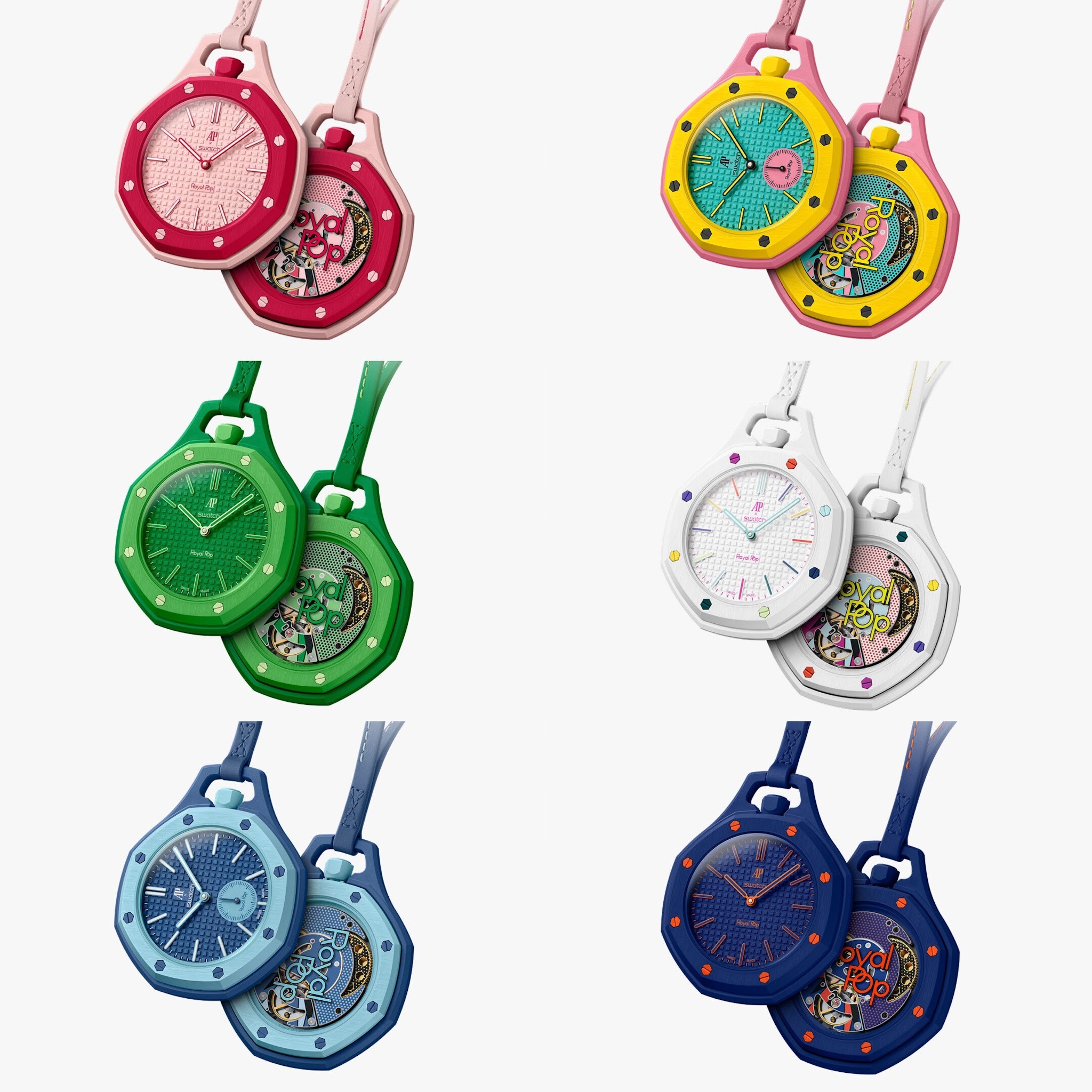
The collaboration also builds on the strange cultural space Swatch has occupied ever since the original MoonSwatch launch in 2022. That release transformed Omega’s Speedmaster into a mass-market cultural object without significantly damaging the mythology of the original watch. Long queues formed outside stores, resale prices exploded, and younger consumers who had never engaged with watch culture suddenly cared about horology, or at least its imagery.
Blancpain followed with the Fifty Fathoms collaboration in 2023, though the impact felt more contained within watch communities. Audemars Piguet entering this territory always carried more symbolic weight because the Royal Oak occupies a different position within fashion culture itself. The watch exists simultaneously as a luxury object, accessory, and internet shorthand.
Royal Pop navigates this by leaning fully into this. Even before launch day, third-party brands had already started producing wrist adapters and replacement straps designed to transform the pocket watches into traditional wearables. Consumers immediately began reshaping the product beyond the intentions of either company. That responsiveness feels central to contemporary fashion consumption now: luxury objects no longer remain fixed after release.Their meaning evolves collaboratively through styling, customization and online circulation.
In many ways, the collaboration feels like the watch industry finally catching up to how fashion already behaves online. Because increasingly the social life surrounding objects matters more.
Online threads are filled with debates about whether AP had diluted its image or secured its future relevance. The outrage itself is becoming part of the product’s visibility cycle. The collaboration is thriving precisely because it generates emotional reactions. And right now, emotional reaction is one of the few things luxury brands cannot manufacture through scarcity alone.
What Royal Pop ultimately recognizes is that younger audiences approach watches differently than previous generations did. More than anything, the collaboration recognizes that watches are re-entering fashion as styling objects rather than purely collector pieces. The wrist is no longer the only destination. The watch becomes part of a larger visual ecosystem built around personalization, attachment, and display. Not everyone buying a Royal Pop will become a serious watch collector. But that almost feels beside the point.
Because in 2026, watches no longer belong exclusively on the wrist.



.png)

