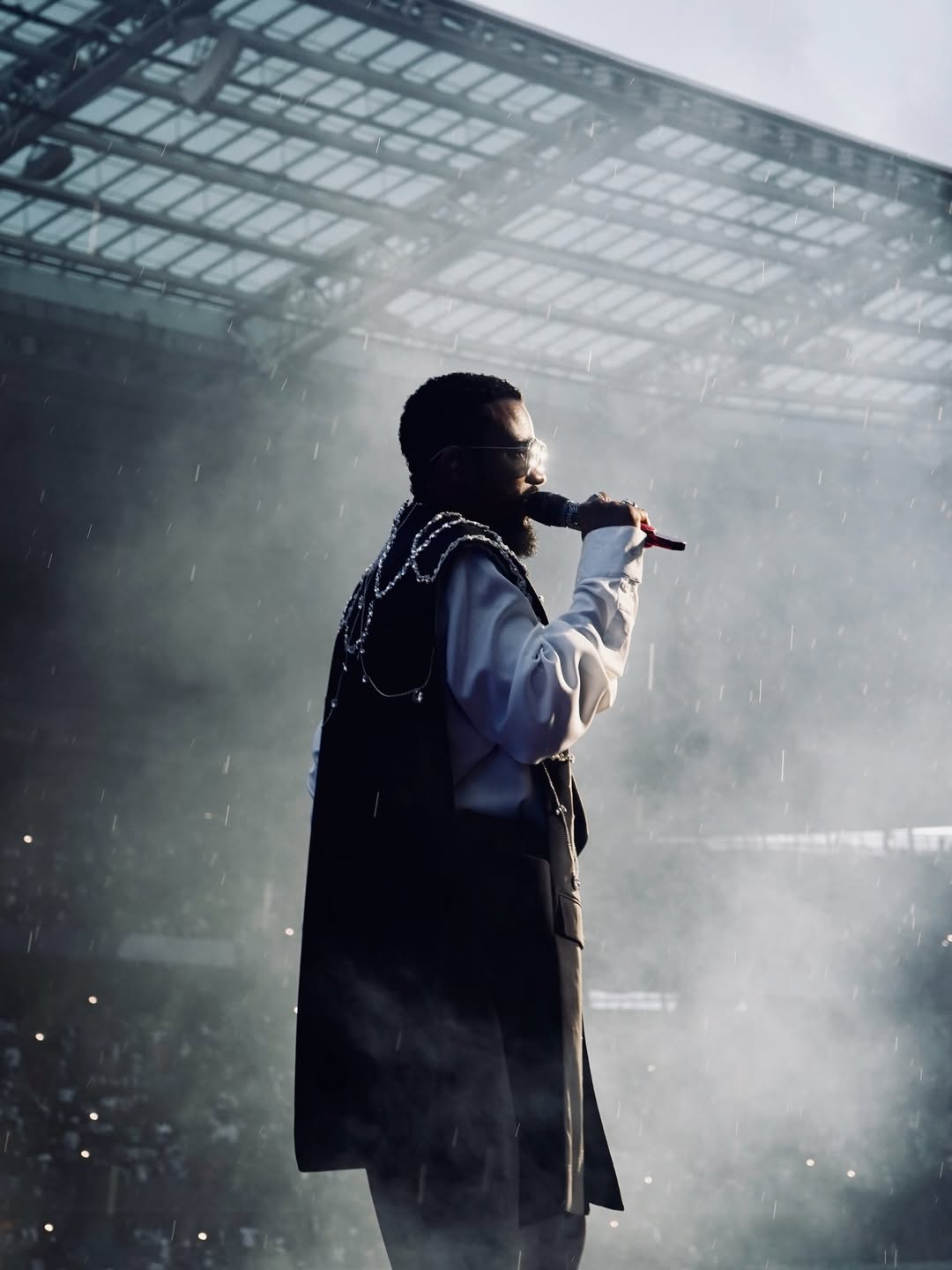
Meet Moohong Kim, the Designer Behind Fally Ipupa’s Historic Stade de France Look

Authored by

When Fally Ipupa stepped onto the stage at Paris’ Stade de France earlier this month, making history as the first African artist to sell out the iconic venue across two consecutive nights, the moment was already destined to live far beyond music. In front of more than 180,000 fans, the Congolese superstar marked the occasion donning a Double Breasted Cutout Vest sharply deconstructed by Moohong Kim, the Seoul-based designer, from his eponymous label, MOOHONG SS26 collection–whose quietly cerebral approach to menswear has been steadily catching the attention of stylists, editors, and performers around the world. For many, it may have been their first introduction to MOOHONG. For those paying closer attention, it felt like the latest chapter in a much bigger story.

While rooted in philosophy, political theory, and a desire to question traditional masculinity, Moohong Kim's work asks bigger questions than most, with a knack for reimagining Western tailoring through a global lens, going beyond simply designing clothes to turning ideas into silhouette, structure, and form. In conversation with Deeds, the designer reflects on the unexpected path that led him from academia to fashion, the intellectual framework behind MOOHONG, and what it meant to see his work become part of one of African music’s most defining cultural moments.

Stanley for Deeds Magazine: Before we talk about recent milestones, I’d love to start at the beginning–what first drew you to fashion, and when did clothing become something you saw not just as design, but as a language?

While I was doing my PhD in Politics in the UK, I visited an exhibition in London that left a strong impression on me. The exhibition connected architecture and philosophical theory in a highly interdisciplinary way. For example, if the theme was Neo-Realism, it presented both architectural works and theoretical ideas related to Neo-Realism together.

Until then, I had always thought of political philosophy and art as completely separate fields. Seeing them operate through similar structures and methods of expression felt like a very fresh shock to me. It made me realize that ideas could move across disciplines, and that theory could also exist visually and emotionally, not only through text.

I had always enjoyed expressing my thoughts from a young age, which is one of the reasons I pursued a PhD in the first place. As I became more accustomed to expressing my thoughts through academic writing during my PhD, I began to have another realization. I started wondering how meaningful it would be if I could also communicate my ideas through visual forms, not only through text.

To me, that felt very exciting–the possibility of being able to communicate through both language and visual expression at the same time. I became increasingly interested in the idea that philosophy, emotion, and perspectives could also be carried through images, silhouettes, and the body itself. Based on those desires and questions, after completing my doctorate, I decided to experiment with the relationship between the humanities and fashion, which eventually led me to launch MOOHONG.

When you launched MOOHONG, what did you feel was missing in menswear, and what kind of space or perspective were you hoping to create through your own work?

At the time, menswear felt relatively conservative to me. I felt that many collections were still centered around a very fixed and dominant idea of masculinity. I was more interested in creating something less rigid–something more androgynous, fluid, and emotionally ambiguous.

I was also drawn to tension and collision between opposing elements. I wanted to place mainstream and underground sensibilities, refinement and rawness, structure and disruption into dialogue with one another. To me, those kinds of contrasts create more dynamic and emotionally complex results.

When I began developing my first collection, I approached it almost like a conceptual mapping process influenced by critical theory, which I was deeply interested in at the time. Rather than designing clothes only from an aesthetic perspective, I became interested in how garments could communicate conflict, instability, and layered identities through silhouette and construction.

Your work often challenges traditional tailoring through deconstruction, draping, and unexpected proportions. What first pulled you toward that design language, and how has it evolved over time?

One of the central ideas within critical theory is the idea of viewing different historical systems and structures not hierarchically, but in parallel. By doing so, it becomes possible to continuously question dominant norms and keep the possibility of change alive.

To me, traditional tailoring represented a dominant cultural system within menswear. But if we look at fashion history through a longer timeline, the history of Western tailoring is actually relatively short. I became interested in placing contemporary tailoring alongside garments, silhouettes, and dress systems from different historical periods and non-Western cultural traditions in order to create transformation and new perspectives.

For me, deconstruction is not simply destruction. It is a reinterpretation of the dominant culture and proposes potential changes. Draping, meanwhile, became a way to introduce fluidity, androgyny, and references to non-Western dress traditions into contemporary menswear. Through these processes, I became interested in creating garments that feel less fixed–something more unstable, layered, and open to multiple interpretations.

There’s a tension in your collections between structure and softness, precision and disruption. How would you describe the emotional or conceptual world of MOOHONG in your own words?

I often think of MOOHONG as a counterintuitive mental framework. I see clothing not simply as fashion, but as a way of proposing different perspectives. In that sense, MOOHONG is less about creating a fixed aesthetic and more about continuously questioning fixed systems, norms, and ways of seeing.

Seoul has become one of the most exciting fashion cities in the world. How has designing there shaped your perspective creatively, culturally, and as the person building this brand?

Seoul is a city with an extremely intense rhythm. Different historical periods, social classes, and cultural identities coexist very closely together, often in quite contradictory ways. I think living and designing in that environment naturally shaped the way I see tension, structure, and transformation.

What interests me about Seoul is not simply its energy or speed, but the constant sense of transition. The city changes very quickly, yet at the same time, there are still strong, unseen social hierarchies, traditions, and pressures underneath the surface. That coexistence between hyper-contemporary culture and deeply rooted structures is something I continuously respond to through MOOHONG.

At the same time, building a brand in Seoul also gave me a certain independence. Because the city is evolving so rapidly, it creates space for younger designers to question existing systems and propose different perspectives.

Your garments often feel architectural–almost sculptural. When you begin a collection, does it usually start with a silhouette, an emotion, a reference, or a larger question you want to explore?

Most of the time, a collection begins from a theoretical framework or a conceptual way of thinking. For example, with the 26FW collection, I became interested in the idea of connecting different times and spaces not hierarchically, but in parallel, following the idea of neo-Gramscian. I wanted to create a world where multiple historical and cultural contexts could coexist simultaneously rather than being understood through a linear structure.

From that starting point, I began experimenting with the collision and coexistence of different dress cultures and garment systems across time and geography. The central question at the beginning of the collection was: “What if contemporary Western tailoring had existed within non-Western historical and cultural contexts?”

That question eventually guided the silhouettes, draping, construction, and layering throughout the collection. Rather than treating tailoring as something fixed or historically absolute, I became interested in how it could transform when placed into completely different cultural and historical environments.

After that, I start researching references from different time periods, dress systems, political theories, architecture, or subcultures, and I try to place those elements into dialogue with one another. The silhouette often emerges later through that process rather than being the starting point itself.

Your SS26 collection reinterprets classic menswear through cutouts, layering, and manipulated proportions. What conversations were you hoping that collection would spark, and what did it reveal about where MOOHONG is creatively right now?

The title of the SS26 collection was “Enlightenment.” With this collection, I wanted many of the philosophical ideas and perspectives behind MOOHONG’s design process–which we discussed earlier–to become more naturally embedded within the garments themselves. I think the collection revealed that MOOHONG is becoming more focused on coexistence and transformation rather than simple opposition or destruction.

How do you approach masculinity when designing, especially at a time when the language around menswear is evolving so quickly, and is timelessness something you consciously design for?

I think I’m interested in exploring various dimensions of masculinity rather than presenting a single fixed idea of it. Traditionally, menswear has often been associated with strength, rigidity, and control, but I’ve always been more drawn to ambiguity, softness, vulnerability, and fluidity existing alongside those qualities.

That’s also why draping and deconstruction became important parts of my work. They allow me to challenge more conventional structures of masculinity and create something less absolute and more open-ended.

I don’t consciously try to design for timelessness every season. Rather than deliberately pursuing something timeless, I’m more interested in remaining aware of the importance of potential change. Because of that, I naturally tend to approach clothing from outside fixed conventions or temporary contemporary trends, and I think that process sometimes leads to garments that feel timeless in the end.

Days ago, the world saw your work on Fally Ipupa during his historic Stade de France performances in Paris. How did that collaboration first come together, and what was your reaction when you learned the look would be part of such a major cultural moment?

The collaboration came together quite naturally through his team and stylists, who connected with the spirit of the collection. What interested me most was not simply the scale of the performance, but the idea of seeing MOOHONG exist within a completely different cultural and musical context.

Fally Ipupa has a very strong stage presence and cultural identity, so it was fascinating to see how the garments transformed through his movement, energy, and performance.

On a stage as large as Stade de France, silhouette almost begins functioning architecturally rather than simply as fashion.

Personally, it was a very meaningful moment. Seeing the work become part of such a large collective experience reminded me that clothing can move beyond the runway and exist within wider cultural conversations and emotional moments.
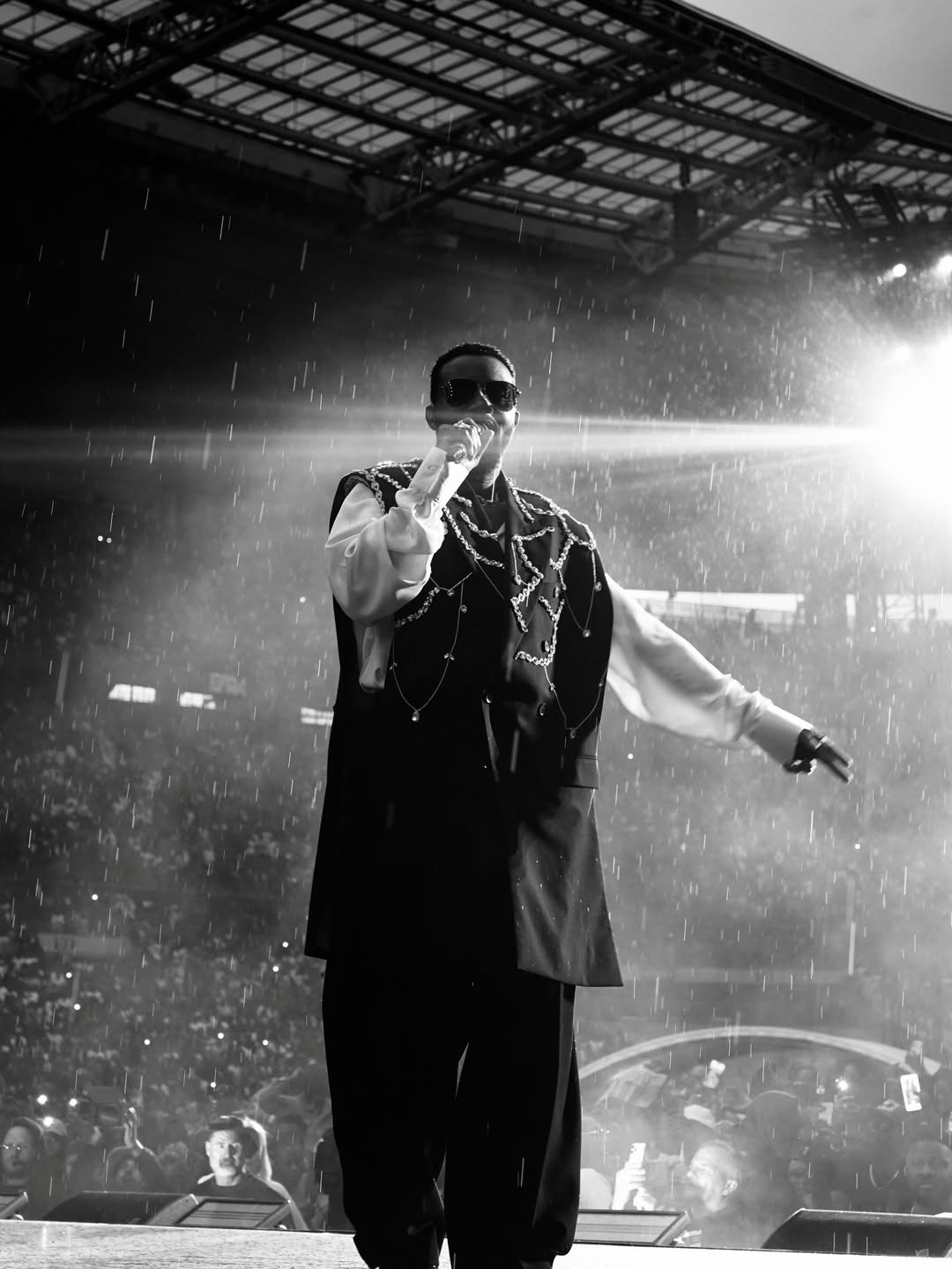
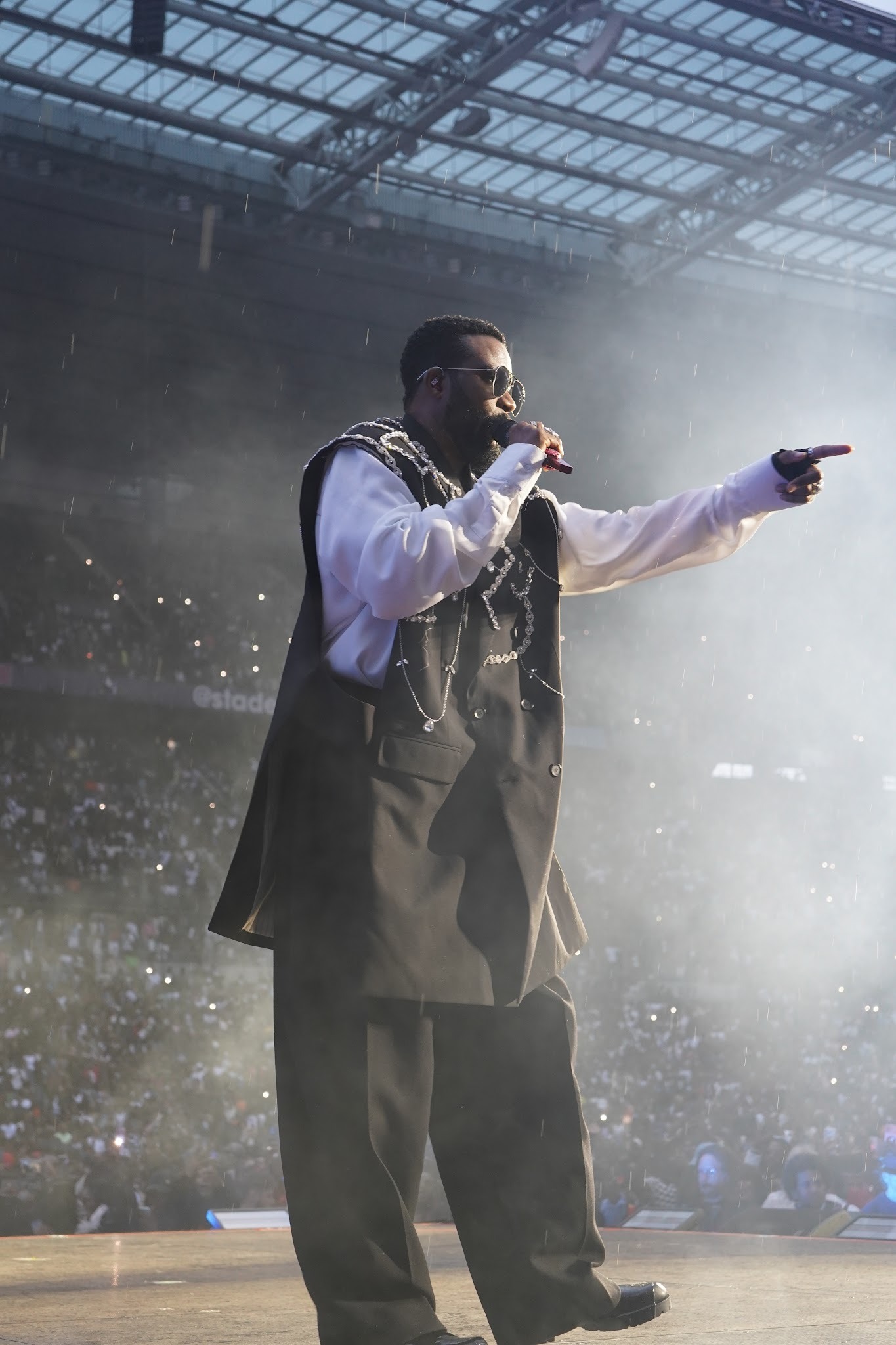
Image Courtesy of MOOHONG/Fally Ipupa Team

Knowing your work would be seen by more than 180,000 people across two nights, did that change how you thought about movement, silhouette, or impact–and what did it mean personally to see your work become part of that moment?

I don’t think it changed the core way I design, but it definitely made me think more about movement and presence. On a stage of that scale, clothing interacts very differently with the body and the audience.

What was especially interesting to me was seeing how the silhouettes transformed through performance and movement in such a large space. Certain proportions and layered constructions became much more visible and expressive from a distance.

Personally, it was a very meaningful moment. Seeing MOOHONG become part of such a large cultural experience reminded me that fashion can live far beyond the runway.

Your designs have also appeared on figures like Emma D'Arcy and in international editorials. Was there a moment when you realized MOOHONG was beginning to resonate far beyond Seoul?

I don’t think there was one single moment. It happened gradually through different people, stylists, artists, and editors connecting with the work in their own way. What felt most meaningful to me was realizing that the emotional and conceptual tension within MOOHONG could still resonate beyond Seoul, even across very different cultural contexts. That made me feel that certain questions around identity, structure, masculinity, instability, or transformation are actually quite universal. 

Seeing figures like Emma D’Arcy or artists such as Fally Ipupa engage with the work was meaningful not simply because of visibility, but because they each brought completely different energy and interpretation to the garments. I’ve always been more interested in that kind of dialogue rather than dressing a specific type of person.

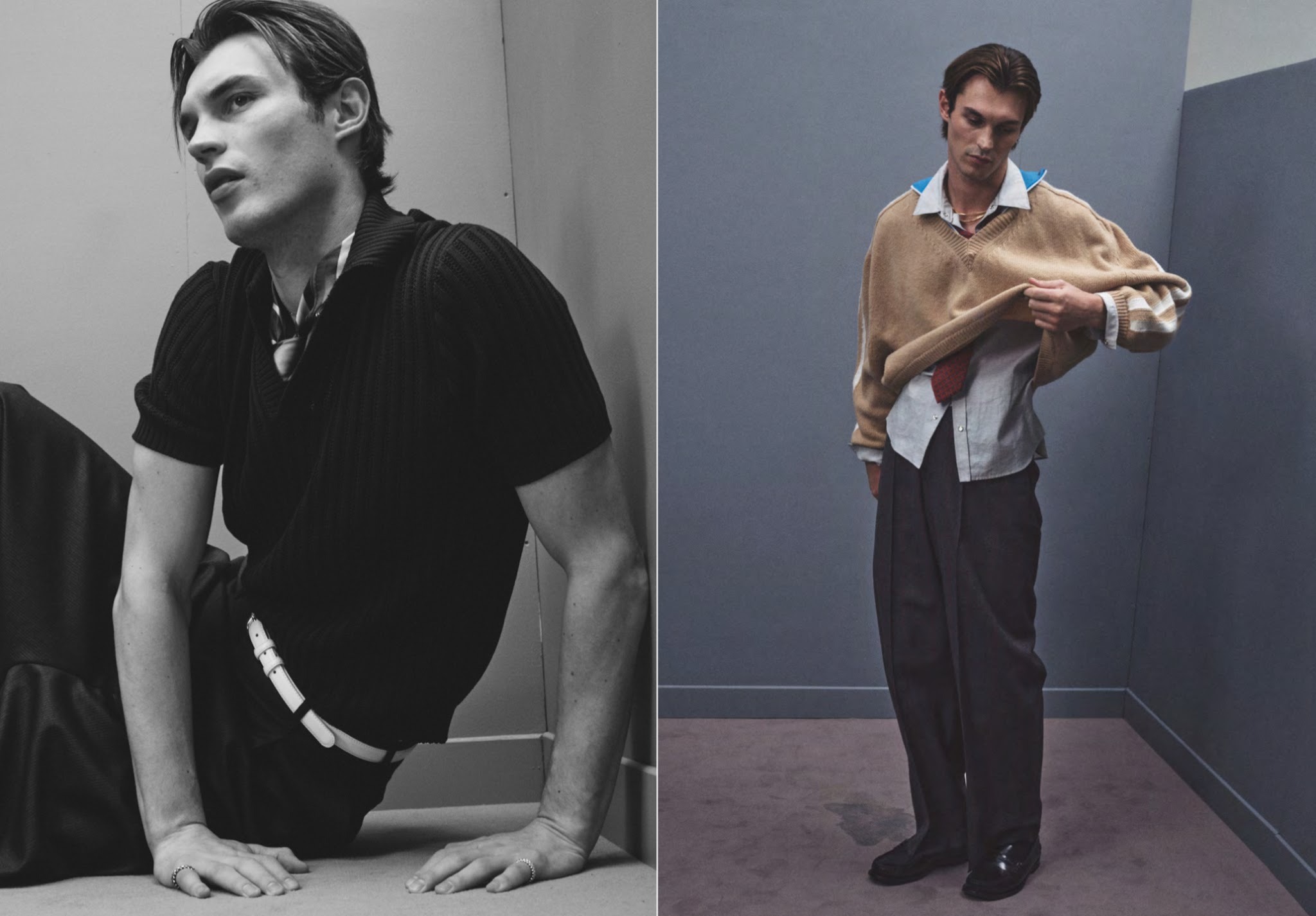
Emma Darcy, Shadowplay Issue 9. Credit: Jorre Janssen
Kit Butler—Vogue Turkey Man, March Cover Story. Photography by Yulia Gorbachenko

As more artists, stylists, and editors around the world discover your work, how do you protect the original DNA of MOOHONG while continuing to evolve?

I think the core DNA of MOOHONG is not a specific silhouette or aesthetic, but a particular way of thinking rooted in theoretical frameworks. Because of that, I believe the brand can continue evolving without losing its identity. Rather than being shaken by temporary trends or external expectations, I want MOOHONG to continue evolving quietly and consistently while remaining connected to its original philosophy.

In recent years, Korean fashion has become increasingly visible on the global stage. Where do you see MOOHONG fitting into that larger conversation?

Recently, Korean fashion has been receiving a great deal of global attention, and I think one of its strengths is the diversity of strong and distinctive brands emerging from the scene. Within that landscape, I think MOOHONG has developed its own unique positioning. While many Korean brands are known for strong visual identity or youth culture, I believe MOOHONG approaches fashion from a slightly different perspective–one that is more rooted in theoretical thinking, structure, and the questioning of established systems. I think that difference has allowed the brand to develop its own language gradually over time.

Outside of fashion, what influences your eye most–whether film, architecture, music, memory, or people–and where do you find yourself creatively recharging?

Without question, contemporary art and books influence me the most. Whenever I have time, I visit contemporary art exhibitions, and I receive a great deal of inspiration and creative energy from them. I’m also deeply influenced by books related to politics, society, and the humanities. In many cases, those ideas and theoretical perspectives actually become the starting point of a collection and even the main theme.

Looking back, what does success mean to you now compared to when you first launched MOOHONG, and what does the next chapter of the brand look like?

To be honest, I think my definition of success has remained quite consistent from the beginning until now. For me, success has never been defined only by visibility or commercial growth. What matters most to me is how freely and convincingly I can communicate my thoughts, perspectives, and philosophies through fashion at a deeply developed level–almost in the way one would construct and communicate ideas through a thesis. That was also the original reason I became interested in fashion in the first place. I wanted to express ideas not only through writing, but through visual and physical forms as well. In many ways, my standard for success is still connected to that same motivation today.

Finally, if someone is discovering MOOHONG for the first time through this Fally Ipupa moment, what’s the first thing you hope they understand–not just about the brand, but about you as a designer?

I hope people understand that MOOHONG is not simply about clothing or aesthetics, but about perspective–a different way of seeing and questioning existing systems.

IG: @_STANLEYKILONZO
Meet Moohong Kim, the Designer Behind Fally Ipupa’s Historic Stade de France Look

Authored by
This is some text inside of a div block.

When Fally Ipupa stepped onto the stage at Paris’ Stade de France earlier this month, making history as the first African artist to sell out the iconic venue across two consecutive nights, the moment was already destined to live far beyond music. In front of more than 180,000 fans, the Congolese superstar marked the occasion donning a Double Breasted Cutout Vest sharply deconstructed by Moohong Kim, the Seoul-based designer, from his eponymous label, MOOHONG SS26 collection–whose quietly cerebral approach to menswear has been steadily catching the attention of stylists, editors, and performers around the world. For many, it may have been their first introduction to MOOHONG. For those paying closer attention, it felt like the latest chapter in a much bigger story.

While rooted in philosophy, political theory, and a desire to question traditional masculinity, Moohong Kim's work asks bigger questions than most, with a knack for reimagining Western tailoring through a global lens, going beyond simply designing clothes to turning ideas into silhouette, structure, and form. In conversation with Deeds, the designer reflects on the unexpected path that led him from academia to fashion, the intellectual framework behind MOOHONG, and what it meant to see his work become part of one of African music’s most defining cultural moments.

Stanley for Deeds Magazine: Before we talk about recent milestones, I’d love to start at the beginning–what first drew you to fashion, and when did clothing become something you saw not just as design, but as a language?

While I was doing my PhD in Politics in the UK, I visited an exhibition in London that left a strong impression on me. The exhibition connected architecture and philosophical theory in a highly interdisciplinary way. For example, if the theme was Neo-Realism, it presented both architectural works and theoretical ideas related to Neo-Realism together.

Until then, I had always thought of political philosophy and art as completely separate fields. Seeing them operate through similar structures and methods of expression felt like a very fresh shock to me. It made me realize that ideas could move across disciplines, and that theory could also exist visually and emotionally, not only through text.

I had always enjoyed expressing my thoughts from a young age, which is one of the reasons I pursued a PhD in the first place. As I became more accustomed to expressing my thoughts through academic writing during my PhD, I began to have another realization. I started wondering how meaningful it would be if I could also communicate my ideas through visual forms, not only through text.

To me, that felt very exciting–the possibility of being able to communicate through both language and visual expression at the same time. I became increasingly interested in the idea that philosophy, emotion, and perspectives could also be carried through images, silhouettes, and the body itself. Based on those desires and questions, after completing my doctorate, I decided to experiment with the relationship between the humanities and fashion, which eventually led me to launch MOOHONG.

When you launched MOOHONG, what did you feel was missing in menswear, and what kind of space or perspective were you hoping to create through your own work?

At the time, menswear felt relatively conservative to me. I felt that many collections were still centered around a very fixed and dominant idea of masculinity. I was more interested in creating something less rigid–something more androgynous, fluid, and emotionally ambiguous.

I was also drawn to tension and collision between opposing elements. I wanted to place mainstream and underground sensibilities, refinement and rawness, structure and disruption into dialogue with one another. To me, those kinds of contrasts create more dynamic and emotionally complex results.

When I began developing my first collection, I approached it almost like a conceptual mapping process influenced by critical theory, which I was deeply interested in at the time. Rather than designing clothes only from an aesthetic perspective, I became interested in how garments could communicate conflict, instability, and layered identities through silhouette and construction.

Your work often challenges traditional tailoring through deconstruction, draping, and unexpected proportions. What first pulled you toward that design language, and how has it evolved over time?

One of the central ideas within critical theory is the idea of viewing different historical systems and structures not hierarchically, but in parallel. By doing so, it becomes possible to continuously question dominant norms and keep the possibility of change alive.

To me, traditional tailoring represented a dominant cultural system within menswear. But if we look at fashion history through a longer timeline, the history of Western tailoring is actually relatively short. I became interested in placing contemporary tailoring alongside garments, silhouettes, and dress systems from different historical periods and non-Western cultural traditions in order to create transformation and new perspectives.

For me, deconstruction is not simply destruction. It is a reinterpretation of the dominant culture and proposes potential changes. Draping, meanwhile, became a way to introduce fluidity, androgyny, and references to non-Western dress traditions into contemporary menswear. Through these processes, I became interested in creating garments that feel less fixed–something more unstable, layered, and open to multiple interpretations.

There’s a tension in your collections between structure and softness, precision and disruption. How would you describe the emotional or conceptual world of MOOHONG in your own words?

I often think of MOOHONG as a counterintuitive mental framework. I see clothing not simply as fashion, but as a way of proposing different perspectives. In that sense, MOOHONG is less about creating a fixed aesthetic and more about continuously questioning fixed systems, norms, and ways of seeing.

Seoul has become one of the most exciting fashion cities in the world. How has designing there shaped your perspective creatively, culturally, and as the person building this brand?

Seoul is a city with an extremely intense rhythm. Different historical periods, social classes, and cultural identities coexist very closely together, often in quite contradictory ways. I think living and designing in that environment naturally shaped the way I see tension, structure, and transformation.

What interests me about Seoul is not simply its energy or speed, but the constant sense of transition. The city changes very quickly, yet at the same time, there are still strong, unseen social hierarchies, traditions, and pressures underneath the surface. That coexistence between hyper-contemporary culture and deeply rooted structures is something I continuously respond to through MOOHONG.

At the same time, building a brand in Seoul also gave me a certain independence. Because the city is evolving so rapidly, it creates space for younger designers to question existing systems and propose different perspectives.

Your garments often feel architectural–almost sculptural. When you begin a collection, does it usually start with a silhouette, an emotion, a reference, or a larger question you want to explore?

Most of the time, a collection begins from a theoretical framework or a conceptual way of thinking. For example, with the 26FW collection, I became interested in the idea of connecting different times and spaces not hierarchically, but in parallel, following the idea of neo-Gramscian. I wanted to create a world where multiple historical and cultural contexts could coexist simultaneously rather than being understood through a linear structure.

From that starting point, I began experimenting with the collision and coexistence of different dress cultures and garment systems across time and geography. The central question at the beginning of the collection was: “What if contemporary Western tailoring had existed within non-Western historical and cultural contexts?”

That question eventually guided the silhouettes, draping, construction, and layering throughout the collection. Rather than treating tailoring as something fixed or historically absolute, I became interested in how it could transform when placed into completely different cultural and historical environments.

After that, I start researching references from different time periods, dress systems, political theories, architecture, or subcultures, and I try to place those elements into dialogue with one another. The silhouette often emerges later through that process rather than being the starting point itself.

Your SS26 collection reinterprets classic menswear through cutouts, layering, and manipulated proportions. What conversations were you hoping that collection would spark, and what did it reveal about where MOOHONG is creatively right now?

The title of the SS26 collection was “Enlightenment.” With this collection, I wanted many of the philosophical ideas and perspectives behind MOOHONG’s design process–which we discussed earlier–to become more naturally embedded within the garments themselves. I think the collection revealed that MOOHONG is becoming more focused on coexistence and transformation rather than simple opposition or destruction.

How do you approach masculinity when designing, especially at a time when the language around menswear is evolving so quickly, and is timelessness something you consciously design for?

I think I’m interested in exploring various dimensions of masculinity rather than presenting a single fixed idea of it. Traditionally, menswear has often been associated with strength, rigidity, and control, but I’ve always been more drawn to ambiguity, softness, vulnerability, and fluidity existing alongside those qualities.

That’s also why draping and deconstruction became important parts of my work. They allow me to challenge more conventional structures of masculinity and create something less absolute and more open-ended.

I don’t consciously try to design for timelessness every season. Rather than deliberately pursuing something timeless, I’m more interested in remaining aware of the importance of potential change. Because of that, I naturally tend to approach clothing from outside fixed conventions or temporary contemporary trends, and I think that process sometimes leads to garments that feel timeless in the end.

Days ago, the world saw your work on Fally Ipupa during his historic Stade de France performances in Paris. How did that collaboration first come together, and what was your reaction when you learned the look would be part of such a major cultural moment?

The collaboration came together quite naturally through his team and stylists, who connected with the spirit of the collection. What interested me most was not simply the scale of the performance, but the idea of seeing MOOHONG exist within a completely different cultural and musical context.

Fally Ipupa has a very strong stage presence and cultural identity, so it was fascinating to see how the garments transformed through his movement, energy, and performance.

On a stage as large as Stade de France, silhouette almost begins functioning architecturally rather than simply as fashion.

Personally, it was a very meaningful moment. Seeing the work become part of such a large collective experience reminded me that clothing can move beyond the runway and exist within wider cultural conversations and emotional moments.

Image Courtesy of MOOHONG/Fally Ipupa Team

Knowing your work would be seen by more than 180,000 people across two nights, did that change how you thought about movement, silhouette, or impact–and what did it mean personally to see your work become part of that moment?

I don’t think it changed the core way I design, but it definitely made me think more about movement and presence. On a stage of that scale, clothing interacts very differently with the body and the audience.

What was especially interesting to me was seeing how the silhouettes transformed through performance and movement in such a large space. Certain proportions and layered constructions became much more visible and expressive from a distance.

Personally, it was a very meaningful moment. Seeing MOOHONG become part of such a large cultural experience reminded me that fashion can live far beyond the runway.

Your designs have also appeared on figures like Emma D'Arcy and in international editorials. Was there a moment when you realized MOOHONG was beginning to resonate far beyond Seoul?

I don’t think there was one single moment. It happened gradually through different people, stylists, artists, and editors connecting with the work in their own way. What felt most meaningful to me was realizing that the emotional and conceptual tension within MOOHONG could still resonate beyond Seoul, even across very different cultural contexts. That made me feel that certain questions around identity, structure, masculinity, instability, or transformation are actually quite universal. 

Seeing figures like Emma D’Arcy or artists such as Fally Ipupa engage with the work was meaningful not simply because of visibility, but because they each brought completely different energy and interpretation to the garments. I’ve always been more interested in that kind of dialogue rather than dressing a specific type of person.

Emma Darcy, Shadowplay Issue 9. Credit: Jorre Janssen
Kit Butler—Vogue Turkey Man, March Cover Story. Photography by Yulia Gorbachenko

As more artists, stylists, and editors around the world discover your work, how do you protect the original DNA of MOOHONG while continuing to evolve?

I think the core DNA of MOOHONG is not a specific silhouette or aesthetic, but a particular way of thinking rooted in theoretical frameworks. Because of that, I believe the brand can continue evolving without losing its identity. Rather than being shaken by temporary trends or external expectations, I want MOOHONG to continue evolving quietly and consistently while remaining connected to its original philosophy.

In recent years, Korean fashion has become increasingly visible on the global stage. Where do you see MOOHONG fitting into that larger conversation?

Recently, Korean fashion has been receiving a great deal of global attention, and I think one of its strengths is the diversity of strong and distinctive brands emerging from the scene. Within that landscape, I think MOOHONG has developed its own unique positioning. While many Korean brands are known for strong visual identity or youth culture, I believe MOOHONG approaches fashion from a slightly different perspective–one that is more rooted in theoretical thinking, structure, and the questioning of established systems. I think that difference has allowed the brand to develop its own language gradually over time.

Outside of fashion, what influences your eye most–whether film, architecture, music, memory, or people–and where do you find yourself creatively recharging?

Without question, contemporary art and books influence me the most. Whenever I have time, I visit contemporary art exhibitions, and I receive a great deal of inspiration and creative energy from them. I’m also deeply influenced by books related to politics, society, and the humanities. In many cases, those ideas and theoretical perspectives actually become the starting point of a collection and even the main theme.

Looking back, what does success mean to you now compared to when you first launched MOOHONG, and what does the next chapter of the brand look like?

To be honest, I think my definition of success has remained quite consistent from the beginning until now. For me, success has never been defined only by visibility or commercial growth. What matters most to me is how freely and convincingly I can communicate my thoughts, perspectives, and philosophies through fashion at a deeply developed level–almost in the way one would construct and communicate ideas through a thesis. That was also the original reason I became interested in fashion in the first place. I wanted to express ideas not only through writing, but through visual and physical forms as well. In many ways, my standard for success is still connected to that same motivation today.

Finally, if someone is discovering MOOHONG for the first time through this Fally Ipupa moment, what’s the first thing you hope they understand–not just about the brand, but about you as a designer?

I hope people understand that MOOHONG is not simply about clothing or aesthetics, but about perspective–a different way of seeing and questioning existing systems.

IG: @_STANLEYKILONZO
This is some text inside of a div block.

Meet Moohong Kim, the Designer Behind Fally Ipupa’s Historic Stade de France Look

Authored by

When Fally Ipupa stepped onto the stage at Paris’ Stade de France earlier this month, making history as the first African artist to sell out the iconic venue across two consecutive nights, the moment was already destined to live far beyond music. In front of more than 180,000 fans, the Congolese superstar marked the occasion donning a Double Breasted Cutout Vest sharply deconstructed by Moohong Kim, the Seoul-based designer, from his eponymous label, MOOHONG SS26 collection–whose quietly cerebral approach to menswear has been steadily catching the attention of stylists, editors, and performers around the world. For many, it may have been their first introduction to MOOHONG. For those paying closer attention, it felt like the latest chapter in a much bigger story.

While rooted in philosophy, political theory, and a desire to question traditional masculinity, Moohong Kim's work asks bigger questions than most, with a knack for reimagining Western tailoring through a global lens, going beyond simply designing clothes to turning ideas into silhouette, structure, and form. In conversation with Deeds, the designer reflects on the unexpected path that led him from academia to fashion, the intellectual framework behind MOOHONG, and what it meant to see his work become part of one of African music’s most defining cultural moments.

Stanley for Deeds Magazine: Before we talk about recent milestones, I’d love to start at the beginning–what first drew you to fashion, and when did clothing become something you saw not just as design, but as a language?

While I was doing my PhD in Politics in the UK, I visited an exhibition in London that left a strong impression on me. The exhibition connected architecture and philosophical theory in a highly interdisciplinary way. For example, if the theme was Neo-Realism, it presented both architectural works and theoretical ideas related to Neo-Realism together.

Until then, I had always thought of political philosophy and art as completely separate fields. Seeing them operate through similar structures and methods of expression felt like a very fresh shock to me. It made me realize that ideas could move across disciplines, and that theory could also exist visually and emotionally, not only through text.

I had always enjoyed expressing my thoughts from a young age, which is one of the reasons I pursued a PhD in the first place. As I became more accustomed to expressing my thoughts through academic writing during my PhD, I began to have another realization. I started wondering how meaningful it would be if I could also communicate my ideas through visual forms, not only through text.

To me, that felt very exciting–the possibility of being able to communicate through both language and visual expression at the same time. I became increasingly interested in the idea that philosophy, emotion, and perspectives could also be carried through images, silhouettes, and the body itself. Based on those desires and questions, after completing my doctorate, I decided to experiment with the relationship between the humanities and fashion, which eventually led me to launch MOOHONG.

When you launched MOOHONG, what did you feel was missing in menswear, and what kind of space or perspective were you hoping to create through your own work?

At the time, menswear felt relatively conservative to me. I felt that many collections were still centered around a very fixed and dominant idea of masculinity. I was more interested in creating something less rigid–something more androgynous, fluid, and emotionally ambiguous.

I was also drawn to tension and collision between opposing elements. I wanted to place mainstream and underground sensibilities, refinement and rawness, structure and disruption into dialogue with one another. To me, those kinds of contrasts create more dynamic and emotionally complex results.

When I began developing my first collection, I approached it almost like a conceptual mapping process influenced by critical theory, which I was deeply interested in at the time. Rather than designing clothes only from an aesthetic perspective, I became interested in how garments could communicate conflict, instability, and layered identities through silhouette and construction.

Your work often challenges traditional tailoring through deconstruction, draping, and unexpected proportions. What first pulled you toward that design language, and how has it evolved over time?

One of the central ideas within critical theory is the idea of viewing different historical systems and structures not hierarchically, but in parallel. By doing so, it becomes possible to continuously question dominant norms and keep the possibility of change alive.

To me, traditional tailoring represented a dominant cultural system within menswear. But if we look at fashion history through a longer timeline, the history of Western tailoring is actually relatively short. I became interested in placing contemporary tailoring alongside garments, silhouettes, and dress systems from different historical periods and non-Western cultural traditions in order to create transformation and new perspectives.

For me, deconstruction is not simply destruction. It is a reinterpretation of the dominant culture and proposes potential changes. Draping, meanwhile, became a way to introduce fluidity, androgyny, and references to non-Western dress traditions into contemporary menswear. Through these processes, I became interested in creating garments that feel less fixed–something more unstable, layered, and open to multiple interpretations.

There’s a tension in your collections between structure and softness, precision and disruption. How would you describe the emotional or conceptual world of MOOHONG in your own words?

I often think of MOOHONG as a counterintuitive mental framework. I see clothing not simply as fashion, but as a way of proposing different perspectives. In that sense, MOOHONG is less about creating a fixed aesthetic and more about continuously questioning fixed systems, norms, and ways of seeing.

Seoul has become one of the most exciting fashion cities in the world. How has designing there shaped your perspective creatively, culturally, and as the person building this brand?

Seoul is a city with an extremely intense rhythm. Different historical periods, social classes, and cultural identities coexist very closely together, often in quite contradictory ways. I think living and designing in that environment naturally shaped the way I see tension, structure, and transformation.

What interests me about Seoul is not simply its energy or speed, but the constant sense of transition. The city changes very quickly, yet at the same time, there are still strong, unseen social hierarchies, traditions, and pressures underneath the surface. That coexistence between hyper-contemporary culture and deeply rooted structures is something I continuously respond to through MOOHONG.

At the same time, building a brand in Seoul also gave me a certain independence. Because the city is evolving so rapidly, it creates space for younger designers to question existing systems and propose different perspectives.

Your garments often feel architectural–almost sculptural. When you begin a collection, does it usually start with a silhouette, an emotion, a reference, or a larger question you want to explore?

Most of the time, a collection begins from a theoretical framework or a conceptual way of thinking. For example, with the 26FW collection, I became interested in the idea of connecting different times and spaces not hierarchically, but in parallel, following the idea of neo-Gramscian. I wanted to create a world where multiple historical and cultural contexts could coexist simultaneously rather than being understood through a linear structure.

From that starting point, I began experimenting with the collision and coexistence of different dress cultures and garment systems across time and geography. The central question at the beginning of the collection was: “What if contemporary Western tailoring had existed within non-Western historical and cultural contexts?”

That question eventually guided the silhouettes, draping, construction, and layering throughout the collection. Rather than treating tailoring as something fixed or historically absolute, I became interested in how it could transform when placed into completely different cultural and historical environments.

After that, I start researching references from different time periods, dress systems, political theories, architecture, or subcultures, and I try to place those elements into dialogue with one another. The silhouette often emerges later through that process rather than being the starting point itself.

Your SS26 collection reinterprets classic menswear through cutouts, layering, and manipulated proportions. What conversations were you hoping that collection would spark, and what did it reveal about where MOOHONG is creatively right now?

The title of the SS26 collection was “Enlightenment.” With this collection, I wanted many of the philosophical ideas and perspectives behind MOOHONG’s design process–which we discussed earlier–to become more naturally embedded within the garments themselves. I think the collection revealed that MOOHONG is becoming more focused on coexistence and transformation rather than simple opposition or destruction.

How do you approach masculinity when designing, especially at a time when the language around menswear is evolving so quickly, and is timelessness something you consciously design for?

I think I’m interested in exploring various dimensions of masculinity rather than presenting a single fixed idea of it. Traditionally, menswear has often been associated with strength, rigidity, and control, but I’ve always been more drawn to ambiguity, softness, vulnerability, and fluidity existing alongside those qualities.

That’s also why draping and deconstruction became important parts of my work. They allow me to challenge more conventional structures of masculinity and create something less absolute and more open-ended.

I don’t consciously try to design for timelessness every season. Rather than deliberately pursuing something timeless, I’m more interested in remaining aware of the importance of potential change. Because of that, I naturally tend to approach clothing from outside fixed conventions or temporary contemporary trends, and I think that process sometimes leads to garments that feel timeless in the end.

Days ago, the world saw your work on Fally Ipupa during his historic Stade de France performances in Paris. How did that collaboration first come together, and what was your reaction when you learned the look would be part of such a major cultural moment?

The collaboration came together quite naturally through his team and stylists, who connected with the spirit of the collection. What interested me most was not simply the scale of the performance, but the idea of seeing MOOHONG exist within a completely different cultural and musical context.

Fally Ipupa has a very strong stage presence and cultural identity, so it was fascinating to see how the garments transformed through his movement, energy, and performance.

On a stage as large as Stade de France, silhouette almost begins functioning architecturally rather than simply as fashion.

Personally, it was a very meaningful moment. Seeing the work become part of such a large collective experience reminded me that clothing can move beyond the runway and exist within wider cultural conversations and emotional moments.

Image Courtesy of MOOHONG/Fally Ipupa Team

Knowing your work would be seen by more than 180,000 people across two nights, did that change how you thought about movement, silhouette, or impact–and what did it mean personally to see your work become part of that moment?

I don’t think it changed the core way I design, but it definitely made me think more about movement and presence. On a stage of that scale, clothing interacts very differently with the body and the audience.

What was especially interesting to me was seeing how the silhouettes transformed through performance and movement in such a large space. Certain proportions and layered constructions became much more visible and expressive from a distance.

Personally, it was a very meaningful moment. Seeing MOOHONG become part of such a large cultural experience reminded me that fashion can live far beyond the runway.

Your designs have also appeared on figures like Emma D'Arcy and in international editorials. Was there a moment when you realized MOOHONG was beginning to resonate far beyond Seoul?

I don’t think there was one single moment. It happened gradually through different people, stylists, artists, and editors connecting with the work in their own way. What felt most meaningful to me was realizing that the emotional and conceptual tension within MOOHONG could still resonate beyond Seoul, even across very different cultural contexts. That made me feel that certain questions around identity, structure, masculinity, instability, or transformation are actually quite universal. 

Seeing figures like Emma D’Arcy or artists such as Fally Ipupa engage with the work was meaningful not simply because of visibility, but because they each brought completely different energy and interpretation to the garments. I’ve always been more interested in that kind of dialogue rather than dressing a specific type of person.

Emma Darcy, Shadowplay Issue 9. Credit: Jorre Janssen
Kit Butler—Vogue Turkey Man, March Cover Story. Photography by Yulia Gorbachenko

As more artists, stylists, and editors around the world discover your work, how do you protect the original DNA of MOOHONG while continuing to evolve?

I think the core DNA of MOOHONG is not a specific silhouette or aesthetic, but a particular way of thinking rooted in theoretical frameworks. Because of that, I believe the brand can continue evolving without losing its identity. Rather than being shaken by temporary trends or external expectations, I want MOOHONG to continue evolving quietly and consistently while remaining connected to its original philosophy.

In recent years, Korean fashion has become increasingly visible on the global stage. Where do you see MOOHONG fitting into that larger conversation?

Recently, Korean fashion has been receiving a great deal of global attention, and I think one of its strengths is the diversity of strong and distinctive brands emerging from the scene. Within that landscape, I think MOOHONG has developed its own unique positioning. While many Korean brands are known for strong visual identity or youth culture, I believe MOOHONG approaches fashion from a slightly different perspective–one that is more rooted in theoretical thinking, structure, and the questioning of established systems. I think that difference has allowed the brand to develop its own language gradually over time.

Outside of fashion, what influences your eye most–whether film, architecture, music, memory, or people–and where do you find yourself creatively recharging?

Without question, contemporary art and books influence me the most. Whenever I have time, I visit contemporary art exhibitions, and I receive a great deal of inspiration and creative energy from them. I’m also deeply influenced by books related to politics, society, and the humanities. In many cases, those ideas and theoretical perspectives actually become the starting point of a collection and even the main theme.

Looking back, what does success mean to you now compared to when you first launched MOOHONG, and what does the next chapter of the brand look like?

To be honest, I think my definition of success has remained quite consistent from the beginning until now. For me, success has never been defined only by visibility or commercial growth. What matters most to me is how freely and convincingly I can communicate my thoughts, perspectives, and philosophies through fashion at a deeply developed level–almost in the way one would construct and communicate ideas through a thesis. That was also the original reason I became interested in fashion in the first place. I wanted to express ideas not only through writing, but through visual and physical forms as well. In many ways, my standard for success is still connected to that same motivation today.

Finally, if someone is discovering MOOHONG for the first time through this Fally Ipupa moment, what’s the first thing you hope they understand–not just about the brand, but about you as a designer?

I hope people understand that MOOHONG is not simply about clothing or aesthetics, but about perspective–a different way of seeing and questioning existing systems.

IG: @_STANLEYKILONZO
Other Stories
London
London
Lagos
London
Newyork
London
Shop
Join the community.
You are now subscribed to receive updates.
Oops! Something went wrong while submitting the form.