.svg)

%20(1)%20(1).png)
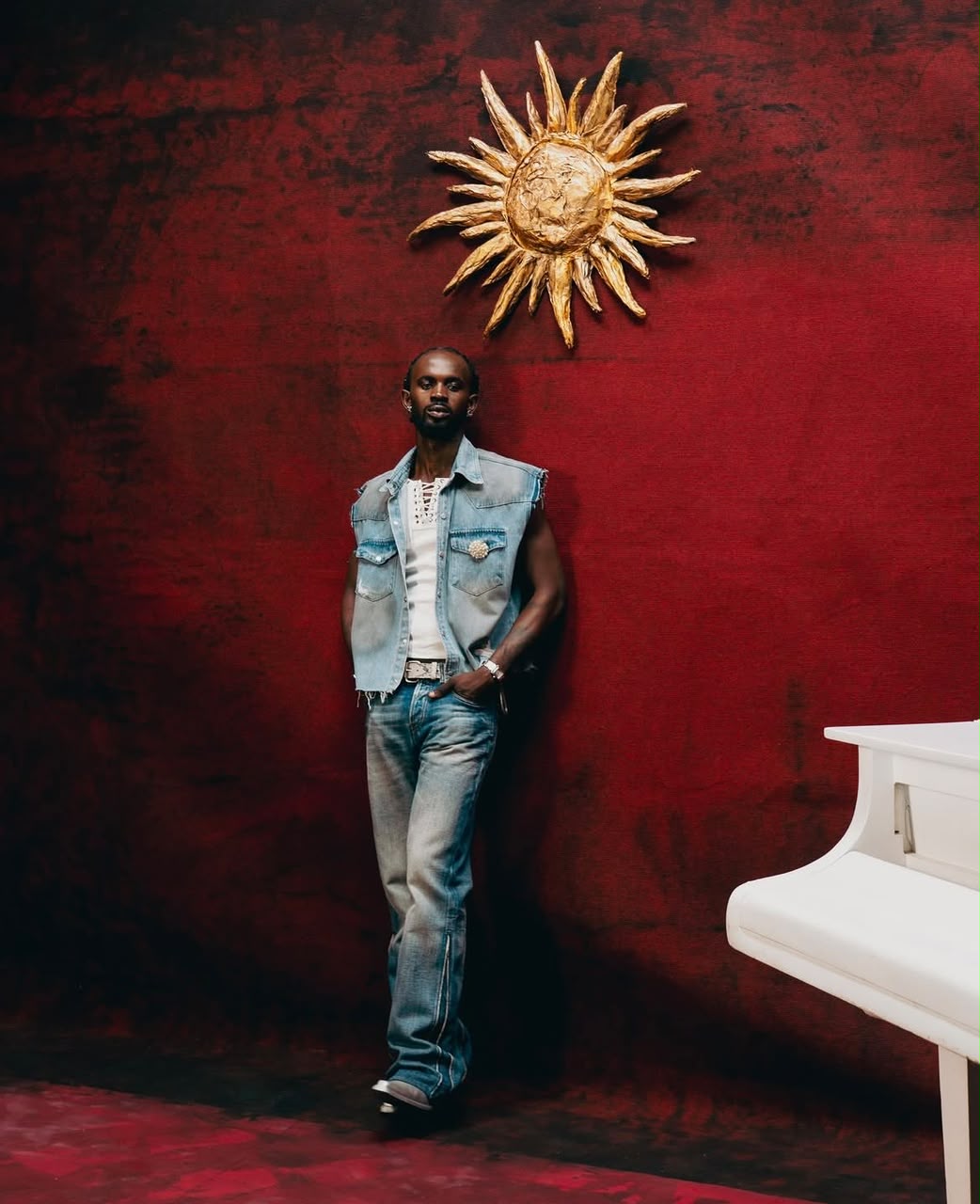
There's a difference between being invited into someone's home, and being shown the parts of the house that they haven’t yet straightened out. Refusing to deny the spaces he’s found himself in the past, or sweep experiences under a carpet of denial, Guvna B opens the door to his tenth studio album, This Bed I Made, with a sincerity that displays his unvarnished truth, allowing us to witness healing in real time.

On his latest offering, British-Ghanaian artist, author, and broadcaster Guvna B doesn't just open the door into his journey from healing and addiction, but shows us the bed we’ve made, and the place in which past decisions have led him. Although pondering on our imperfections brings us to an uncomfortable place to sit, this album encourages us not to leave that introspection over its 11 tracks, offering honesty, but to sit with the less favourable parts of ourselves and acknowledge our humanity in its fullness.
A new era has arrived for Guvna B, whose identity extends beyond artistry, through his work as an author, broadcaster, and most importantly, a Father. After intending to celebrate garage, grime, and gospel sounds on 2023’s The Village Is On Fire,which debuted at No.1 on the Official Hip-Hop and R&B Chart, an encounter and painful endurance through racial aggravation caused him to re-examine his world through the lens of this shocking incident. Three years on, This Bed I Made has arrived with Guvna B turning inward once more, as he examines addiction and its ripple effects that are often too heavy for an already weary heart trying to move through the world.
.png)
Suit: Labrum, Tie: Boohoo
"People often show their scars, but not their wounds” he shares, at the premiere of his short film accompanying his tenth album of the same name. Created in partnership with The Samaritans, The Forward Trust, and addiction expert and author Dr Gabor Maté, the film serves as a visual supplement to the album, exploring the everyday nuances of addiction through its quieter, often overlooked details, like interactions with friends and family or routine tasks like laundry, all reframed through the weight of a life living under the constant effects of addiction and its weight. Over the sixteen minute runtime, we’re left suspended in the reality of addiction as a constant, ever-present force.
“I wanted to make a film alongside the album for two reasons, ” Guvna B says. “The first is that I don’t know if we’re into music videos like we used to be - and the second is that film has the unique ability to show nuance without necessarily saying words,” Co-written by Guvna B and director Christopher Davis, the artist himself stars in the short, which leans on visual storytelling rather than an overload of dialogue to communicate emotion. Colour choices, subtle nods to tracks on the album, and the recurring widely debated two-sided coin motif all explore how triggers beyond our control can shift a day of progress into a decline, without warning. The coin, one side a happy face, and the other a downcast one, appears throughout the film, spinning as a symbol of instability and the tender process of healing. It resonates with themes explored in ‘What Now’, a track that captures the instinct to slip into a well of guilt after a mistake, while also pointing towards the possibility of starting again, a feeling that those on a healing journey from addiction often know all too well. “Things can change at any point, and none of us are exempt,” Guvna B says of the track.
.png)
‘What Now’, a lyrical microcosm of the non-linear healing map, points to the album as a subtle and subconscious nod to the structural make-up of the album itself. “The first half is self-facing. The second half is my chance to say no one’s perfect, me included. That doesn’t excuse us, but it does mean we can’t write each other off. Two things can be true at the same time.”
The album begins in closed off, dark spaces, drawing us into isolation to understand the context in which addiction is so often navigated. The opening tracks find us confined to a bed, suspended in hallways, and behind closed doors as the self confessional nature of the record is laid bare. “I've always felt that when talking about difficult things there has to be a neat little bow tied to the end of it” Guvna B explains. “With this album I was deliberate with starting it off in a really vulnerable and honest and human way - without any answers promised,”
Beginning in the dark is a deliberate choice for Guvna B, as approaches the structure of this album in a different way than he’s used to - instead of embracing hard truths with victory and sweetness on every end, we’re launched into the dark, and then able to bask in the light with him at the end. It’s not a perfect arc, but even the sun doesn’t shine always. By the time light begins to seep through the record on ‘To Be Free’, the sound enters a lighter sonical space, as airy production, choirs, and layered vocals begin to characterize the latter end of the record.
.jpg)
Jacket - Burberry @Designer Exchange, Shirt - Boohoo,
From his debut album The Narrow Road, faith has remained a defining thread in Guvna B’s work, as he has become known for his lyricism that sits within hope. Alongside that visibility comes an inevitable pressure in the form of consistency, and being seen as “having it all together”, a pressure which can be exemplified within the context of faith. Yet despite this, Guvna B shares his private struggles in public in order to not do anything groundbreaking, but introduce dialogue, which is the start of it all. “What I found strange is that in church and faith spaces, it’s a conversation that rarely happens. Yet in community meetings, you’ll find Muslims, Buddhists, Christians and Sikhs all speaking openly. People feel more comfortable in those external spaces than within faith spaces for some reason. That made me want to be able to go into any place of worship and have a real, honest conversation,”
It’s On ‘To Be Free’ this shift into the light is articulated directly. “The judge has set me free from everything I have hidden… the prison I was in wasn’t real, it was a figment, the cycle I was in was a cycle of addiction.”
The second half of This Bed I Made feels like a slow ascent, like a staircase being climbed, with trips along the way, but ascending nevertheless. Working alongside trauma specialist Dr Gabor Maté, Guvna B begins to frame addiction not simply as behaviour, but as something rooted in biology, environment, and pain carried over time. Maté, a clinical physician, addiction expert, speaker and author, offered a framework to Guvna B during times of hardship that moved beyond the region of opinion and into the realm of evidence-based, and biologically explainable explanations, in aid to help people make sense of feelings carried privately.
.png)
Jacket - Burberry @ Designer exchange Shirt- Boohoo
“When you can back up some of these feelings by science, it’s really affirming - it's contributed to me being able to forgive myself, and move forward. Learning the difference between guilt and shame has been huge,” Guilt, as he reflects, is a healthy response to wrongdoing and a catalyst for change, while shame almost threatens one's identity, and seeps into cloud judgment, encouraging the belief of being inherently flawed, offering no resolution except to move through the world with those flaws. That perspective, reinforced through Maté’s work, became especially significant during periods where he would turn to his lectures for clarity and reassurance.
Speaking to younger men through his wider advocacy work where he encourages them to pick up their own pens and write at creative writing workshops, Guvna B often returns to the importance of language between men and how easily silence becomes inherited during our conversation. “ My dad didn't speak at all - not because he didn’t want to - but probably because he just didn’t have the tools to express himself. I saw how that affected him and me, and I’ve been able to do that by doing the inner work, and I can now see the effect that has on my son who is six years old - he is the most expressive, confident, communicator that I’ve seen, definitely in my family intergenerationally. I can see the progress, and I hope that it will continue,”
.jpg)
It’s within this widening emotional landscape that ‘Kintsugi’ (feat. Claudia Isaki) finds itself on the record. Named after the Japanese art of repairing broken pottery, and highlighting cracks rather than hiding them, the track isn't a metaphor that lives on the album, but a practice that's extended forward into Guvna B’s real life, as he helps others sit with the cracks with their own lives. Isaki, a French-Congolese singer and songwriter, is only one of the artists who contribute to the album, as Bawo, Frankie Stew and Harvey Gunn, and Arathejay also lend their voices and presence to other tracks, adding more sonical colour to an album already expansive and decorated in production from Sillkey, Maths Time Joy, as well as others. Although it could have been a solitary story told, Guvna B describes a form of community that exists in his life before any recording begins when reflecting on community. “Bawo came to mine just to talk at first,” he says, “We ended up speaking for hours about addiction, habits, coping mechanisms, all the ways people try to escape things. And I realised how similar all humans actually are, even if our stories look vastly different. Vulnerability really does breed vulnerability, ” By the time they stepped into the booth, the foundation of the album, ‘Nearly’ had already been built in conversation.
Even its most personal moments, This Bed I Made resists isolation, teaching us that sharing wounds in real time must also come with people willing to bind them up as steps forwards are made. As the record lifts fully into its final stretch, it raises a natural question - how such deeply personal material can be released into the world and sit within the ears and hearts of listeners regardless of whether they know the context behind it. Though deeply personal, This Bed I Made hasn’t changed Guvna B’s perspective on releasing material into the world. “It’s beautiful,” he says “My favourite thing about music is when I listen to a song and it does something completely different for me to what it did for the writer. I think that's so special. This album has done what it was meant to do for me. It’s helped me process my thoughts and put language to a lot of things I’ve been feeling, and it’s helped me be creative. It’s served its purpose, so now it has to move through and evolve into something else. Someone else can listen to this album, and they can have a completely different life experience to me, and the album can remind them of a relationship, or their mum, or their own issues with dependency.”
With three MOBOs, multiple UMA Awards, ten albums, and two books under his belt, it’s no question that there are more than a few things on the horizon for Guvna B, as he has remained standing as a cultural force beyond music. His work has seen collaborations with the likes of DarkoVibes, D Double E , Wretch 32 and Madison Ryann Ward, to name very few. Yet as our conversation draws to a close, Guvna B isn’t interested in rushing to write a new album, or jumping into another cycle of musical output, but by a visit to Japan. Although the release of new music naturally creates anticipation for what’s next, for now, This Bed I Made will land where it’s meant to - upon broken ears and weary hearts, shedding even just a fraction of the light that comes from healing and becoming acquainted with the process of recovery. For anyone who can relate to any element of this story, the world created with This Bed I Made serves as a warm reminder that hope is never out of reach, and even the darkest and heaviest of nights can give way to a new dawn.
Team Credits
Photographer: Peter Sullivan @peterosullivan_
Creative Director: Zekaria Al-Bostani @zek.snaps
Producer: Seneo Mwamba @seneomwamba
1st Photo Assist: @jessicas4n
2nd Photo Assist: @mmgoesgallivanting
Stylist: Kiera Liberati @kieraliberati
Styling Assistant: Oral Gold @orahgold
Grooming/MUA: @tabna.rt
Design: @dianeadanna
Writer: @_mapesho
EIC: Roderick Deeds




.png)

