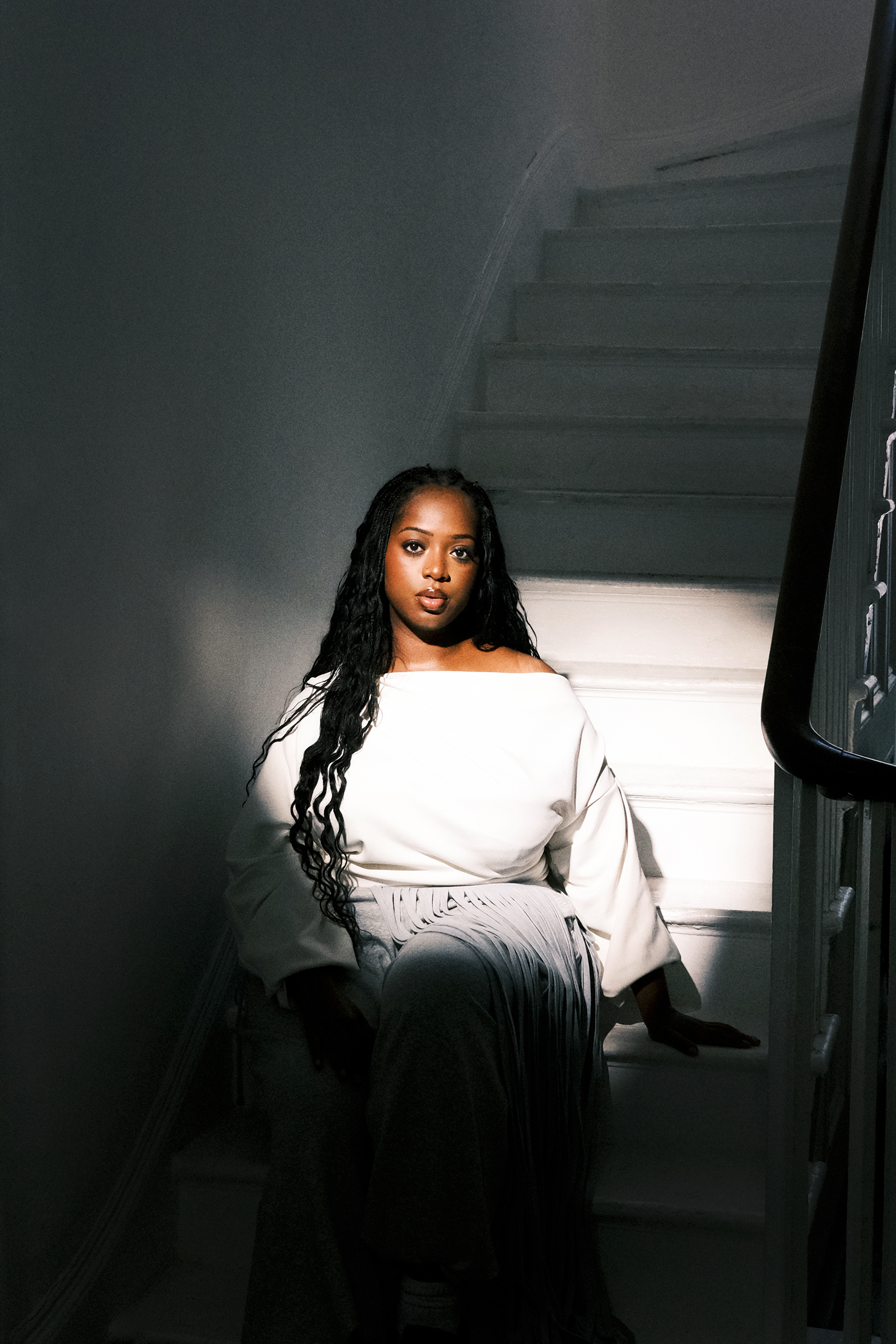
Konyikeh Rediscovers Herself: A Journey of Meticulous Craft and Artistic Growth in 'Cinere'

Authored by

“I knew what I wanted to say, and I spoke up a lot more in the studio. I was very meticulous with everything, and I just felt like I was getting back to my sense of self, and that's something that I really discovered in this process.” British singer-songwriter Konyikeh shares about the process of creating her third EP, Cinere. The project begins with a simple, somewhat haunting sound on the opening track “Buyer’s Remorse,” which once again brings her deep, rich vocals to the forefront amid a stunning piano-and-string arrangement. It begins the journey across the 7-track EP, bringing a fresh vibe to her and introducing us to a more elevated, evolved version of the singer we met back in 2023.

I was very meticulous in the process of making this project, and the songs were extremely personal to me. I want people to listen to this music and take in everything around it.” She shares about the making of this EP. Everything from the sequencing to the instrumentation, arrangements and everything in between was carefully crafted and considered for the listener's experience. The project, which plays for a total of 15 minutes across the 7 tracks, really does bring an effortless and smooth process as you weave between tracks and once again displays her as an artist who feels like a breath of fresh air cutting through the clutter of noise that exists in the musical landscape and brings something new and refreshing to the table.

The EP, which follows 2024’s Problem With Authority, represents a shift not just sonically, bringing together a variety of sounds into the project she has tapped into, but also another layer of her artistry in how she has presented herself. For her, the shift has brought back a true sense of herself and her love for the music she is creating. There is a rawness and openness that comes through in what she says and in the topics she speaks about on the project. That presentation has been really intentional about what she wants to say and how she has represented where she is and everything it has taken to reach this point in her journey.

Speaking with Konyikeh, we caught up on everything from making the EP to regaining control, expressing vulnerability, finding your voice, and more.

Congratulations on the release, Cinere. This is your third EP, and so even getting to this point and putting the project out, how does this feel for you?

I feel like I've always trusted myself as a musician since I started making music. This is the first EP where I've had to really become an artist, build a visual world around the music I've made for this project, and just think about every single thing. I’m so passionate about it. I was very meticulous in the process of making this project, and the songs being extremely personal to me, that attention to detail is super important, and in the world that we live in, where everyone's attention span is so short, I want people to listen to this music and take in everything around it. I feel like this project, I've really pushed myself and, in a way, yes, it's my third project, but I feel like it's the first project, also, in a sense, with an extremely clear vision. The first two projects were learning experiences and helped me find my footing, whereas this one was very clear about what I wanted it to be and how I wanted to make it.

With the entire process of creating the EP. How did that experience differ for this EP compared to the previous ones?

The first project was a collection of songs I'd written, and I still very much stand by that body of work. I still think it flows together beautifully. The second project was a collection of songs that people thought was good and I put it out, but there was no real cohesive thread behind it, So coming into my third EP I had to force myself to trust myself, Bar the last song, “There For Me (Freestyle)” was written in 2021 I made the project within a two, three month period in 2025. I worked with the same three producers: the production duo DUKE (David Dyson and Luke Grieve), and Charlie Perry, whom I had worked with before. Those are the only people I worked with, including myself, obviously, and that was something I loved. In my first EP, I had worked with just one producer and really liked it, so with this one, I knew I wanted to keep it small. I knew what I wanted to say, I was very meticulous with everything, and I just felt like I was getting back to myself. That is something I really discovered in this process: I need to understand who I am and how to iterate that understanding with others, so I can understand that as well.

You are someone who has always been very open in your music, and even on this EP, you are very open and raw. So, even in how you express yourself and your emotions, is that something that has always been easy for you?

​I think because, especially as a woman, as a black woman, we're so constrained and put into boxes, and you always have to be self-pleasing, not always able to be ourselves, and so for me, I feel like if I can't have one medium where I can be completely honest, then what the hell is the point? I find it extremely cathartic, like just putting it all out, and if you listen, you listen, and if you don't, you don't. I hate that other people can relate to it  because it's not a feeling that I'd want other people to relate to. It is quite a selfish act, and it's so freeing not to have to think, Oh, can I say this, or can I say that, or can I do this, or can I do that? And just put it into a medium that I love, and like it's heard by other people, and like people can find comfort in that.

As you listen to the EP, one thing that stands out is the variety of sounds you hear throughout. You can hear all sorts of musical influences and styles. So when you were approaching this sonically, in terms of what you wanted it to sound like, how did that come together?

​What I like about this project is that I went into it thinking I'm just gonna lay down a bunch of ideas. I didn't go in saying, "I want to achieve this, I want to do this, I want to do this," which is something I usually apply in every other aspect of my life. It was literally whatever flowed. With “Mercenary”, I was listening to a lot of Amapiano and Gqom at the time with the log drums; I was obsessed with that sound. I was also listening to a lot of Arabic scales and that type of sound, and then I was like, re-listening to Les Misérables, which is one of my favourite musicals, and I love the gang vocals from there. There was no, I want to tap into this. I want to tap into this. It was an amalgamation of everything, and I just want to make something I want to listen to that taps into my feelings and makes me feel what I want it to.

Even though it's seven tracks, I thought of it as an A-side and a B-side. I made “Miserere”, which I think is like track five, like a kind of palette cleanser that, like soft watches you into, like the softer side of the EP with “BlackThorne” and “There For Me” coming off the back of “Jealous”, which has all the drums and is quite a big song. After I put the tracklist together, everything was so meticulous, down to the second, and it has been curated for the listener's experience. I just want people to be able to tune out of the world for 15  minutes and just listen.

Talk to me about the visual aspects of the EP, since you have put out a couple of videos for the project, and that's always been a strong part of your process: working with the music to bring it to life. So how did you approach these for the EP?

So with my previous EPs, I’ve always done my videos by sending the song to a bunch of directors, who come back with a treatment, and we do it that way. This time, I focused on the ideas and what I wanted them to be, and I wrote them down meticulously. This is what's going on, and I want this to be the idea. So it was just a case of me needing someone to help elevate this, like, a shot list and all that. Every music video that's coming out has come out, I've written everything down, down to what I want the location to look like, what the casting should look like. Even giving proposed shots, and all that stuff. I thought it would be harder than it was, but I used to be a photographer, which kind of helped. The visuals have been really important. I love consuming art, whether it's paintings or photos, and I've spent a lot of time in galleries and museums over the past year or so. Even just on Pinterest, that was like a huge reference point as well. So yeah, just building that world around it has been super important.

How do you find that inspiration? Going beyond just the visuals, but even in the things that fuel or interest you and speak to you creatively?

I think it’s just like immersion therapy; it's definitely quality over quantity. If you expose yourself to a lot of art and all mediums, from theatre to concerts and all that stuff, you never know how it can come out in the studio. You just file things away in your brain and can pull them out as a reference. For example, the cover art for my EP was inspired by a picture I saw on Twitter from a film, which prompted me to watch it and use it as a set of different reference points. Even watching things, for example, TV shows where you see things that may visually look interesting or hearing something sonically somewhere, I find that it's just having things and storing them in your brain that you can pull out musically, visually, as reference points at a later point that speaks to me creatively.​

In speaking to the starting process of the EP, where would you say it began, as to when you knew that it was something you were working towards, as opposed to just making music?

So actually, I started this process in January 2025. It was a very weird time for me, and I ended up in the studio. I literally was like, I have nothing else to do, so I just said fuck it, I'm just gonna be as raw and open. And that was actually a session I had with Charlie. It was very cathartic, and we were working on a song. It was a session where I wanted a lot of instrumentation, all the stuff, and it took me two days to emotionally recover from that session. I played it for the people I work with, and they liked it, but it was like oh maybe this is a bit too honest. So I said to myself, unless I can make something better, I'm still gonna release this other song. But then I made something better: “Buyer’s Remorse”. I also had my first conversation with DUKE, and that was “Vulnerability”. I remember the first half of vulnerability hadn't been finished, and I was going on tour, I was playing some new material, and I was like, I need to finish this one because I can't wait to play it live. So that was when I knew I had something to work with. What turned out to be “Buyer's Remorse” and “Vulnerability” were the real starting things for the EP.

When it comes to how you’ve spoken about making the EP in the meticulousness of everything, and really taking everything into your own hands and leading every single process. How has that been like in terms of actually finding that voice and being able to take this control and really assert yourself when it comes to working with other people and just being able to find your voice in expressing yourself in this way?

With my first EP, I already had the songs written. So I had made that EP myself, and it was very much a "take it or leave it" project. I am extremely stubborn and headstrong, and that has ruined a lot of things for me in the past. I am someone who doesn't crave external validation, and any validation I do seek is unfortunately tied to my work. I know people liked my second EP and responded to it very well; however, I wasn't necessarily proud of the music I put on it, and it made me extremely insecure, and I felt that bled into other parts of my life. And I knew that I didn’t want to feel that way ever again.​

So now, with this process, I've been much stricter; I set high standards and expect the people I work with to at least do their best. It's been a really hard process, but I have found some people to work with who also take their work seriously and hold themselves to a high standard. From Maria the girl who shot my cover art, to the girl who does my nails, she does things to a very high standard. So it's been a lot. It's been a process, and I've had to learn a lot myself, so I at least have a baseline standard, and anyone coming in can build on that. I feel like I'm going back to my 15/16-year-old self, who had unshakable confidence and knew right from wrong. Also, I think it's important to always speak with kindness and give people grace, but don't let people take the piss, because people will take the fucking piss.

So even in the era that you're in now, what does that feel like for you? And what are you excited about and looking forward to in this next phase?

I think before, I had a way of thinking of the studios as work. I didn't really associate work with fun. But I feel like, after this process and while making this project, I felt so free in the studio that I allowed myself to have fun. Now I find myself looking forward to studio sessions, learning new things, like learning past my voice, like feeling free, and sometimes I can just get something off my chest. Like, sometimes I can just have, like, the most fun. And like, I'm super, super excited to perform this project live, all my other music, all this new stuff that I'm working on live. So I'm just so excited to play this music live, build new worlds. And I feel like I'm growing, it sounds so stupid, because I have discovered a sense of self. And I feel like I've transitioned and I'm growing up. And just curating everything with an intention. But my big thing, I just wanna have fun. I just wanna have the best time farming, expand my musical palate, and discover new artists I haven't listened to in a long time that I'm loving. So, yeah, I'm just big on having fun.
Konyikeh Rediscovers Herself: A Journey of Meticulous Craft and Artistic Growth in 'Cinere'

Authored by
This is some text inside of a div block.

“I knew what I wanted to say, and I spoke up a lot more in the studio. I was very meticulous with everything, and I just felt like I was getting back to my sense of self, and that's something that I really discovered in this process.” British singer-songwriter Konyikeh shares about the process of creating her third EP, Cinere. The project begins with a simple, somewhat haunting sound on the opening track “Buyer’s Remorse,” which once again brings her deep, rich vocals to the forefront amid a stunning piano-and-string arrangement. It begins the journey across the 7-track EP, bringing a fresh vibe to her and introducing us to a more elevated, evolved version of the singer we met back in 2023.

I was very meticulous in the process of making this project, and the songs were extremely personal to me. I want people to listen to this music and take in everything around it.” She shares about the making of this EP. Everything from the sequencing to the instrumentation, arrangements and everything in between was carefully crafted and considered for the listener's experience. The project, which plays for a total of 15 minutes across the 7 tracks, really does bring an effortless and smooth process as you weave between tracks and once again displays her as an artist who feels like a breath of fresh air cutting through the clutter of noise that exists in the musical landscape and brings something new and refreshing to the table.

The EP, which follows 2024’s Problem With Authority, represents a shift not just sonically, bringing together a variety of sounds into the project she has tapped into, but also another layer of her artistry in how she has presented herself. For her, the shift has brought back a true sense of herself and her love for the music she is creating. There is a rawness and openness that comes through in what she says and in the topics she speaks about on the project. That presentation has been really intentional about what she wants to say and how she has represented where she is and everything it has taken to reach this point in her journey.

Speaking with Konyikeh, we caught up on everything from making the EP to regaining control, expressing vulnerability, finding your voice, and more.

Congratulations on the release, Cinere. This is your third EP, and so even getting to this point and putting the project out, how does this feel for you?

I feel like I've always trusted myself as a musician since I started making music. This is the first EP where I've had to really become an artist, build a visual world around the music I've made for this project, and just think about every single thing. I’m so passionate about it. I was very meticulous in the process of making this project, and the songs being extremely personal to me, that attention to detail is super important, and in the world that we live in, where everyone's attention span is so short, I want people to listen to this music and take in everything around it. I feel like this project, I've really pushed myself and, in a way, yes, it's my third project, but I feel like it's the first project, also, in a sense, with an extremely clear vision. The first two projects were learning experiences and helped me find my footing, whereas this one was very clear about what I wanted it to be and how I wanted to make it.

With the entire process of creating the EP. How did that experience differ for this EP compared to the previous ones?

The first project was a collection of songs I'd written, and I still very much stand by that body of work. I still think it flows together beautifully. The second project was a collection of songs that people thought was good and I put it out, but there was no real cohesive thread behind it, So coming into my third EP I had to force myself to trust myself, Bar the last song, “There For Me (Freestyle)” was written in 2021 I made the project within a two, three month period in 2025. I worked with the same three producers: the production duo DUKE (David Dyson and Luke Grieve), and Charlie Perry, whom I had worked with before. Those are the only people I worked with, including myself, obviously, and that was something I loved. In my first EP, I had worked with just one producer and really liked it, so with this one, I knew I wanted to keep it small. I knew what I wanted to say, I was very meticulous with everything, and I just felt like I was getting back to myself. That is something I really discovered in this process: I need to understand who I am and how to iterate that understanding with others, so I can understand that as well.

You are someone who has always been very open in your music, and even on this EP, you are very open and raw. So, even in how you express yourself and your emotions, is that something that has always been easy for you?

​I think because, especially as a woman, as a black woman, we're so constrained and put into boxes, and you always have to be self-pleasing, not always able to be ourselves, and so for me, I feel like if I can't have one medium where I can be completely honest, then what the hell is the point? I find it extremely cathartic, like just putting it all out, and if you listen, you listen, and if you don't, you don't. I hate that other people can relate to it  because it's not a feeling that I'd want other people to relate to. It is quite a selfish act, and it's so freeing not to have to think, Oh, can I say this, or can I say that, or can I do this, or can I do that? And just put it into a medium that I love, and like it's heard by other people, and like people can find comfort in that.

As you listen to the EP, one thing that stands out is the variety of sounds you hear throughout. You can hear all sorts of musical influences and styles. So when you were approaching this sonically, in terms of what you wanted it to sound like, how did that come together?

​What I like about this project is that I went into it thinking I'm just gonna lay down a bunch of ideas. I didn't go in saying, "I want to achieve this, I want to do this, I want to do this," which is something I usually apply in every other aspect of my life. It was literally whatever flowed. With “Mercenary”, I was listening to a lot of Amapiano and Gqom at the time with the log drums; I was obsessed with that sound. I was also listening to a lot of Arabic scales and that type of sound, and then I was like, re-listening to Les Misérables, which is one of my favourite musicals, and I love the gang vocals from there. There was no, I want to tap into this. I want to tap into this. It was an amalgamation of everything, and I just want to make something I want to listen to that taps into my feelings and makes me feel what I want it to.

Even though it's seven tracks, I thought of it as an A-side and a B-side. I made “Miserere”, which I think is like track five, like a kind of palette cleanser that, like soft watches you into, like the softer side of the EP with “BlackThorne” and “There For Me” coming off the back of “Jealous”, which has all the drums and is quite a big song. After I put the tracklist together, everything was so meticulous, down to the second, and it has been curated for the listener's experience. I just want people to be able to tune out of the world for 15  minutes and just listen.

Talk to me about the visual aspects of the EP, since you have put out a couple of videos for the project, and that's always been a strong part of your process: working with the music to bring it to life. So how did you approach these for the EP?

So with my previous EPs, I’ve always done my videos by sending the song to a bunch of directors, who come back with a treatment, and we do it that way. This time, I focused on the ideas and what I wanted them to be, and I wrote them down meticulously. This is what's going on, and I want this to be the idea. So it was just a case of me needing someone to help elevate this, like, a shot list and all that. Every music video that's coming out has come out, I've written everything down, down to what I want the location to look like, what the casting should look like. Even giving proposed shots, and all that stuff. I thought it would be harder than it was, but I used to be a photographer, which kind of helped. The visuals have been really important. I love consuming art, whether it's paintings or photos, and I've spent a lot of time in galleries and museums over the past year or so. Even just on Pinterest, that was like a huge reference point as well. So yeah, just building that world around it has been super important.

How do you find that inspiration? Going beyond just the visuals, but even in the things that fuel or interest you and speak to you creatively?

I think it’s just like immersion therapy; it's definitely quality over quantity. If you expose yourself to a lot of art and all mediums, from theatre to concerts and all that stuff, you never know how it can come out in the studio. You just file things away in your brain and can pull them out as a reference. For example, the cover art for my EP was inspired by a picture I saw on Twitter from a film, which prompted me to watch it and use it as a set of different reference points. Even watching things, for example, TV shows where you see things that may visually look interesting or hearing something sonically somewhere, I find that it's just having things and storing them in your brain that you can pull out musically, visually, as reference points at a later point that speaks to me creatively.​

In speaking to the starting process of the EP, where would you say it began, as to when you knew that it was something you were working towards, as opposed to just making music?

So actually, I started this process in January 2025. It was a very weird time for me, and I ended up in the studio. I literally was like, I have nothing else to do, so I just said fuck it, I'm just gonna be as raw and open. And that was actually a session I had with Charlie. It was very cathartic, and we were working on a song. It was a session where I wanted a lot of instrumentation, all the stuff, and it took me two days to emotionally recover from that session. I played it for the people I work with, and they liked it, but it was like oh maybe this is a bit too honest. So I said to myself, unless I can make something better, I'm still gonna release this other song. But then I made something better: “Buyer’s Remorse”. I also had my first conversation with DUKE, and that was “Vulnerability”. I remember the first half of vulnerability hadn't been finished, and I was going on tour, I was playing some new material, and I was like, I need to finish this one because I can't wait to play it live. So that was when I knew I had something to work with. What turned out to be “Buyer's Remorse” and “Vulnerability” were the real starting things for the EP.

When it comes to how you’ve spoken about making the EP in the meticulousness of everything, and really taking everything into your own hands and leading every single process. How has that been like in terms of actually finding that voice and being able to take this control and really assert yourself when it comes to working with other people and just being able to find your voice in expressing yourself in this way?

With my first EP, I already had the songs written. So I had made that EP myself, and it was very much a "take it or leave it" project. I am extremely stubborn and headstrong, and that has ruined a lot of things for me in the past. I am someone who doesn't crave external validation, and any validation I do seek is unfortunately tied to my work. I know people liked my second EP and responded to it very well; however, I wasn't necessarily proud of the music I put on it, and it made me extremely insecure, and I felt that bled into other parts of my life. And I knew that I didn’t want to feel that way ever again.​

So now, with this process, I've been much stricter; I set high standards and expect the people I work with to at least do their best. It's been a really hard process, but I have found some people to work with who also take their work seriously and hold themselves to a high standard. From Maria the girl who shot my cover art, to the girl who does my nails, she does things to a very high standard. So it's been a lot. It's been a process, and I've had to learn a lot myself, so I at least have a baseline standard, and anyone coming in can build on that. I feel like I'm going back to my 15/16-year-old self, who had unshakable confidence and knew right from wrong. Also, I think it's important to always speak with kindness and give people grace, but don't let people take the piss, because people will take the fucking piss.

So even in the era that you're in now, what does that feel like for you? And what are you excited about and looking forward to in this next phase?

I think before, I had a way of thinking of the studios as work. I didn't really associate work with fun. But I feel like, after this process and while making this project, I felt so free in the studio that I allowed myself to have fun. Now I find myself looking forward to studio sessions, learning new things, like learning past my voice, like feeling free, and sometimes I can just get something off my chest. Like, sometimes I can just have, like, the most fun. And like, I'm super, super excited to perform this project live, all my other music, all this new stuff that I'm working on live. So I'm just so excited to play this music live, build new worlds. And I feel like I'm growing, it sounds so stupid, because I have discovered a sense of self. And I feel like I've transitioned and I'm growing up. And just curating everything with an intention. But my big thing, I just wanna have fun. I just wanna have the best time farming, expand my musical palate, and discover new artists I haven't listened to in a long time that I'm loving. So, yeah, I'm just big on having fun.
This is some text inside of a div block.

Konyikeh Rediscovers Herself: A Journey of Meticulous Craft and Artistic Growth in 'Cinere'

Authored by

“I knew what I wanted to say, and I spoke up a lot more in the studio. I was very meticulous with everything, and I just felt like I was getting back to my sense of self, and that's something that I really discovered in this process.” British singer-songwriter Konyikeh shares about the process of creating her third EP, Cinere. The project begins with a simple, somewhat haunting sound on the opening track “Buyer’s Remorse,” which once again brings her deep, rich vocals to the forefront amid a stunning piano-and-string arrangement. It begins the journey across the 7-track EP, bringing a fresh vibe to her and introducing us to a more elevated, evolved version of the singer we met back in 2023.

I was very meticulous in the process of making this project, and the songs were extremely personal to me. I want people to listen to this music and take in everything around it.” She shares about the making of this EP. Everything from the sequencing to the instrumentation, arrangements and everything in between was carefully crafted and considered for the listener's experience. The project, which plays for a total of 15 minutes across the 7 tracks, really does bring an effortless and smooth process as you weave between tracks and once again displays her as an artist who feels like a breath of fresh air cutting through the clutter of noise that exists in the musical landscape and brings something new and refreshing to the table.

The EP, which follows 2024’s Problem With Authority, represents a shift not just sonically, bringing together a variety of sounds into the project she has tapped into, but also another layer of her artistry in how she has presented herself. For her, the shift has brought back a true sense of herself and her love for the music she is creating. There is a rawness and openness that comes through in what she says and in the topics she speaks about on the project. That presentation has been really intentional about what she wants to say and how she has represented where she is and everything it has taken to reach this point in her journey.

Speaking with Konyikeh, we caught up on everything from making the EP to regaining control, expressing vulnerability, finding your voice, and more.

Congratulations on the release, Cinere. This is your third EP, and so even getting to this point and putting the project out, how does this feel for you?

I feel like I've always trusted myself as a musician since I started making music. This is the first EP where I've had to really become an artist, build a visual world around the music I've made for this project, and just think about every single thing. I’m so passionate about it. I was very meticulous in the process of making this project, and the songs being extremely personal to me, that attention to detail is super important, and in the world that we live in, where everyone's attention span is so short, I want people to listen to this music and take in everything around it. I feel like this project, I've really pushed myself and, in a way, yes, it's my third project, but I feel like it's the first project, also, in a sense, with an extremely clear vision. The first two projects were learning experiences and helped me find my footing, whereas this one was very clear about what I wanted it to be and how I wanted to make it.

With the entire process of creating the EP. How did that experience differ for this EP compared to the previous ones?

The first project was a collection of songs I'd written, and I still very much stand by that body of work. I still think it flows together beautifully. The second project was a collection of songs that people thought was good and I put it out, but there was no real cohesive thread behind it, So coming into my third EP I had to force myself to trust myself, Bar the last song, “There For Me (Freestyle)” was written in 2021 I made the project within a two, three month period in 2025. I worked with the same three producers: the production duo DUKE (David Dyson and Luke Grieve), and Charlie Perry, whom I had worked with before. Those are the only people I worked with, including myself, obviously, and that was something I loved. In my first EP, I had worked with just one producer and really liked it, so with this one, I knew I wanted to keep it small. I knew what I wanted to say, I was very meticulous with everything, and I just felt like I was getting back to myself. That is something I really discovered in this process: I need to understand who I am and how to iterate that understanding with others, so I can understand that as well.

You are someone who has always been very open in your music, and even on this EP, you are very open and raw. So, even in how you express yourself and your emotions, is that something that has always been easy for you?

​I think because, especially as a woman, as a black woman, we're so constrained and put into boxes, and you always have to be self-pleasing, not always able to be ourselves, and so for me, I feel like if I can't have one medium where I can be completely honest, then what the hell is the point? I find it extremely cathartic, like just putting it all out, and if you listen, you listen, and if you don't, you don't. I hate that other people can relate to it  because it's not a feeling that I'd want other people to relate to. It is quite a selfish act, and it's so freeing not to have to think, Oh, can I say this, or can I say that, or can I do this, or can I do that? And just put it into a medium that I love, and like it's heard by other people, and like people can find comfort in that.

As you listen to the EP, one thing that stands out is the variety of sounds you hear throughout. You can hear all sorts of musical influences and styles. So when you were approaching this sonically, in terms of what you wanted it to sound like, how did that come together?

​What I like about this project is that I went into it thinking I'm just gonna lay down a bunch of ideas. I didn't go in saying, "I want to achieve this, I want to do this, I want to do this," which is something I usually apply in every other aspect of my life. It was literally whatever flowed. With “Mercenary”, I was listening to a lot of Amapiano and Gqom at the time with the log drums; I was obsessed with that sound. I was also listening to a lot of Arabic scales and that type of sound, and then I was like, re-listening to Les Misérables, which is one of my favourite musicals, and I love the gang vocals from there. There was no, I want to tap into this. I want to tap into this. It was an amalgamation of everything, and I just want to make something I want to listen to that taps into my feelings and makes me feel what I want it to.

Even though it's seven tracks, I thought of it as an A-side and a B-side. I made “Miserere”, which I think is like track five, like a kind of palette cleanser that, like soft watches you into, like the softer side of the EP with “BlackThorne” and “There For Me” coming off the back of “Jealous”, which has all the drums and is quite a big song. After I put the tracklist together, everything was so meticulous, down to the second, and it has been curated for the listener's experience. I just want people to be able to tune out of the world for 15  minutes and just listen.

Talk to me about the visual aspects of the EP, since you have put out a couple of videos for the project, and that's always been a strong part of your process: working with the music to bring it to life. So how did you approach these for the EP?

So with my previous EPs, I’ve always done my videos by sending the song to a bunch of directors, who come back with a treatment, and we do it that way. This time, I focused on the ideas and what I wanted them to be, and I wrote them down meticulously. This is what's going on, and I want this to be the idea. So it was just a case of me needing someone to help elevate this, like, a shot list and all that. Every music video that's coming out has come out, I've written everything down, down to what I want the location to look like, what the casting should look like. Even giving proposed shots, and all that stuff. I thought it would be harder than it was, but I used to be a photographer, which kind of helped. The visuals have been really important. I love consuming art, whether it's paintings or photos, and I've spent a lot of time in galleries and museums over the past year or so. Even just on Pinterest, that was like a huge reference point as well. So yeah, just building that world around it has been super important.

How do you find that inspiration? Going beyond just the visuals, but even in the things that fuel or interest you and speak to you creatively?

I think it’s just like immersion therapy; it's definitely quality over quantity. If you expose yourself to a lot of art and all mediums, from theatre to concerts and all that stuff, you never know how it can come out in the studio. You just file things away in your brain and can pull them out as a reference. For example, the cover art for my EP was inspired by a picture I saw on Twitter from a film, which prompted me to watch it and use it as a set of different reference points. Even watching things, for example, TV shows where you see things that may visually look interesting or hearing something sonically somewhere, I find that it's just having things and storing them in your brain that you can pull out musically, visually, as reference points at a later point that speaks to me creatively.​

In speaking to the starting process of the EP, where would you say it began, as to when you knew that it was something you were working towards, as opposed to just making music?

So actually, I started this process in January 2025. It was a very weird time for me, and I ended up in the studio. I literally was like, I have nothing else to do, so I just said fuck it, I'm just gonna be as raw and open. And that was actually a session I had with Charlie. It was very cathartic, and we were working on a song. It was a session where I wanted a lot of instrumentation, all the stuff, and it took me two days to emotionally recover from that session. I played it for the people I work with, and they liked it, but it was like oh maybe this is a bit too honest. So I said to myself, unless I can make something better, I'm still gonna release this other song. But then I made something better: “Buyer’s Remorse”. I also had my first conversation with DUKE, and that was “Vulnerability”. I remember the first half of vulnerability hadn't been finished, and I was going on tour, I was playing some new material, and I was like, I need to finish this one because I can't wait to play it live. So that was when I knew I had something to work with. What turned out to be “Buyer's Remorse” and “Vulnerability” were the real starting things for the EP.

When it comes to how you’ve spoken about making the EP in the meticulousness of everything, and really taking everything into your own hands and leading every single process. How has that been like in terms of actually finding that voice and being able to take this control and really assert yourself when it comes to working with other people and just being able to find your voice in expressing yourself in this way?

With my first EP, I already had the songs written. So I had made that EP myself, and it was very much a "take it or leave it" project. I am extremely stubborn and headstrong, and that has ruined a lot of things for me in the past. I am someone who doesn't crave external validation, and any validation I do seek is unfortunately tied to my work. I know people liked my second EP and responded to it very well; however, I wasn't necessarily proud of the music I put on it, and it made me extremely insecure, and I felt that bled into other parts of my life. And I knew that I didn’t want to feel that way ever again.​

So now, with this process, I've been much stricter; I set high standards and expect the people I work with to at least do their best. It's been a really hard process, but I have found some people to work with who also take their work seriously and hold themselves to a high standard. From Maria the girl who shot my cover art, to the girl who does my nails, she does things to a very high standard. So it's been a lot. It's been a process, and I've had to learn a lot myself, so I at least have a baseline standard, and anyone coming in can build on that. I feel like I'm going back to my 15/16-year-old self, who had unshakable confidence and knew right from wrong. Also, I think it's important to always speak with kindness and give people grace, but don't let people take the piss, because people will take the fucking piss.

So even in the era that you're in now, what does that feel like for you? And what are you excited about and looking forward to in this next phase?

I think before, I had a way of thinking of the studios as work. I didn't really associate work with fun. But I feel like, after this process and while making this project, I felt so free in the studio that I allowed myself to have fun. Now I find myself looking forward to studio sessions, learning new things, like learning past my voice, like feeling free, and sometimes I can just get something off my chest. Like, sometimes I can just have, like, the most fun. And like, I'm super, super excited to perform this project live, all my other music, all this new stuff that I'm working on live. So I'm just so excited to play this music live, build new worlds. And I feel like I'm growing, it sounds so stupid, because I have discovered a sense of self. And I feel like I've transitioned and I'm growing up. And just curating everything with an intention. But my big thing, I just wanna have fun. I just wanna have the best time farming, expand my musical palate, and discover new artists I haven't listened to in a long time that I'm loving. So, yeah, I'm just big on having fun.

Other Stories
London
London
Lagos
London
Newyork
London
Shop
Join the community.
You are now subscribed to receive updates.
Oops! Something went wrong while submitting the form.