.svg)

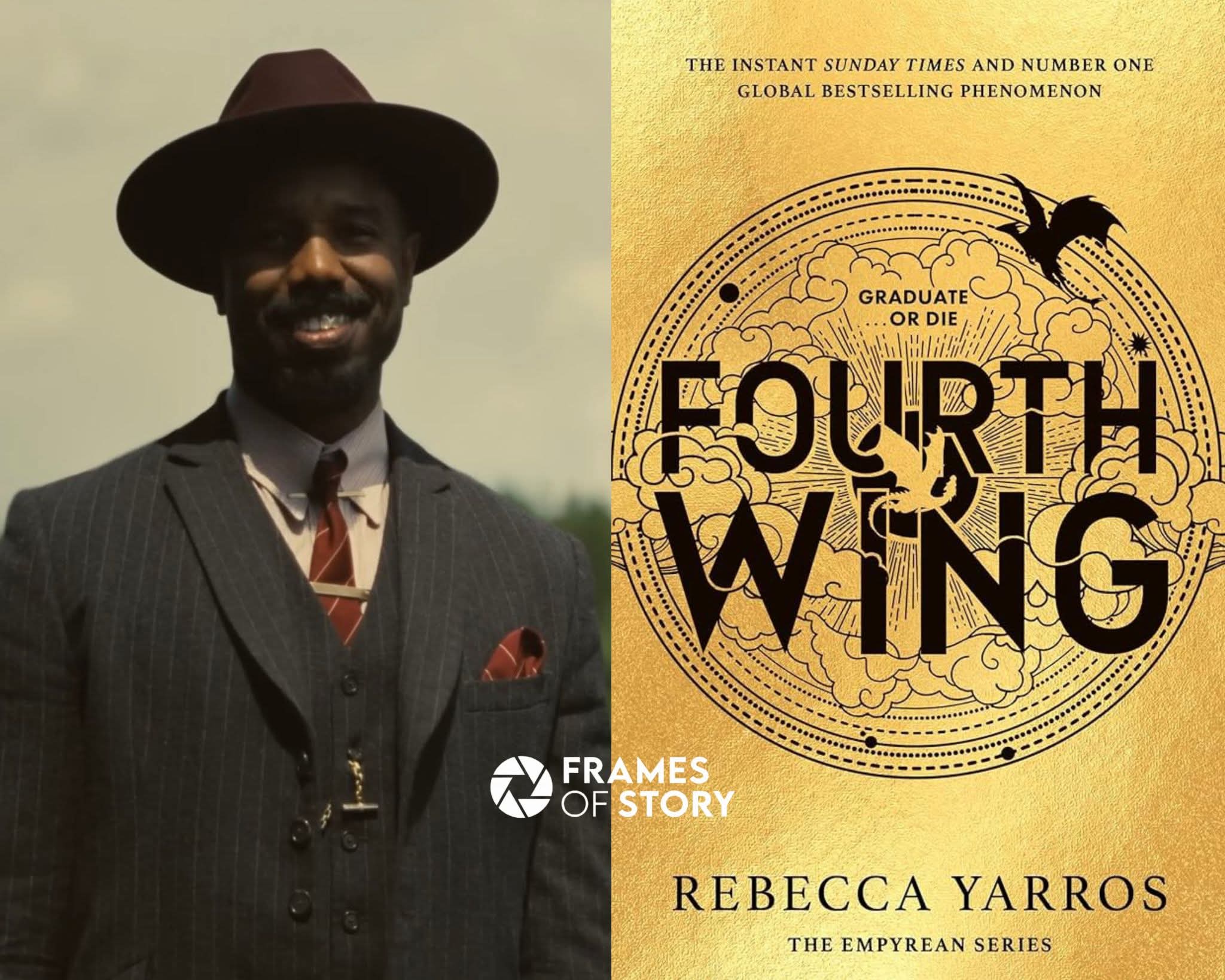
Recently, news about Michael B. Jordan's role as executive producer of the upcoming TV series adaptation of BookTok darling and New York Times bestseller, Fourth Wing, made the rounds. Jordan's role was positively received and signalled a turning point for Black people in fantasy films. Fourth Wing has been endeared to readers for two cogent reasons: (1)the kind of romance it breeds between main characters, Xarden and Violet, and (2) the presence of dragons, magic and the like, leading to it being dubbed a “romantasy” novel, a portmanteau of “romance” and “fantasy”. Its plot centres on Violet Sorrengail, daughter of military general Lilith Sorrengail, who is forced to give up her dream of being a scribe and fulfil her mother’s wishes to be a dragon rider of the fictional kingdom of Navarre. Violet has to undergo strict and brutal dragon rider training at Basgiath War College, to prove to herself and her mother that she is tougher than perceived. The goal of Violet’s dragon rider training, other included, is to bond with a dragon to gain powers that can be used to defend the kingdom. However, as the book goes on, this training is put to the test sooner than later as she’s forced to fight, alongside other dragon riders, against dark forces, the Venin and Wyvern as well as other threats within Navarre’s government.
Fantasy movies cannot be divorced from being seen through the perspective of the White man due to the social and cultural history from which it was conceived. The easiest proof of this are franchises and series like The Lord of the Rings, Underworld, Merlin, Legend of the Seeker, which were all Eurocentric and replicated tales similar to those born from the Medieval era or Middle Ages. Watching these fantasy movies and shows by white producers reinforced the fact that fantasy traditionally built its conventions around race and gender, which, usually, were White, middle-class and male, although Black people constituted a large part of fantasy culture.
However, Jordan's role as executive producer shows the new zeitgeist regarding Black audience and fantasy culture: the movement from representation in fantasy movies as playing the roles of slaves and dressed in drab clothing in movies to control and ownership of the institutions that shape the genre. The timing of this could not be more important in light of Hollywood's search for the next major fantasy franchise or series after Game of Thrones, the rise of romantasy as more than just a concept created by fans, and Black creatives opting for more ownership and authorship roles in the movie industry.
Fantasy films and TV have traditionally centered whiteness. As fans often argue, fantasy adaptations are expected to maintain faithfulness to their source material, that is, preserving whiteness as the default visual identity of the genre. Fandoms attached to historically white fantasy worlds have often demanded the removal of the Black cast members of the cast. Anything short of this attracts accusations like “going woke equals going broke”. These reactions followed, for instance, Steve Toussaint as Lord Corlys Velaryon in House of the Dragon. This just goes to show that race doesn't just serve as a pillar in fantasy movies; it is a towering cornerstone which holds the fantasy world together.
But, Black people have always been present in fantasy worlds and fandoms: Usopp from One Piece(1997), Killer Bee, jinchūriki of the Eight Tails, from Naruto(2002), and Ogun Montgomery from Fire Force(2015) stand as clear examples of Black representation in fantasy, even if filtered via stereotypes. Black audiences have also shown love for fantasy through gaming, cosplay, and sci-fi communities, albeit with more controversy than reception. This just shows that the issue was never about participation but power: to show who is in charge. Black people existed in these fantasy worlds but were prevented from shaping the institutions, aesthetics and storytelling architectures that governed them.
As executive producer, Jordan occupies a position that can challenge this perception. An executive producer (EP) oversees producers, development decisions, financing and major creative direction(s). Through his company, Outlier Society, his influence extends further across production, post-production and marketing. More than this, it gives Jordan and his company input as to who's cast in Fourth Wing, how the adaptation is to be shaped, as well as what story receives company endorsement. As a Black man involved in the series production, Jordan's role augments an argument that has long been canvassed by Black actors, creatives and audience as far as fantasy movies are concerned: representation matters, but infrastructure even more.
Case in point is the time before Black Panther. Black participation in fantasy and speculative storytelling was often treated by Hollywood as a niche experiment rather than a central commercial force. Big-budget fantasy worlds were still imagined through mainly white creative infrastructures, and fantasy genre projects by Black people were frequently framed as financially risky, culturally limited, or dependent on “diversity” goodwill rather than the demands of a broad audience.
Black Panther disrupted that logic entirely. The film became a global cultural event. It proved that Black audiences were not just laid-back consumers of fantasy movies, but one of its most powerful and emotionally invested markets. More importantly, it demonstrated that worldbuilding that focused on Black people could generate the same scale of obsession, fandom, merchandising, and mythmaking traditionally associated with franchises like Star Wars or The Lord of the Rings.
That success changed the economics of genre storytelling in Hollywood. After Black Panther, Black involvement in fantasy and science fiction no longer looked like a gamble but a profitable venture. The shift was both about visibility onscreen and legitimacy behind the scenes. Black creatives began to move from mere participation within genre worlds to positions of authorship and institutional influence. Producers, directors, and production companies gained greater leverage to shape which speculative stories received investment, adaptation deals, and franchise support.
This is the context in which Michael B. Jordan's production of Fourth Wing is culturally significant. Jordan’s involvement reflects a post-Black Panther Hollywood in which Black creatives are no longer being invited into fantasy worlds simply as actors or supporting figures. They are the ones now charged with determining how those worlds are built, marketed, and imagined in the first place. In this regard, Fourth Wing is part of a broader transformation in genre culture: the gradual redistribution of imaginative power within fantasy itself.
Fourth Wing is not just another fantasy adaptation. It represents the kind of franchise Hollywood believes can define the next era of streaming culture. Its emergence from BookTok's ecosystem, where romantasy has become one of publishing’s most commercially powerful genres, marks its significance in sales numbers and the intensity of its fandom. Readers build online identities around it through fancasts, edits, discourse, theories, and emotional investment in its characters and world. That kind of participatory fandom is precisely what streaming platforms now want. In an entertainment industry still searching for its next long-running fantasy obsession after Game of Thrones, romantasy offers something especially valuable: audiences that are already organized, emotionally engaged, and digitally active long before adaptation begins.
This is why Fourth Wing matters as a case study. Jordan's entrance into this space as executive producer is therefore culturally meaningful because romance itself is becoming a new site of mainstream fantasy power. For decades, fantasy’s dominant visual language was largely shaped around male-centered epics and overwhelmingly white creative frameworks. But the success of books like Fourth Wing suggests that the future of fantasy may be increasingly shaped by audiences that are younger, more female, more online, and more racially diverse than the genre’s traditional gatekeepers. That shift, from a broader perspective, then raises the bigger question of who gets to visually define the next generation of fantasy worlds. Fantasy determines whose faces become mythic, whose desires become central, and whose imagination gets treated as universal. In that sense, the adaptation of Fourth Wing derives its meaning mainly from the fact that it asks who now has the authority to shape fantasy culture itself.
IG:@muyiwavstheopp



.png)

